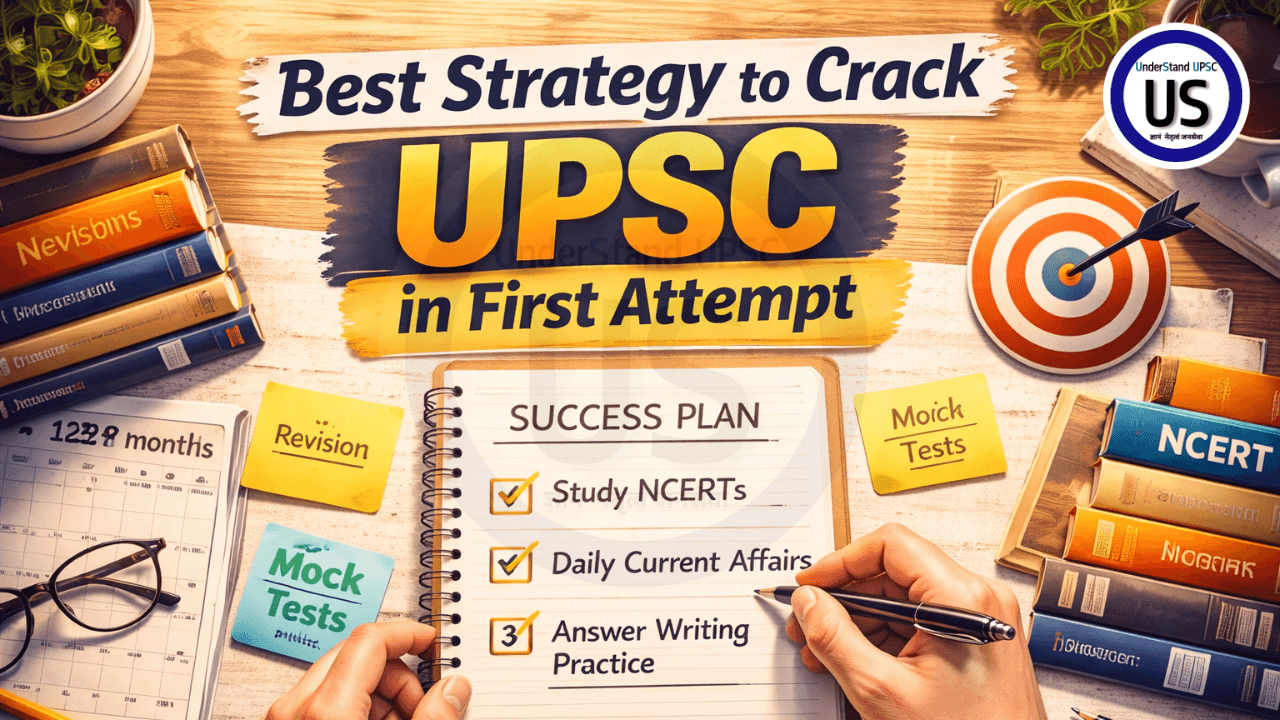
What Is the Best Strategy to Crack UPSC in First Attempt? Your first UPSC attempt can be your strongest attempt, but only if you stop treating it like a trial run. A lot of students prepare for the first attempt with half-serious energy. They keep telling themselves they are “just understanding the exam,” and before they realise it, months are gone. That is exactly what you cannot afford if you are following the best strategy to crack UPSC in first attempt. That is not how serious aspirants should look at it. Your first attempt should ideally be the first time you are genuinely ready to compete, not the first time you feel curious enough to sit in the exam hall. That distinction matters a lot. Because in UPSC, attempts are limited, but more importantly, serious mental energy is also limited. A casual first attempt often sounds harmless. Students say they are giving it “just for experience.” But in reality, that approach can damage confidence, distort preparation, and waste one full exam cycle. The better mindset is to build toward a first attempt that has weight behind it—this is the foundation of the best strategy to crack UPSC in first attempt. That is why many strong aspirants think in terms of a one-year to one-and-a-half-year serious preparation window before expecting their first attempt to become a real one. Not because UPSC requires drama, but because the exam demands maturity across too many layers at once. You are not just covering subjects. You are building conceptual understanding, current affairs depth, answer-writing ability, elimination skill for Prelims, optional subject command, and the stamina to revise under pressure. All of this takes time to settle, which is why timing plays a key role in the best strategy to crack UPSC in first attempt. So the best first-attempt strategy is not simply “study hard.” It is to make sure your preparation reaches a certain level before you emotionally treat an attempt as serious. A mature first-attempt strategy usually looks like this: This is the phase that turns preparation into competitiveness and defines the best strategy to crack UPSC in first attempt. This is also why first-attempt success is rarely about brilliance. It is usually about entering the attempt at the right time. If you sit too early, you may gain experience but lose momentum. If you sit after building enough depth, your first attempt can become your strongest one. This video by Satyam Sir explains the first-attempt strategy in a structured way for aspirants targeting 2027, especially those who want to think seriously about preparation, runway, readiness, and planning from the beginning. So the real question is not just, “Can I crack UPSC in my first attempt?” The better question is: 👉 “Am I building my first attempt in a way that gives it a real chance?” That is how mature aspirants think. And that is usually what separates a form-filled attempt from a competitive attempt—and ultimately reflects the best strategy to crack UPSC in first attempt. Frequently Asked Questions Q1. Can I crack UPSC in first attempt?Yes, with the right preparation strategy, consistency, and proper timing, many aspirants crack UPSC in their first attempt. Q2. How many months are required for UPSC first attempt preparation?Ideally, 12–18 months of serious preparation is considered effective. Q3. What is the biggest mistake in first attempt?Treating it as a trial attempt and not preparing seriously. Q4. Is coaching necessary for first attempt success?No, self-study with the right strategy can also lead to success.
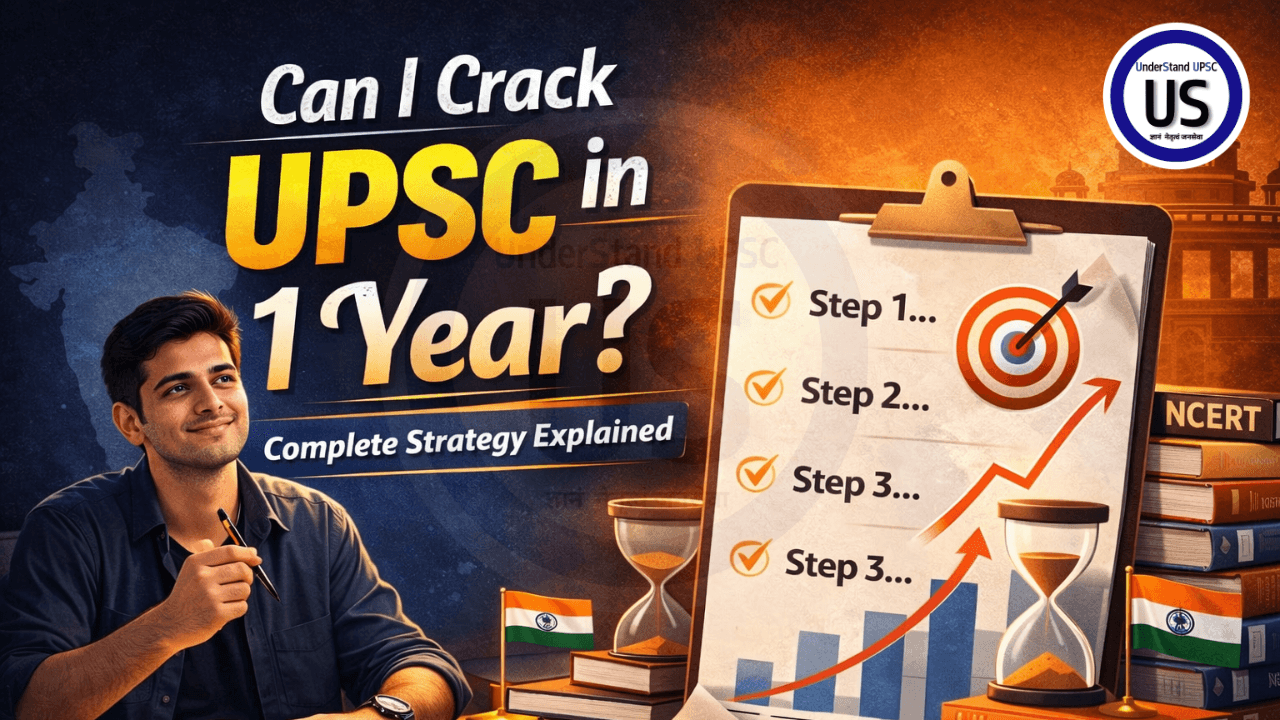
Can I Crack UPSC in 1 Year? Complete Strategy Explained for Beginners
Can I Crack UPSC in 1 Year? This is one of the most common questions among UPSC aspirants who want a focused and time-bound preparation strategy. Can I Crack UPSC in 1 Year? Complete Strategy Explained Can UPSC be cracked in one year? Yes, it can. But that answer makes sense only when you understand what “one year” really means in UPSC preparation. It does not mean twelve casual months of reading. It means twelve highly planned months in which your basics, standard books, current affairs, optional subject, answer writing, MCQ practice, and revision all have to move together in a disciplined way. So if you are planning to prepare in one year, the best way is to divide the year into clear phases. Month 1 to 3: Build the baseThese months should go into understanding the exam properly and strengthening your foundation. Finish the syllabus overview first. Then start NCERTs for History, Geography, Polity, Economy, and Science. Alongside this, begin reading one newspaper daily so current affairs does not become a burden later. You should also choose your optional subject early in this phase, not after six months of confusion. Month 4 to 7: Move to standard booksOnce your basics are in place, shift to core books like Laxmikanth for Polity, Spectrum for Modern History, and other limited standard sources. This is also the phase where you should begin making short notes for revision. Do not write pages and pages of notes. Make notes that you can actually revise. Start solving Prelims MCQs every week and begin basic answer writing for Mains. Month 8 to 10: Practice seriouslyNow your preparation should become more exam-focused. Your optional subject should be moving properly. GS revision should continue. Answer writing should become regular. MCQ practice should become sharper. At this stage, you should start identifying your weak areas and fixing them. This is where serious preparation begins to separate itself from passive reading. Month 11 to 12: Revision and testingThese last months should not be about new resources. They should be about revision, mock tests, previous year questions, and improving recall. This is where many students go wrong. They keep reading new material and never consolidate what they have already studied. One more thing: if you are preparing in one year, your biggest advantage will be discipline. Study hours matter, but planned study matters more. Even 8 focused hours every day with revision, tests, and consistency can do much more than 12 random hours. So yes, UPSC can be cracked in one year. But not by studying everything. It is cracked by studying the right things, in the right order, and revising them enough times to perform under pressure.
Uniform Civil Code: Supreme Court Calls It a Constitutional Ambition for Equality
Context: Uniform Civil Code The Supreme Court, while dealing with issues in personal laws, stated that the Uniform Civil Code (UCC) is a “constitutional ambition” and not linked to religion, aiming to ensure uniform civil laws for all citizens. What is Uniform Civil Code (UCC) • A common set of civil laws governing:• Marriage, divorce, inheritance, adoption, succession• Applicable to all citizens irrespective of religion• Objective → legal uniformity + gender justice + equality Relevant Constitutional provisions • Article 44 (DPSP) → State shall endeavour to secure UCC• Article 14 → Equality before law• Article 15 → Non-discrimination• Article 21 → Right to dignity• Article 25 → Freedom of religion (subject to reform) Supreme Court’s key observations Recent state-level developments Uttarakhand• UCC implemented• Covers marriage, divorce, inheritance, live-in relations Gujarat• Committee formed / exploring UCC• Not implemented yet Present status UCC is not yet enacted at the national level, but is progressing through constitutional mandate, judicial support, and gradual state-level initiatives.
Rules-based international order Essential for Lasting Peace: India-Austria Talks
Context: Rules-based international order During the Austrian Chancellor’s maiden visit to India, both sides emphasized that a rules-based international order is essential for lasting peace, especially amid ongoing global conflicts. Importance of Austria for India • Acts as a strategic partner in Central Europe• Supports India’s engagement with Europe (as an EU member where relevant)• Strong in high-technology sectors → collaboration scope• Key partner in green energy, climate tech, innovation• Provides a stable and trusted partnership in a multipolar world What happened during the visit (key developments)
Israel Lebanon ceasefire Announced by US to De-escalate Border Tensions
Context: Israel Lebanon ceasefire The U.S. announced a 10-day ceasefire between Israel and Lebanon, aiming to de-escalate rising tensions in the border region. What has been happening in Lebanon (ground situation) • Continuous cross-border conflict between Israel and Hezbollah Southern Lebanon facing:• Airstrikes, artillery shelling, and destruction of villages• Civilians displaced → border areas partially evacuated• Conflict is part of spillover of Gaza war into northern front Locations Israel was hitting (important for mapping) • South Lebanon (primary zone)• Border villages like Kfar Tibnit (Nabatieh region)• Hezbollah strongholds• Areas near Litani River belt What Israel has been doing • Conducting targeted airstrikes and military operations Objective:• Neutralise Hezbollah’s military capability• Prevent cross-border rocket attacks into northern Israel Current developments
Iran nuclear deal Talks Progress as US Signals Agreement on Nuclear Limits
Context: Iran nuclear deal The U.S. indicated progress towards a possible deal with Iran to limit its nuclear programme and reduce regional tensions. What Trump is saying • Iran has agreed to give up enriched uranium• Iran has pledged not to develop nuclear weapons• Deal may be signed in Pakistan (Islamabad)• He may visit Pakistan if finalized Iran’s enrichment level (important addition) • Iran has enriched uranium up to ~60% purity• This is near weapons-grade (90% needed for nuclear weapons)• Stockpile ~400–440 kg of 60% enriched uranium
Delimitation in India: Government Assures No Cut in South’s Seat Share
Context: Delimitation in India Amid concerns that delimitation may reduce the political representation of southern States, the Prime Minister and Home Minister assured Parliament that their share will not decline. What has been assured Fair delimitation process• PM assured no State will face injustice• Process will be balanced and equitable
India China trade: China becomes India’s largest trading partner in FY26
Context: India China trade China has overtaken the United States as India’s largest trading partner in FY26 due to a surge in imports, leading to a record trade deficit. India China trade • Total trade $151.1 billion• Trade deficit $112.6 billion all-time high• Exports $19.47 billion rise 36.66%• Imports $131.63 billion rise 16% India US trade • Exports $87.3 billion marginal rise• Imports $52.9 billion rise 15.95%• Trade surplus $34.4 billion decline from $40.9 billion India top trading partners China | USA | UAE India top export destinations USA | UAE | Netherlands India top import sources China | Russia | UAE
WPI inflation rises to 3-year high due to crude oil surge
Context: WPI inflation Wholesale Price Index WPI rose sharply in March due to crude oil shock from West Asia tensions. Key data • WPI Wholesale Price Index 3.88 percent highest in 38 months• Previous 2.13 percent• Crude petroleum up 49.1 percent• Chemicals ammonia PVC rising• Fuel prices LPG petrol diesel ATF increased• CPI Consumer Price Index 3.4 percent Reasons • Crude oil surge• Fuel and energy cost rise• Petrochemical input cost push WPI and CPI Meaning• WPI Wholesale Price Index measures wholesale prices• CPI Consumer Price Index measures retail prices Coverage• WPI primary articles fuel manufactured goods excludes services• CPI food fuel housing clothing services Released by• WPI Office of Economic Adviser Ministry of Commerce• CPI National Statistical Office Ministry of Statistics
Scarborough Shoal dispute: China blocks access in South China Sea
Context: Scarborough Shoal dispute China is deploying ships and barriers to block access to Scarborough Shoal, escalating tensions with the Philippines in the South China Sea. Scarborough Shoal • Located in South China Sea near Philippines• Within Philippines Exclusive Economic Zone• Claimed by China and Philippines• China has de facto control since 2012 standoff• 2016 UNCLOS arbitration ruled in favour of Philippines rejected by China• Important for fishing and strategic access Other disputed features in South China Sea • Paracel Islands — China vs Vietnam• Spratly Islands — China vs Vietnam Philippines Malaysia Brunei Taiwan• Second Thomas Shoal — China vs Philippines• Natuna waters — China vs Indonesia• Pratas Island — China vs Taiwan