22 Dec 2025 | Daily Current Affairs

Consumer Justice in India: Issues in Speedy Redressal

Context

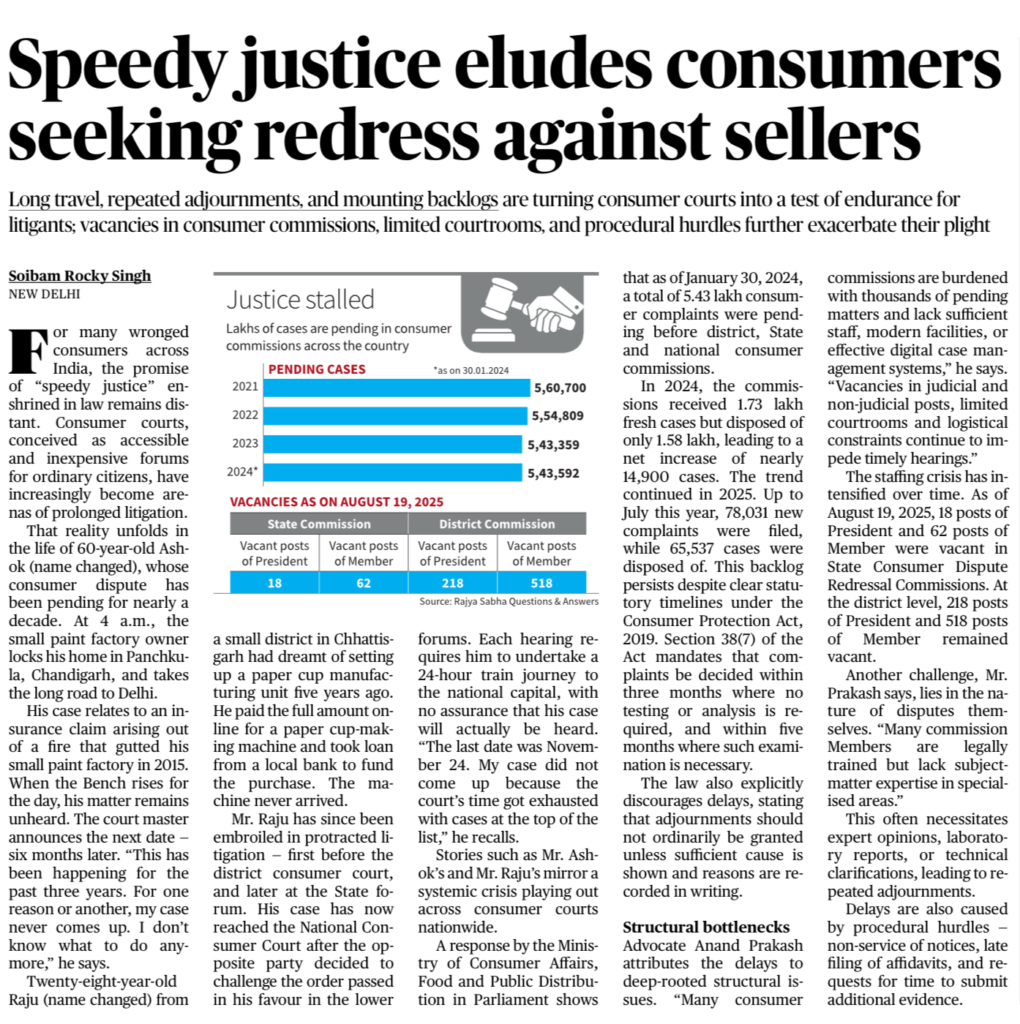
Consumer courts, created to provide speedy and inexpensive justice, are increasingly unable to do so due to rising pendency, staff shortages, and procedural delays, weakening consumer confidence in redressal mechanisms.

Core Issues

1. High pendency
• ~5.43 lakh cases pending across consumer commissions (Jan 2024).

2. Backlog accumulation
• 2024: Filings 1.73 lakh > Disposals 1.58 lakh.
• 2025 (till July): Filings 78,031 > Disposals 65,537.

3. Severe vacancies
• State commissions: 18 Presidents, 62 Members vacant.
• District commissions: 218 Presidents, 518 Members vacant.

4. Statutory timelines breached
• Law mandates 3–5 months disposal under the Consumer Protection Act, 2019, but cases run for years.

5. Frequent adjournments
• Hearings delayed due to congestion, non-appearance, and incomplete filings.

6. Weak infrastructure
• Shortage of courtrooms, staff, and effective digital case systems.

7. Limited expertise
• Lack of technical members → reliance on expert reports → delays.
consumer justice in India

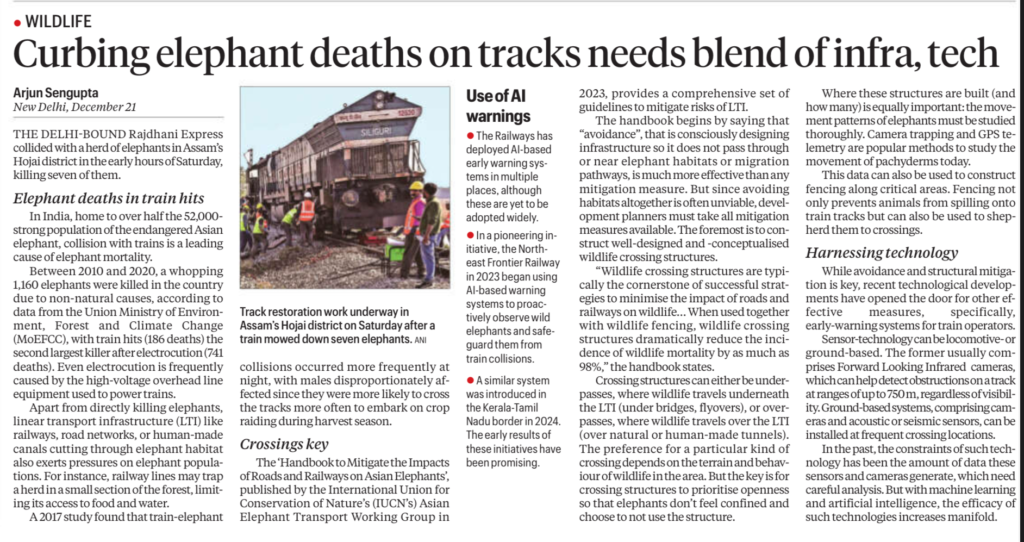
Elephant Deaths on Railway Tracks: Causes and Solutions

Context

Train–elephant collisions along railway lines passing through elephant habitats require preventive solutions, combining physical infrastructure interventions and technology-driven early warnings.

Solutions

A. Infrastructure-based solutions

1. Avoidance-first planning
• Align or redesign railway lines to bypass elephant habitats and migration corridors.

2. Wildlife crossing structures
• Construction of underpasses, overpasses, flyovers, and tunnels at elephant crossing points.
• Structures must be wide, open, and aligned with natural movement routes.

3. Strategic fencing
• Fencing along high-risk rail stretches to:
• Prevent elephants from entering tracks.
• Guide herds towards designated crossings.

B. Technology-based solutions

1. AI-based early warning systems
• Artificial Intelligence-enabled systems to detect elephant presence near tracks.
• Provide real-time alerts to train drivers for slowing or stopping trains.

2. Sensor-based detection
• Use of infrared cameras, acoustic sensors, and seismic sensors.
• Effective during night-time and low-visibility conditions.

3. Movement tracking & data use
• Camera trapping and GPS telemetry to map elephant movement patterns.
• Helps identify precise hotspots for crossings and fencing.

elephant deaths on railway tracks

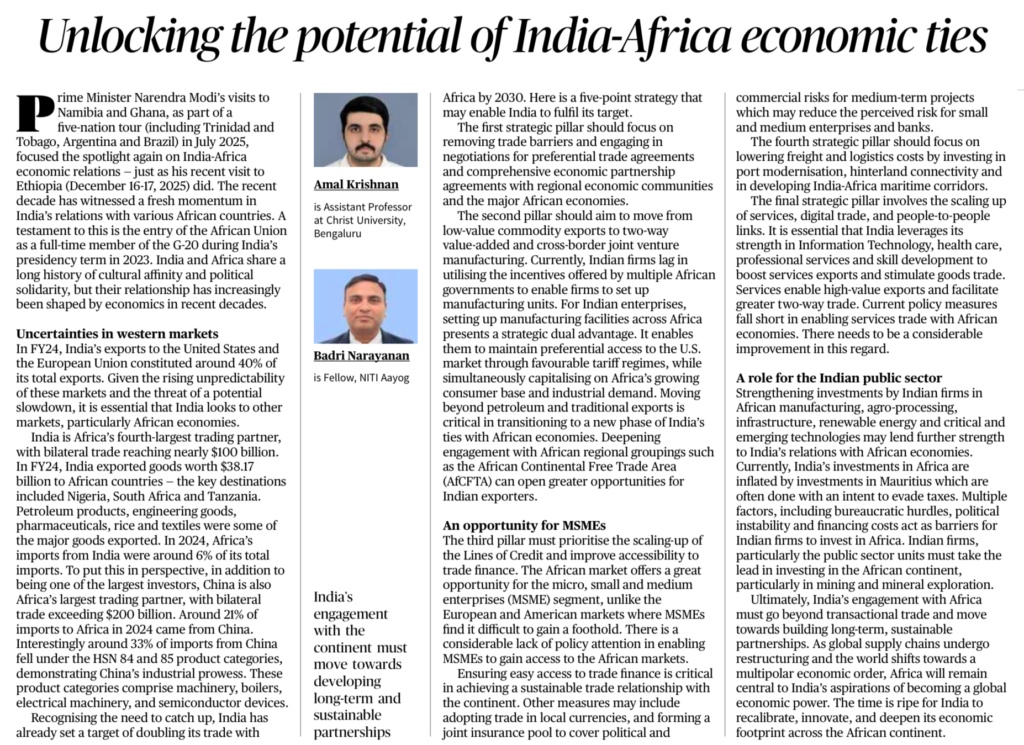
India–Africa Economic Ties: Opportunities and Challenges for UPSC

1. Core Context

• Rising uncertainty in Western markets (US & EU absorb ~40% of India’s exports).
• Africa emerging as a key alternative growth partner due to:
Large consumer base
Resource availability
Strategic geopolitical importance
• Need to shift India–Africa ties from transactional trade to long-term economic partnership.

2. Current Status of India–Africa Trade

• Africa is India’s 4th largest trading partner.
• Bilateral trade: ~$100 billion.
• India’s exports to Africa (FY24): $38.17 billion.
• Africa accounts for only ~6% of its imports from India → untapped potential.
• China dominates African trade (> $200 billion), especially in machinery and electronics.

3. Key Challenges Identified

• Over-reliance on low-value and commodity-based exports.
• Limited Indian manufacturing presence in Africa.
• MSMEs constrained by:
Lack of trade finance
High risk perception
Weak institutional support
High logistics and freight costs.

4. Five strategic pillars suggested by the editorial

1. Trade architecture
• Remove trade barriers.
• Engage with regional blocs like African Continental Free Trade Area (AfCFTA).
• Preferential and comprehensive economic partnerships.

2. Move to value-added trade
• Shift from raw commodities to manufacturing, joint ventures, and cross-border production.
• Use Africa’s growing consumer base and industrial demand.

3. MSME-centric strategy
• Expand Lines of Credit.
• Improve access to trade finance.
• Explore local currency trade and joint insurance mechanisms to manage political risk.

4. Logistics & connectivity
• Invest in ports, hinterland connectivity, freight efficiency.
• Develop India–Africa maritime corridors.

5. Services & people-to-people ties
• Leverage India’s strengths in Information Technology, health, education, professional services.
• Scale up digital trade and skill partnerships.

India Africa economic ties
India–Africa economic ties

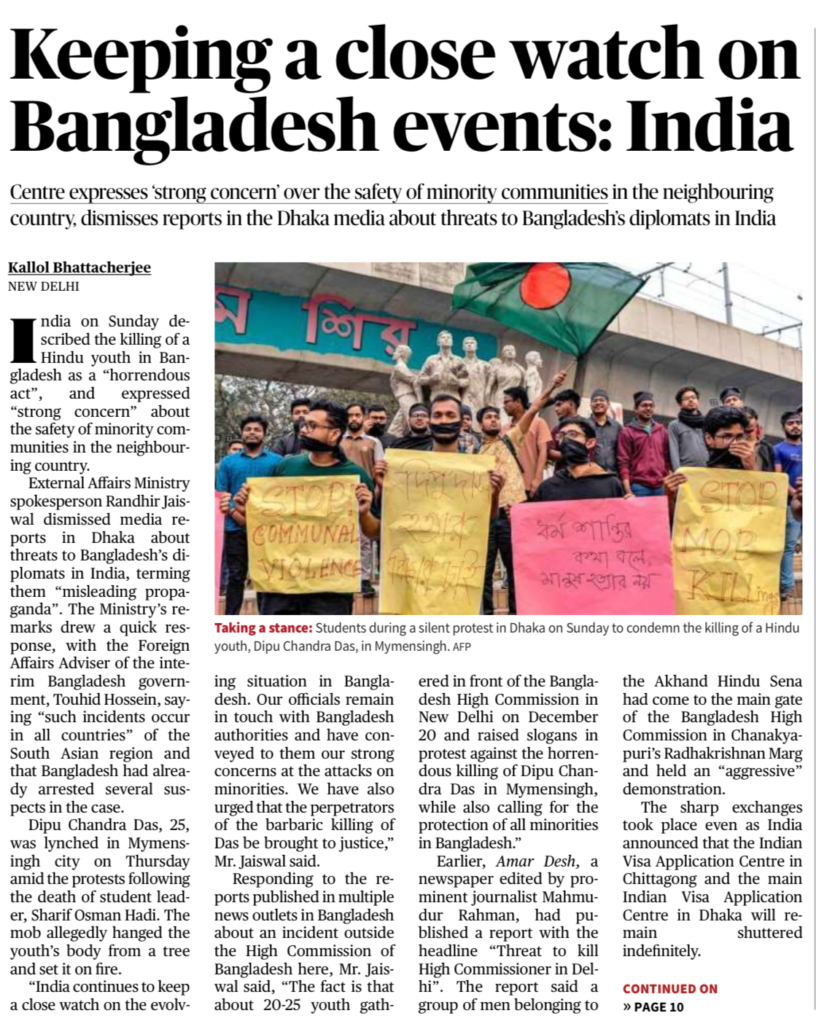
India Bangladesh Relations: Recent Developments Explained

Context

India has responded to recent communal violence in Bangladesh, following the lynching of a Hindu youth, by formally expressing strong concern over minority safety while simultaneously rejecting unverified media reports alleging threats to Bangladeshi diplomats in India.

What is India’s interest here?

• Protection of minorities: Safety of Hindus in Bangladesh is a long-standing diplomatic and domestic concern.
• Regional stability: Communal unrest in a neighbouring country can spill over socially and politically.
• Diplomatic credibility: India wants to counter misinformation and prevent diplomatic escalation.
• Neighbourhood First policy: Stability in Bangladesh is critical for:
• Border management
• Connectivity projects
• Economic and security cooperation

India Bangladesh relations

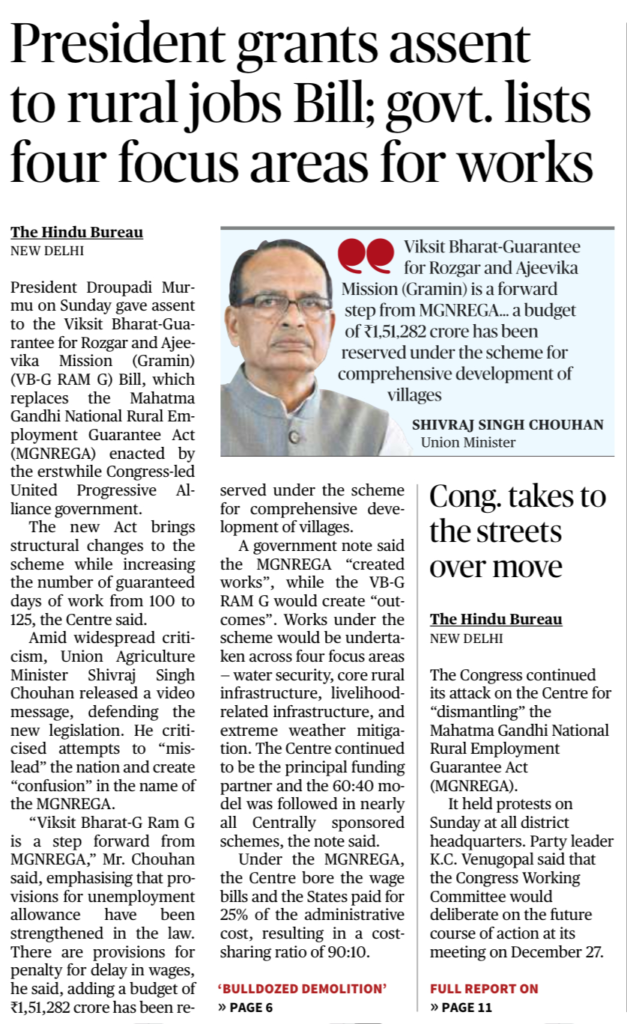
New Rural Employment Law Gets Presidential Assent | UPSC

Viksit Bharat–Guarantee for Rozgar and Ajeevika Mission (Gramin) Act

Key features:
• Now an Act, following Presidential assent.
• Replaces the Mahatma Gandhi National Rural Employment Guarantee Act.
• Guaranteed employment increased from 100 to 125 days per rural household.

Conceptual shift:
• Earlier focus on creation of works.
• New Act emphasises measurable outcomes from rural public works.

Four priority areas for works under the Act:

  1. Water security
  2. Core rural infrastructure
  3. Livelihood-related infrastructure
  4. Extreme weather mitigation

Funding pattern:
• Centre as principal funding partner.
• 60:40 Centre–State cost sharing, aligned with centrally sponsored schemes.

Financial outlay:
• ₹1.51 lakh crore allocated for comprehensive village development.

Administrative provisions:
• Stronger accountability for delays in wage payments.
• Structural redesign of rural employment delivery.

rural employment law

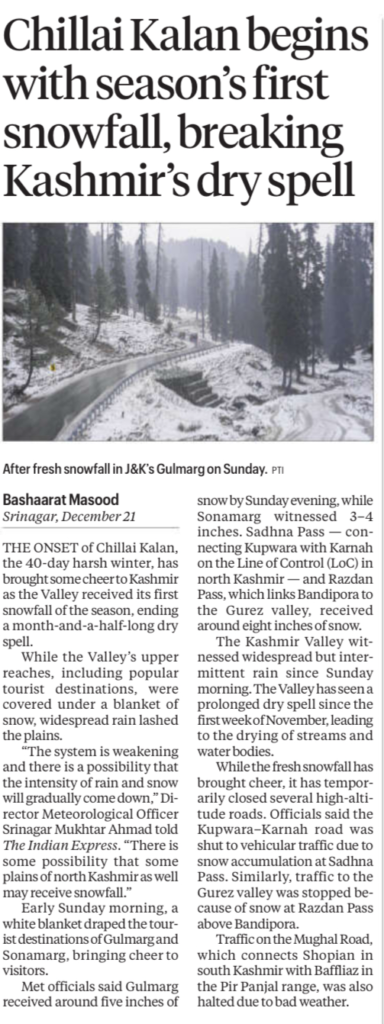
Chilla-i-Kalan in Kashmir: Winter Season Explained for UPSC

What is Chilla-i-Kalan?

• Meaning: Chilla = forty; Kalan = major → “the major 40 days”
• Period: Roughly 21 December to 30 January
• Nature: Harshest winter phase in the Kashmir Valley

Weather features:
• Extremely low temperatures
• Frequent snowfall in higher reaches
• Frozen water bodies, icy roads, disrupted transport

Importance:
• Crucial for snow accumulation, which later feeds rivers and streams in spring
• High impact on daily life, agriculture, tourism, and infrastructureAfter Chilla-i-Kalan, two milder phases follow:
• Chilla-i-Khurd (20 days)
• Chilla-i-Bachha (10 days)

Chilla-i-Kalan in Kashmir
About the UPSC Civil Services Examination (UPSC CSE)

The UPSC Civil Services Examination (CSE) is one of the most competitive and esteemed examinations in India, conducted by the Union Public Service Commission to recruit officers for services such as the Indian Administrative Service (IAS), Indian Police Service (IPS), Indian Foreign Service (IFS), and others. The exam comprises three stages — Prelims, Mains, and the Personality Test (Interview) — designed to test a candidate’s knowledge, aptitude, decision-making, and leadership skills.


How to Prepare Effectively for UPSC CSE

Cracking the UPSC CSE requires a deep understanding of the syllabus, consistent revision, structured answer writing, and smart test-taking strategies. The Prelims test analytical and conceptual clarity, the Mains focuses on critical thinking, articulation, and subject mastery, while the Interview assesses presence of mind, ethical judgment, and personality traits relevant to public service.

At Understand UPSC, we empower aspirants with a personalized and focused approach to each stage of the exam.


Why Choose Understand UPSC?

Understand UPSC is a mentorship-driven platform offering a clear, clutter-free strategy to tackle the Civil Services Examination. Our programs like Transform (for beginners and intermediate learners) and Conquer (for advanced mains preparation) provide structured study plans, syllabus-wise video content, interactive live sessions, and answer writing support.

We emphasize:

  • Concept clarity through topic-wise lectures

  • Test series designed around real UPSC standards

  • Personalized mentorship in small groups

  • Regular performance tracking and peer benchmarking

  • Doubt-clearing sessions, current affairs analysis, and monthly magazines


Join the Understand UPSC Learning Community

Our mission is to make UPSC preparation less overwhelming and more strategic. We combine mentorship, discipline, and academic rigor to help you clear CSE with confidence. Whether you’re preparing from Delhi, Mumbai, Bangalore, or a remote village — our online-first model ensures quality guidance reaches every corner of India.

Join the thousands of aspirants who trust Understand UPSC to guide their journey toward becoming civil servants.

Stay connected with us through our Telegram, YouTube, and Instagram channels for daily tips, strategies, and updates.

Copyright © 2025 USARAMBHA EDUCATION (UnderStand UPSC). All Rights Reserved.

Join the Success Journey!