
Mains-Focused Summary
1. Core Argument
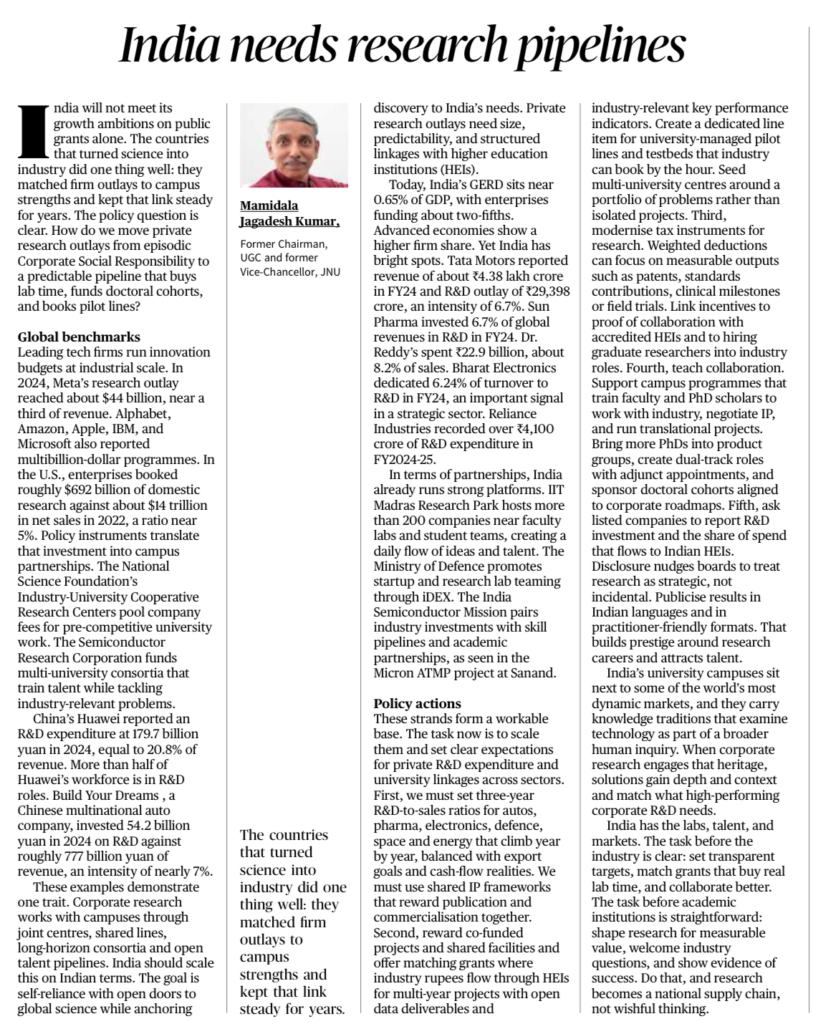
India must build predictable, long-term R&D pipelines rather than episodic or CSR-based funding. Private R&D investment needs scale, continuity, structured industry–academia linkages, and measurable outcomes.
2. The Global Benchmark
• Countries successful in innovation match long-term research funding with university strengths.
• Tech companies (Alphabet, Apple, IBM, Amazon, Microsoft) invest heavily in R&D — up to 20–25% of revenue.
• China’s Huawei invests ~20.8% of revenue in R&D; BYD invests 5.2B yuan.
3. India’s R&D Challenge
• GERD = 0.65% of GDP (low).
• Enterprise funding is 2/3rd of GERD in advanced economies, but in India it remains much lower.
4. Existing Positive Moves
• IIT Madras Research Park → 200+ companies, translational research.
• iDEX (Defence), Semiconductor Mission → growing industry collaborations.
• Multiple industry-funded university centres addressing large problem portfolios.
5. Key Policy Actions Suggested
(A) Build Predictable R&D Pipelines
• Set 3-year R&D-to-sales targets for auto, pharma, electronics, clean energy, etc.
• Link grants to real lab time, not paperwork.
• Make research funding multiyear with stability.
(B) Strengthen Industry–Academia Linkages
• Create shared IP frameworks, joint centres, and consortia.
• Co-funded research facilities; renting of lab time/testbed access by industry.
• Bring more PhDs and postdocs into industrial R&D roles.
(C) Improve Accountability & Measurement
• Require firms to report R&D spend clearly.
• Focus on measurable outputs → patents, standards, clinical milestones.
• Publish results in practitioner-friendly formats and Indian languages.
(D) Support Talent Pipelines
• Support PhD + postdoc communities through industry projects.
• Incentivise doctoral chairs, translational fellowships, startup-industry pathways.