
CONTEXT
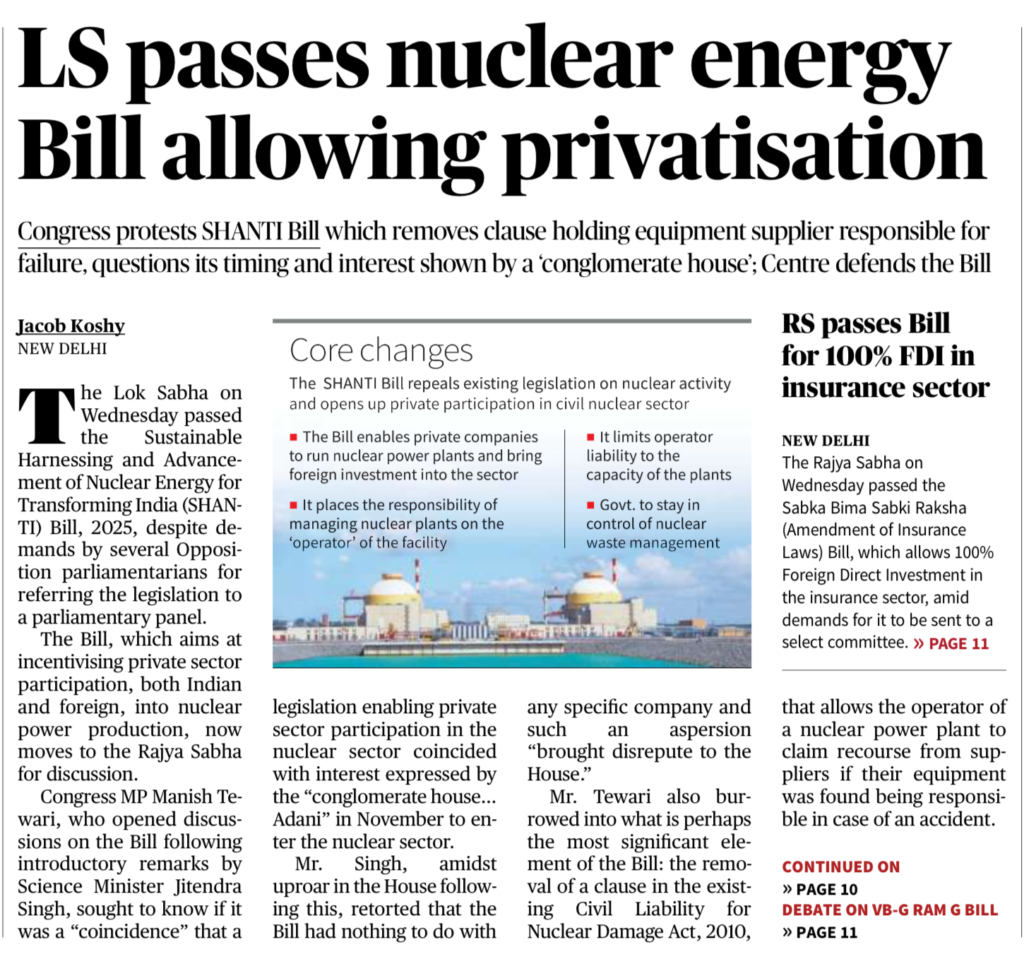
The Lok Sabha passed the Sustainable Harnessing and Advancement of Nuclear Energy for Transforming India (SHANTI) Bill, 2025, which proposes opening India’s civil nuclear sector to private and foreign participation and amending the existing nuclear liability framework. The Bill triggered sharp debate in Parliament, with the Opposition raising concerns over liability dilution and lack of scrutiny.
KEY PROVISIONS
• The Bill allows private Indian and foreign companies to set up and operate civil nuclear power plants, a sector so far dominated by public sector entities.
• It opens the civil nuclear sector to foreign investment, aimed at mobilising capital and facilitating faster nuclear capacity expansion.
• The Bill places the responsibility for managing nuclear power plants on the operator, making the operator accountable for plant functioning.
• It limits the liability of the operator in case of a nuclear accident to the capacity of the nuclear plant, replacing the earlier open-ended liability framework.
• The Bill removes the provision that allowed operators to seek legal recourse against equipment suppliers under the Civil Liability for Nuclear Damage Act, 2010.
• The government retains control over nuclear waste management, even while permitting private participation in plant operations.
ISSUES AND CONCERNS RAISED
• The Opposition argued that removal of supplier liability weakens accountability, especially if accidents occur due to faulty equipment.
• Concerns were raised that capping operator liability may dilute compensation for victims of nuclear accidents.
• The Opposition alleged that the Bill favours large corporate interests, questioning the timing of the legislation.
• Demand for sending the Bill to a parliamentary standing committee for scrutiny was rejected, leading to criticism over insufficient legislative examination.
• The government countered that the Bill is investment-oriented and not company-specific, and that changes are necessary to make the sector viable.