
1. Context
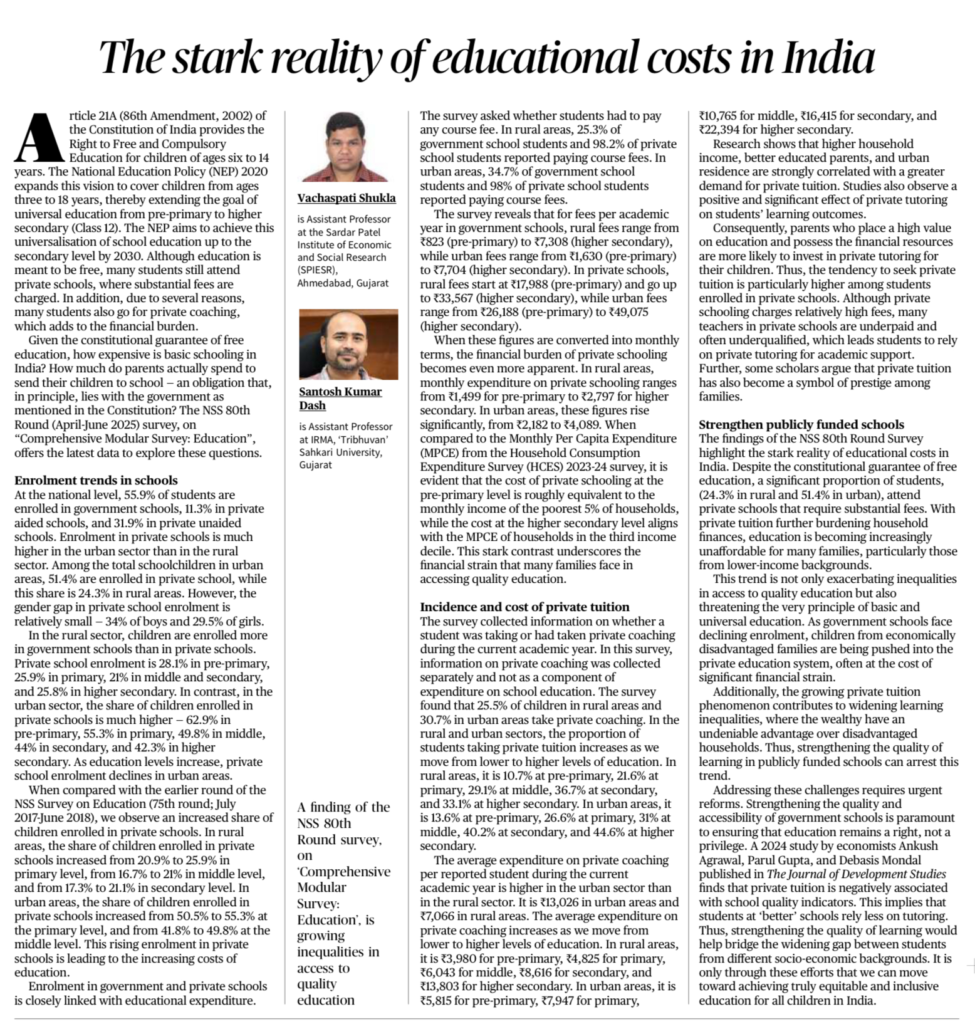
India constitutionally guarantees free and compulsory education (6–14 years) under Article 21A, and NEP 2020 aims for universal schooling up to secondary. Yet, NSS 80th Round (2022–23) shows households facing high and rising educational expenditure, driven mainly by private schools and private coaching, weakening the equity goals of public education.
2. Enrolment Pattern: Shift Toward Private Education
• National enrolment: 56% govt, 31.9% private; private share rising steadily.
• Urban preference is stark: private enrolment 51.4% urban vs 24.3% rural.
• Gender gap persists: in rural private schools 34% boys vs 29.5% girls.
• Overall trend: families opt for private schools despite free govt schools, signalling eroding trust in public education.
3. Costs of Schooling: Sharp Govt–Private and Rural–Urban Divide
Government Schools (Annual Fees)
• Rural: ₹823–₹7,308
• Urban: ₹1,630–₹7,044
Private Schools (Annual Fees)
• Rural: ₹7,898–₹33,567
• Urban: ₹26,185–₹49,075
Key Insight: Urban private higher-secondary schooling costs are up to 10× rural government schooling—a massive affordability gap.
4. Household Monthly Spending (Private Schooling)
• Rural: ₹1,499 → ₹12,874
• Urban: ₹2,797 → ₹28,098
These values have increased over previous NSS rounds, confirming rising financial pressure on families.
5. The Coaching Explosion
• Private coaching taken by 25.5% rural and 30.7% urban students.
• Much higher in higher classes and urban areas.
• Annual spending (Rural): ₹4,805 (secondary), ₹7,825 (higher secondary).
• Annual spending (Urban): ₹13,300 (secondary), ₹24,000 (higher secondary).
Analytical Point
Coaching has become a parallel education system, reducing schooling to a credential rather than a learning source.
6. Inequality Deepens
• Higher-income households dominate private schools and coaching.
• Government schools increasingly serve low-income households only, leading to social stratification.
• Poor families cut essential consumption to afford education, worsening intergenerational poverty.
• Education no longer acts as a leveller; it is becoming a reproducer of inequality.