17 Dec, 2025 | Daily Current Affairs

India Trade Deficit Falls to $6.6 Billion in November | GS3 Economy

Context
• India has been facing global economic uncertainty, slowing external demand and volatile commodity prices.
• In this backdrop, trade deficit trends are closely tracked as they affect current account balance, forex stability, and growth outlook.

Summary
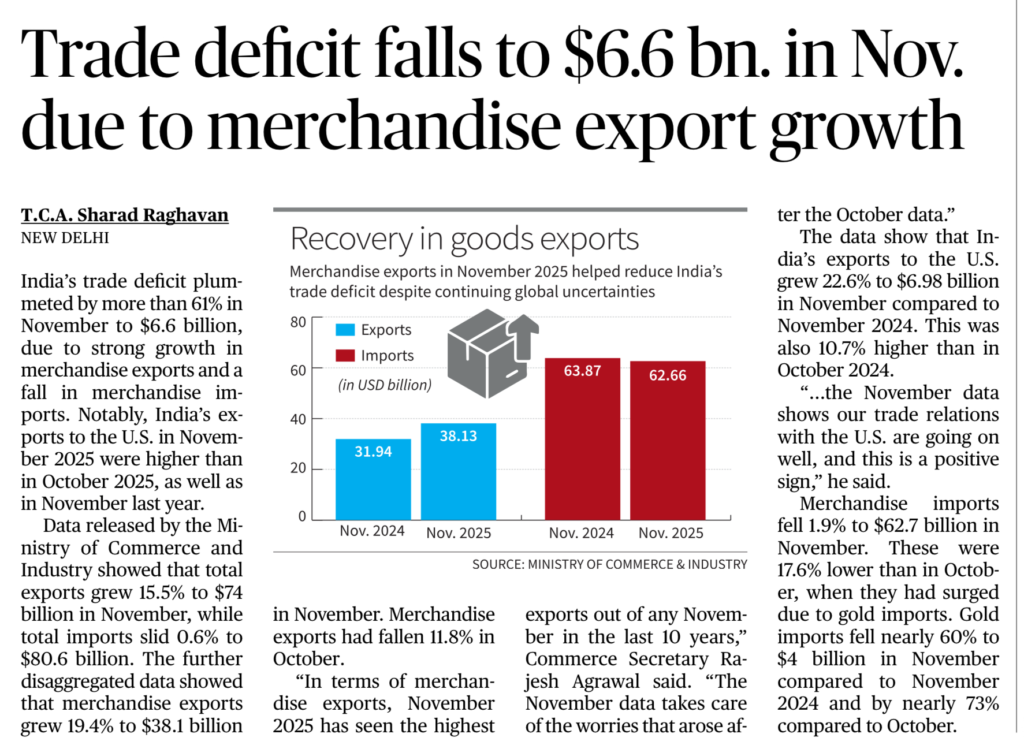
• India’s merchandise trade deficit sharply narrowed by over 61% to $6.6 billion in November 2025.
• The improvement was driven by strong recovery in merchandise exports and moderation in imports, especially gold.

Key Data

Total exports:
• Grew 15.5% to $74 billion (Nov 2025).

Merchandise exports:
• Rose 19.4% to $38.1 billion — highest November level in the last 10 years.

Total imports:
• Declined 0.6% to $80.6 billion.

Merchandise imports:
• Fell 1.9% to $62.7 billion.
• Were 17.6% lower than October, mainly due to a sharp fall in gold imports.

Gold imports:
• Fell nearly 60% year-on-year and about 73% month-on-month.
Post Maoist Governance in India and Future Challenges | GS3

CORE CONTEXT
• Maoist violence has declined due to security operations, especially in Fifth Schedule tribal areas.
• However, Maoism emerged and sustained itself due to deep governance failures, not ideology alone.
• The post-Maoist phase demands a shift from military dominance to legitimate, participatory governance.

PROBLEM: Governance Deficits Behind Maoism
• Administrative neglect in Fifth Schedule areas.
• Extractive state institutions (police, forest, revenue) with weak accountability.
• Under-representation of Adivasis in governance and local bodies.
• Poor service delivery: health, education, nutrition, welfare.
• Justice vacuum → Maoist jan adalats filled the gap.

Failure of protective laws:
• PESA (1996): Gram Sabhas lack real autonomy.
• Forest Rights Act (2006): rights diluted via executive actions.
• Land alienation and mining without genuine consent → loss of trust in state.

SOLUTION: Post-Maoist Governance Roadmap
• Move beyond security-centric approach to governance-centric reforms.

Strengthen local self-governance:
• Empower Gram Sabhas under PESA.
• Functional Autonomous and Zonal Councils.

Administrative reforms:
• Greater tribal representation in bureaucracy, police, forest and revenue departments.
• Context-sensitive governance.

Justice and rule of law:
• Accessible, speedy, non-coercive justice.
• End parallel authority spaces.

Restore constitutional protections:
• Faithful implementation of PESA and FRA.
• Reverse dilution through executive and legal bypasses.
• Political priority to Fifth Schedule areas for durable peace.

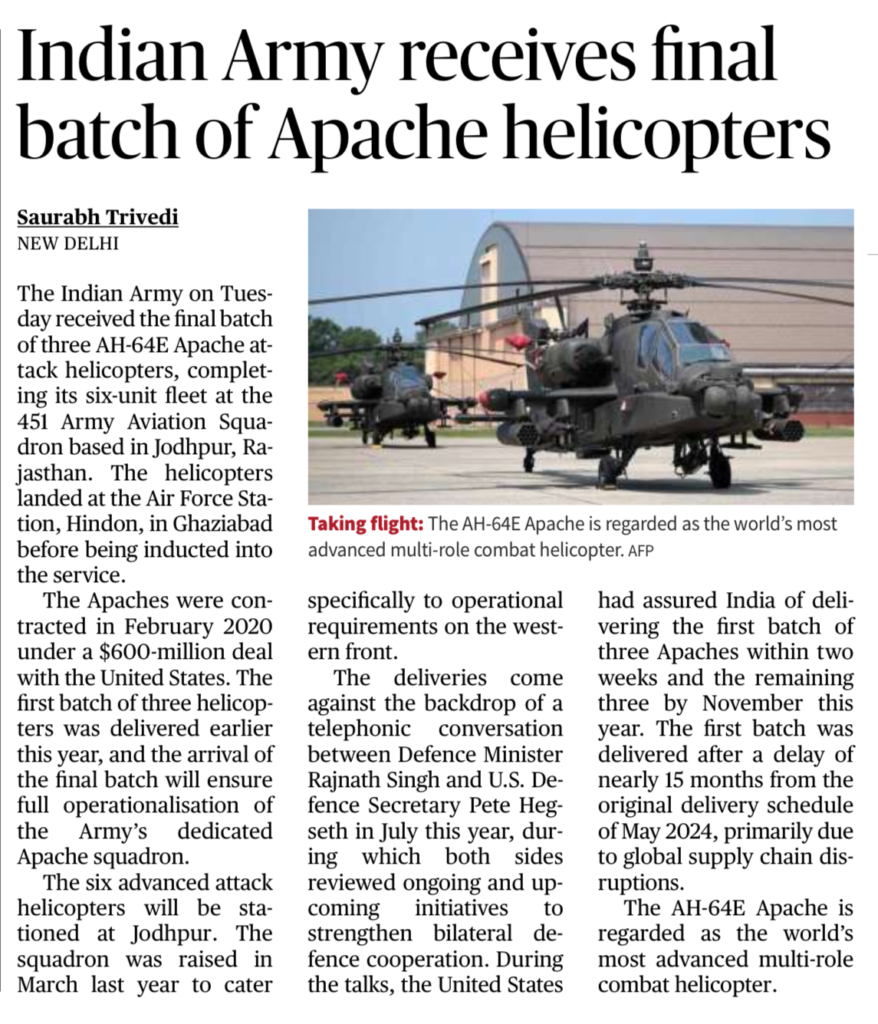
Indian Army Apache Helicopters Final Batch Inducted | GS3 Defence

Context
• The Indian Army has completed the induction of AH-64E Apache attack helicopters, strengthening its offensive aviation capability, especially along the western front.

AH-64E Apache
• Type: Attack / multi-role combat helicopter.
• Variant with India: AH-64E Apache Guardian.
• Manufacturer: Boeing (USA).

Key Features
• All-weather, day-night combat capability.
• Longbow fire-control radar for target detection and tracking.
• High survivability in hostile combat environments.

India Maldives Military Exercise EKUVERIN Concludes | GS3 Defence

Context
• The bilateral military exercise EKUVERIN between the Indian Army and the Maldives National Defence Forces (MNDF) concluded in Thiruvananthapuram.
• The exercise marked the culmination of two weeks of joint training, reinforcing defence cooperation between India and Maldives under India’s Neighbourhood First and SAGAR vision.

EKUVERIN
• Type: Bilateral military exercise.
• Countries involved: India – Maldives.
• Forces: Indian Army and Maldives National Defence Forces (MNDF).
• Nature of exercise: Annual (alternately hosted by India and Maldives).
• Location (latest edition): Thiruvananthapuram, Kerala.

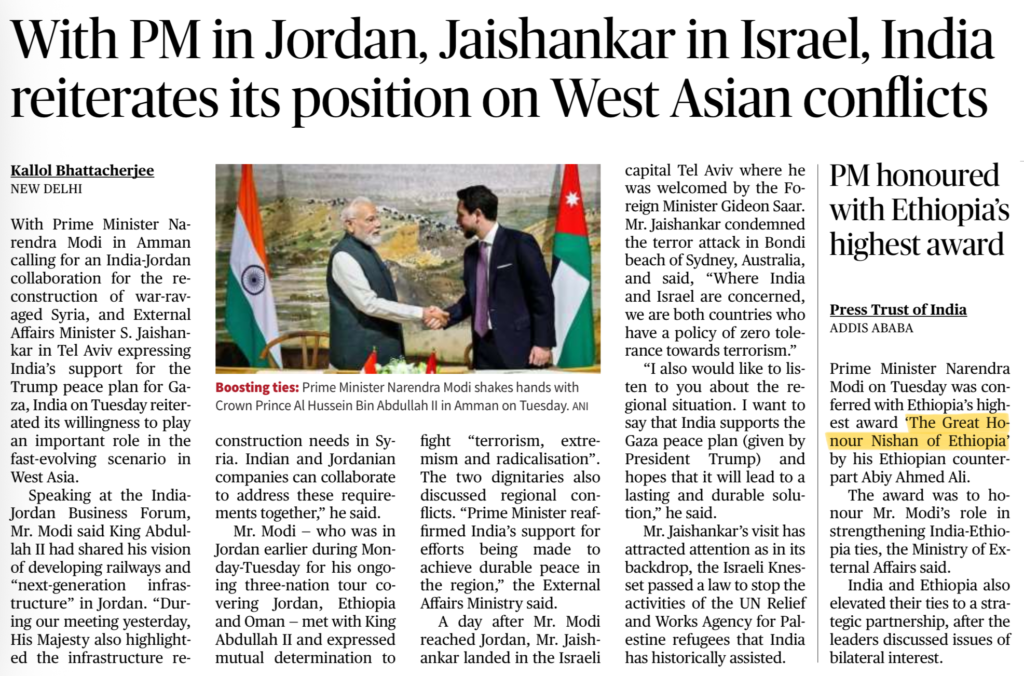
India West Asia Policy Reiterated During Jordan and Israel Visits | GS2

Context
PM Modi conferred Ethiopia’s highest civilian award.

• PM Narendra Modi received “The Grand Honour – Nishan of Ethiopia”.

Significance:
• Recognition of India’s growing engagement with Africa.
• India–Ethiopia ties elevated to a Strategic Partnership.

Core Developments

PM Modi in Jordan
• Talks with King Abdullah II in Amman.

Key focus:
• India–Jordan cooperation in Syria’s reconstruction.
• Infrastructure collaboration (railways, next-gen infrastructure).
• Joint concern over terrorism, extremism, radicalisation.

Significance:
• India’s role as a responsible stakeholder in West Asian stability.

EAM Jaishankar in Israel
• Visit to Tel Aviv; meetings with Israeli leadership.

Key points:
• Reaffirmed zero tolerance to terrorism.
• Supported U.S.-proposed Gaza peace plan for a durable solution.

Context:
• Visit amid Israeli law restricting UNRWA activities (historically supported by India).

Significance:
• Balanced diplomacy: strong Israel ties alongside Arab engagement.

About the UPSC Civil Services Examination (UPSC CSE)

The UPSC Civil Services Examination (CSE) is one of the most competitive and esteemed examinations in India, conducted by the Union Public Service Commission to recruit officers for services such as the Indian Administrative Service (IAS), Indian Police Service (IPS), Indian Foreign Service (IFS), and others. The exam comprises three stages — Prelims, Mains, and the Personality Test (Interview) — designed to test a candidate’s knowledge, aptitude, decision-making, and leadership skills.


How to Prepare Effectively for UPSC CSE

Cracking the UPSC CSE requires a deep understanding of the syllabus, consistent revision, structured answer writing, and smart test-taking strategies. The Prelims test analytical and conceptual clarity, the Mains focuses on critical thinking, articulation, and subject mastery, while the Interview assesses presence of mind, ethical judgment, and personality traits relevant to public service.

At Understand UPSC, we empower aspirants with a personalized and focused approach to each stage of the exam.


Why Choose Understand UPSC?

Understand UPSC is a mentorship-driven platform offering a clear, clutter-free strategy to tackle the Civil Services Examination. Our programs like Transform (for beginners and intermediate learners) and Conquer (for advanced mains preparation) provide structured study plans, syllabus-wise video content, interactive live sessions, and answer writing support.

We emphasize:

  • Concept clarity through topic-wise lectures

  • Test series designed around real UPSC standards

  • Personalized mentorship in small groups

  • Regular performance tracking and peer benchmarking

  • Doubt-clearing sessions, current affairs analysis, and monthly magazines


Join the Understand UPSC Learning Community

Our mission is to make UPSC preparation less overwhelming and more strategic. We combine mentorship, discipline, and academic rigor to help you clear CSE with confidence. Whether you’re preparing from Delhi, Mumbai, Bangalore, or a remote village — our online-first model ensures quality guidance reaches every corner of India.

Join the thousands of aspirants who trust Understand UPSC to guide their journey toward becoming civil servants.

Stay connected with us through our Telegram, YouTube, and Instagram channels for daily tips, strategies, and updates.

Copyright © 2025 USARAMBHA EDUCATION (UnderStand UPSC). All Rights Reserved.

Join the Success Journey!