9 Dec, 2025 | Daily Current Affairs

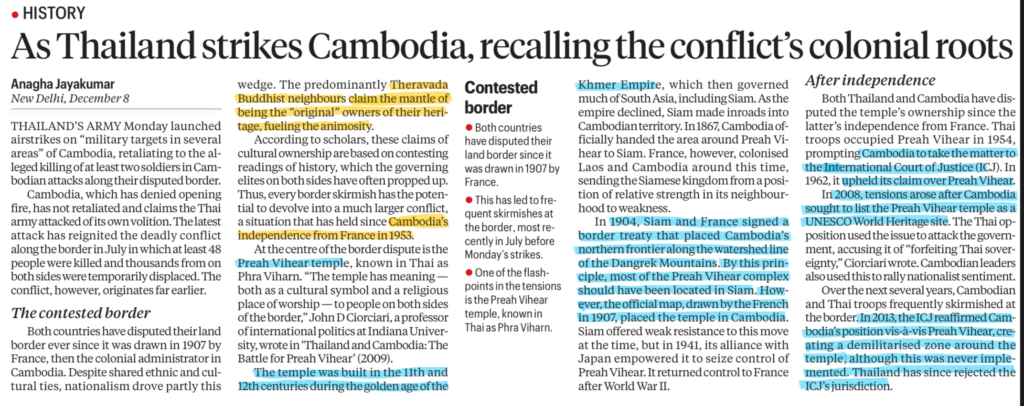
Thailand Cambodia Clash: Preah Vihear Temple Dispute Explained

  1. Basic Context
    • Thailand (earlier Siam) carried out airstrikes in Cambodia after clashes along their disputed border.
    • The conflict centers on territorial claims around the Preah Vihear temple.
  2. Why Are the Two Countries Fighting?
    → Because both claim the land around Preah Vihear temple.
    • Temple lies on a cliff along the Cambodia–Thailand border.
    • Temple belongs to Cambodia (as per ICJ), but access routes lie through Thailand → constant friction.
  3. Deep Historical Roots
    The dispute originates in colonial-era border drawing.
    • The Khmer Empire originally controlled the region, but Siam  later expanded into Cambodian territory.
    • Under French colonial rule, borders were redrawn.
    • A 1904 Siam–France treaty placed the border along the Dangrek watershed, which would put the temple in Siam.
    • However, a 1907 French map placed the temple in Cambodia.

This contradiction—treaty vs map—created the long-standing territorial ambiguity. Nationalist claims and shared Theravada Buddhist heritage further fuel the rivalry, with both nations claiming cultural ownership.

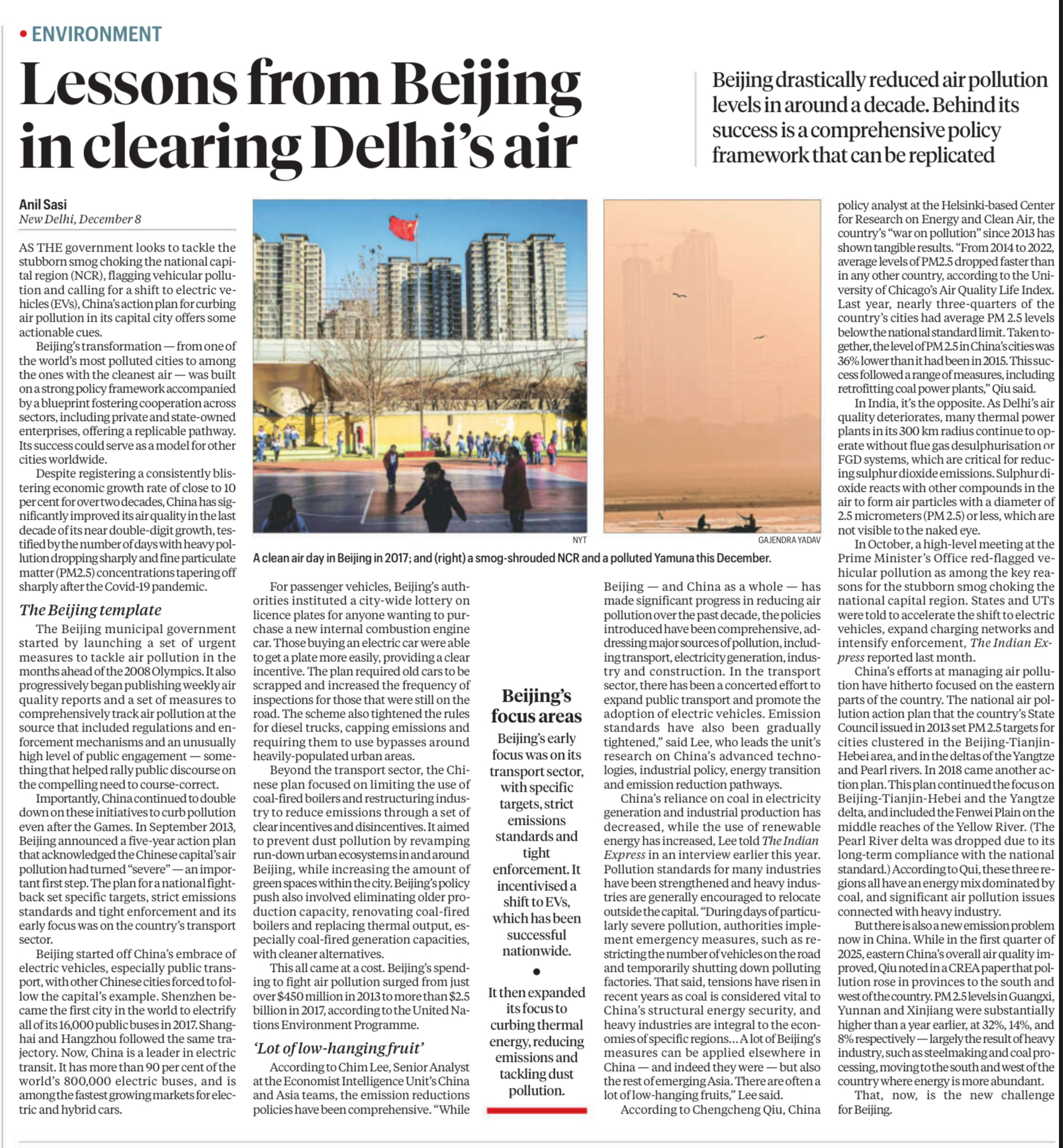
Beijing Clean Air Strategy: How China Reduced Air Pollution

Beijing’s Governance Approach to Air Pollution

  1. Treated air pollution as a governance challenge, not an environmental afterthought—requiring coordinated state action across sectors.
  2. Adopted a centralised clean-air action plan with clear targets, strict  timelines, and institutional accountability.
  3. Implemented multi-sector reforms simultaneously—energy transition, industrial restructuring, transport reforms, and construction controls.
  4. Ensured strong enforcement, real-time monitoring, and transparency to track progress.
  5. Backed reforms with substantial public investment in clean energy, EVs, mass transit, and cleane industrial technology.

What Delhi Can Learn from Beijing ??

  1. Unified Clean Air Mission: Create a single NCR-wide command structure with time-bound targets covering transport, industry, energy, and construction.
  2. Transport Transformation: Rapid expansion of metro/bus fleets, last-mile  EVs; reduce private vehicle dependence through congestion and parking management.
  3. Industrial & Energy Reforms: Relocate/retrofit polluting units; enforce strict emission norms; phase down dirty fuels in NCR periphery and shift to cleaner energy sources.
  4. Dust & Construction Management: Strict controls on construction emissions and real-time monitoring of hotspots.
  5. Robust Enforcement & Transparency: Rigorous inspections, emissions monitoring, public dashboards, and penalties for non-compliance.
  6. Investment-Backed Action: Prioritise funding for clean energy, EV  infrastructure, and pollution-control technology—making clean air a strategic state objective.

Carceral Culture in Prisons: Disability Rights and Systemic Issues

Carceral Culture

  1. SC’s recent directions mandate disability-related facilities in prisons, triggered by  cases like G.N. Saibaba and Stan Swamy, who were denied essential accommodations despite severe physical disabilities.
  2. The Rights of Persons with Disabilities Act, 2016 obligates governments to ensure accessible infrastructure and equal dignity in all institutions, including prisons. However,  implementation gaps persist as many State prison manuals still assume prisoners are physically able.
  3. The Court also held caste-based segregation in prisons unconstitutional, noting intersections of caste, disability and structural discrimination.
  4. Colonial-era prison rules and poor oversight have normalised neglect, where the suffering of disabled and marginalised prisoners is treated as part of punishment rather than a violation of rights.
  5. The NCRB data shows significant numbers of inmates with mental illness, yet prisons lack systems for disability recognition, accommodation, and sanitation assistance.
  6. The editorial argues that the Centre and States must amend prison manuals to specify duties regarding disability screening, accessible facilities, and support mechanisms—requiring higher funding and a shift away from “carceral austerity.”
  7. It stresses the need for independent inspections and routine publication of caste￾and disability-disaggregated data to ensure transparency and enforce rights.

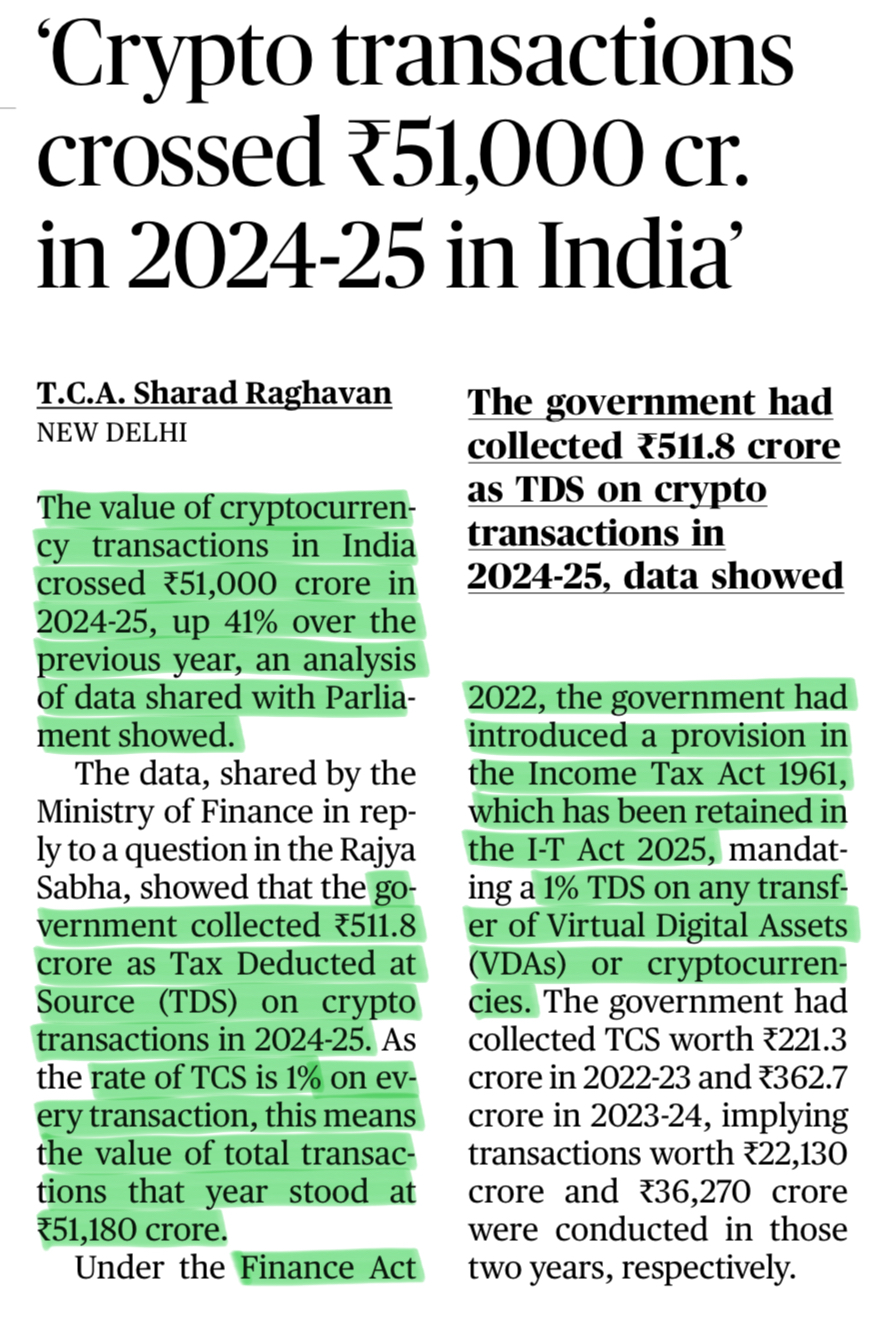
Crypto Transactions 1% TDS: Impact of the Rule Explained

Crypto Taxation

  1. Finance Act 2022 introduced two rules:
    • 1% TDS on transfers of Virtual Digital Assets (VDAs)  including cryptocurrency.
    • 30% flat tax on crypto gains (only cost of acquisition allowed; surcharge + 4% cess apply).
  2. TDS collected by Government:
    • 2022–23: ₹221.3 cr → transactions ₹22,130 cr.
    • 2023–24: ₹362.7 cr → transactions ₹36,270 cr.
    • 2024–25: ₹511.8 cr → transactions ₹51,180 cr (41%  growth).

Overall:
• Crypto transactions in 2024–25 crossed ₹51,000 cr.

Tax Devolution Gap: 7 States Face Revenue Shortfall Explained

Tax Contribution vs Devolution
Period: 2020-21 to 2024-25

States contributing MORE than they receive (7 States)
• Maharashtra: Contributes 36.1%; receives 6.65% (biggest negative gap).
• Karnataka: Gap –8.8 pps.
• Haryana: Gap –4.3 pps.
• Gujarat: Gap –3.5 pps.
• Tamil Nadu: Gap –2.95 pps.
• Telangana: Gap –1.4 pps.
• Goa: Gap –0.04 pps.

States receiving MORE than they contribute
• Uttar Pradesh: Contributes 4.6%; receives 15.8% (highest positive gap).
• Bihar: Gap +8 pps.
• Madhya Pradesh: Gap +5.5 pps.
• Rajasthan: Gap +3.55 pps.

China Trade Surplus: Understanding the $1 Trillion Export Advantage

China Trade Surplus

  1. China’s trade surplus topped $1 trillion for the first time (for the 11 months of the year).
  2. Reason: Manufacturers shifted exports to non-US markets (Europe, Australia, Southeast Asia) to avoid Donald Trump’s tariffs.
  3. Shipments to the US fell by almost one-third compared to the same month a year earlier.
  4. November 2024 exports: Grew 5.9% YoY (reversing October’s  1.1% contraction).
    • Analysts had expected 3.8% growth
  5. November 2024 imports: Rose 1.9%, compared to a 1.0% uptick in October.
    • Economists expected 3%.
  6. China’s November trade surplus: $111.68 billion (highest since  June); up from $90.07 billion in October; above forecast of $100.2  billion.
  7. China is diversifying exports due to concerns over Trump’s  expected tariff policies (post 2024 US election), focusing on Southeast Asia and the EU.
About the UPSC Civil Services Examination (UPSC CSE)

The UPSC Civil Services Examination (CSE) is one of the most competitive and esteemed examinations in India, conducted by the Union Public Service Commission to recruit officers for services such as the Indian Administrative Service (IAS), Indian Police Service (IPS), Indian Foreign Service (IFS), and others. The exam comprises three stages — Prelims, Mains, and the Personality Test (Interview) — designed to test a candidate’s knowledge, aptitude, decision-making, and leadership skills.


How to Prepare Effectively for UPSC CSE

Cracking the UPSC CSE requires a deep understanding of the syllabus, consistent revision, structured answer writing, and smart test-taking strategies. The Prelims test analytical and conceptual clarity, the Mains focuses on critical thinking, articulation, and subject mastery, while the Interview assesses presence of mind, ethical judgment, and personality traits relevant to public service.

At Understand UPSC, we empower aspirants with a personalized and focused approach to each stage of the exam.


Why Choose Understand UPSC?

Understand UPSC is a mentorship-driven platform offering a clear, clutter-free strategy to tackle the Civil Services Examination. Our programs like Transform (for beginners and intermediate learners) and Conquer (for advanced mains preparation) provide structured study plans, syllabus-wise video content, interactive live sessions, and answer writing support.

We emphasize:

  • Concept clarity through topic-wise lectures

  • Test series designed around real UPSC standards

  • Personalized mentorship in small groups

  • Regular performance tracking and peer benchmarking

  • Doubt-clearing sessions, current affairs analysis, and monthly magazines


Join the Understand UPSC Learning Community

Our mission is to make UPSC preparation less overwhelming and more strategic. We combine mentorship, discipline, and academic rigor to help you clear CSE with confidence. Whether you’re preparing from Delhi, Mumbai, Bangalore, or a remote village — our online-first model ensures quality guidance reaches every corner of India.

Join the thousands of aspirants who trust Understand UPSC to guide their journey toward becoming civil servants.

Stay connected with us through our Telegram, YouTube, and Instagram channels for daily tips, strategies, and updates.
Copyright © 2025 USARAMBHA EDUCATION (UnderStand UPSC). All Rights Reserved.

Join the Success Journey!