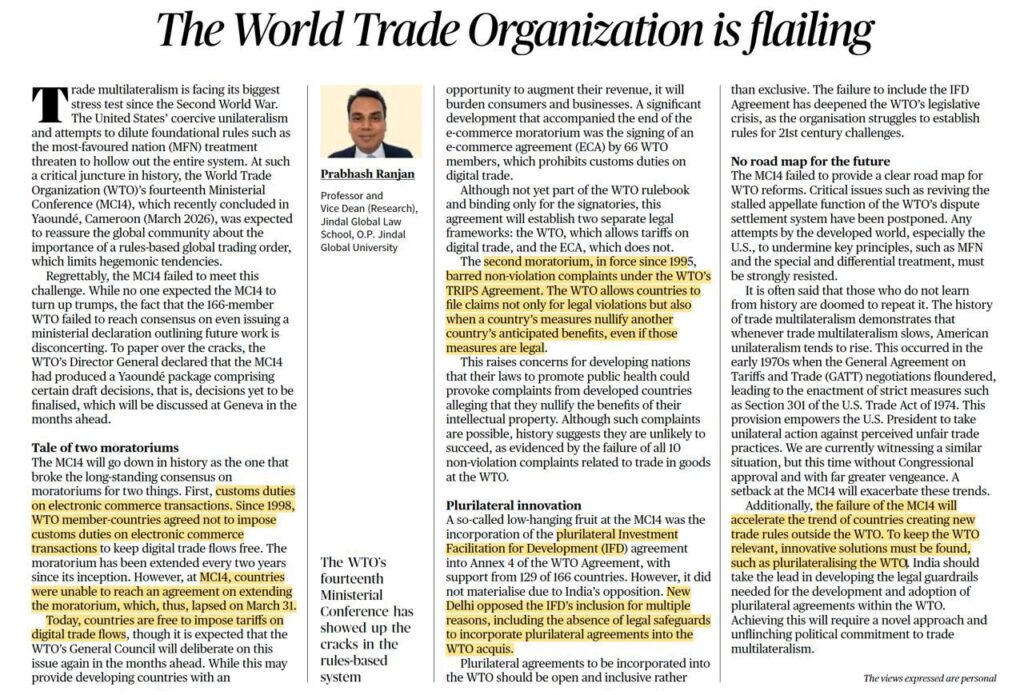
Context: World Trade Organization crisis
The World Trade Organization is under stress after its 14th Ministerial Conference failed to deliver consensus, showing weakening of the rules-based global trade system.
Key Issues
- Breakdown of two important moratoriums
• E-commerce moratorium (1998): No customs duties on digital trade → now lapsed → countries can impose tariffs, increasing costs and fragmenting digital trade.
• TRIPS (Trade-Related Aspects of Intellectual Property Rights) non-violation moratorium (1995): Earlier, countries could not file complaints without rule violation → weakening of this protection allows disputes even when policies are legally valid → risk for developing countries. - Dispute settlement system not working
• WTO’s appellate body is non-functional → no final dispute resolution.
• Result: Rules exist but enforcement is weak. - Rise of plurilateral approach
• Push for Investment Facilitation for Development (IFD) agreement.
• Issue: Not supported by all members → breaks consensus-based system.
• Concern: WTO shifting from inclusive multilateralism → selective rule-making. - Increasing unilateral actions
• Major economies taking independent trade measures.
• Undermines core principles like Most Favoured Nation (MFN). - No clear reform direction
• No roadmap on dispute settlement revival or institutional reforms.
• Issues like special and differential treatment for developing countries remain unresolved. - Declining relevance of WTO
• Countries increasingly relying on regional and bilateral trade agreements.
• WTO’s central role in global trade governance weakening.