Context: Health insurance in India
Findings from the 80th Round of the National Sample Survey (NSS) – “Household Social Consumption: Health” (2025) show that higher health insurance coverage has not improved access to care or reduced financial burden.
About National Sample Survey (NSS)
- Conducted by: National Statistical Office (NSO) (earlier NSSO), under Ministry of Statistics and Programme Implementation (MoSPI)
- Periodic nationwide survey (not annual)
- Health rounds after ~5–7 years
- Key source for policy data
Data-backed Summary
1. Coverage increased, utilisation stagnant
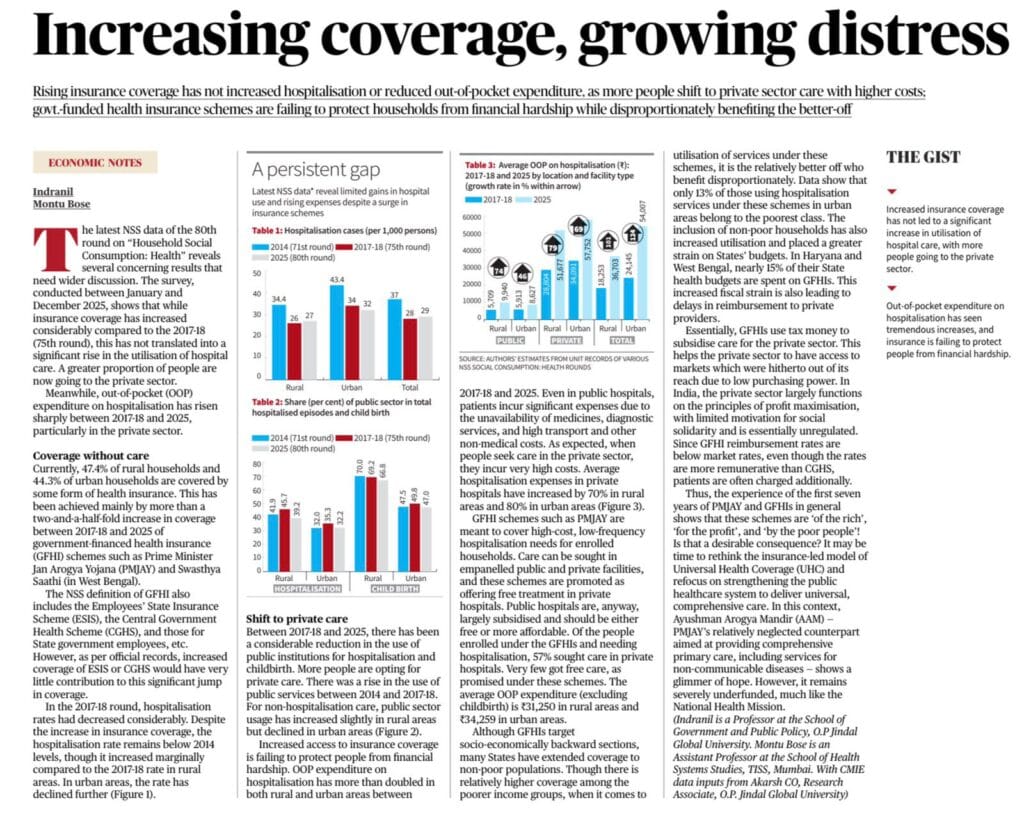
- Coverage: 47.4% rural (2025), 44.3% urban (2025)
- Hospitalisation (per 1,000 persons):
- 37 (2014) → 28 (2017–18) → 29 (2025)
2. Shift towards private healthcare
- Public sector share in hospitalisation:
- Rural: 41.9% (2014) → 44.7% (2017–18) → 39.2% (2025)
- Urban: 32% (2014) → 35.8% (2017–18) → 32.2% (2025)
3. Rising Out-of-Pocket (OOP) expenditure
Public hospitals:
- Rural: ₹5,709 (2017–18) → ₹9,940 (2025)
- Urban: ₹6,582 (2017–18) → ₹8,627 (2025)
Private hospitals:
- Rural: ₹28,655 (2017–18) → ₹51,677 (2025)
- Urban: ₹34,031 (2017–18) → ₹57,752 (2025)
Total OOP:
- Rural: ₹18,253 (2017–18) → ₹30,639 (2025)
- Urban: ₹24,145 (2017–18) → ₹54,007 (2025)
4. Inequitable access
- Only 13% poorest households (2025, urban) benefit from Government-Funded Health Insurance (GFHI)
5. Fiscal stress and structural issues
- States like Haryana and West Bengal (~2025) spend ~15% of health budgets on insurance schemes
- Public healthcare remains underfunded, private sector dominant