18 Dec, 2025 | Daily Current Affairs

India Bangladesh Relations: India Urges Safety Amid Dhaka Protests

Context
India raised concerns over the safety and security of its diplomatic mission in Dhaka after a radical group in Bangladesh announced a march to the Indian High Commission. Following this, the Ministry of External Affairs summoned the Bangladesh High Commissioner in New Delhi and reminded Bangladesh of its responsibility under international norms to protect foreign missions.

What is happening in Bangladesh
• A radical group in Dhaka announced a march to the Indian High Commission to protest India’s alleged interference in Bangladeshi politics.
• The protestors demanded the return of “Fascist Hasina”, referring to ousted former Prime Minister Sheikh Hasina, who is currently living in India.
• The group also called for an end to what it described as an “unchecked conspiracy” by India’s proxy political party, media and officials.

In response, India:
• Summoned Bangladesh’s High Commissioner to New Delhi.
• Emphasised Bangladesh’s responsibility to ensure the safety of Indian diplomatic and visa facilities.
• India rejected the allegations, stating that extremist elements are attempting to create a false narrative about India’s role in recent developments in Bangladesh.

India Bangladesh Relations

Nuclear Energy Bill India: Lok Sabha Passes Bill Allowing Private Sector

CONTEXT
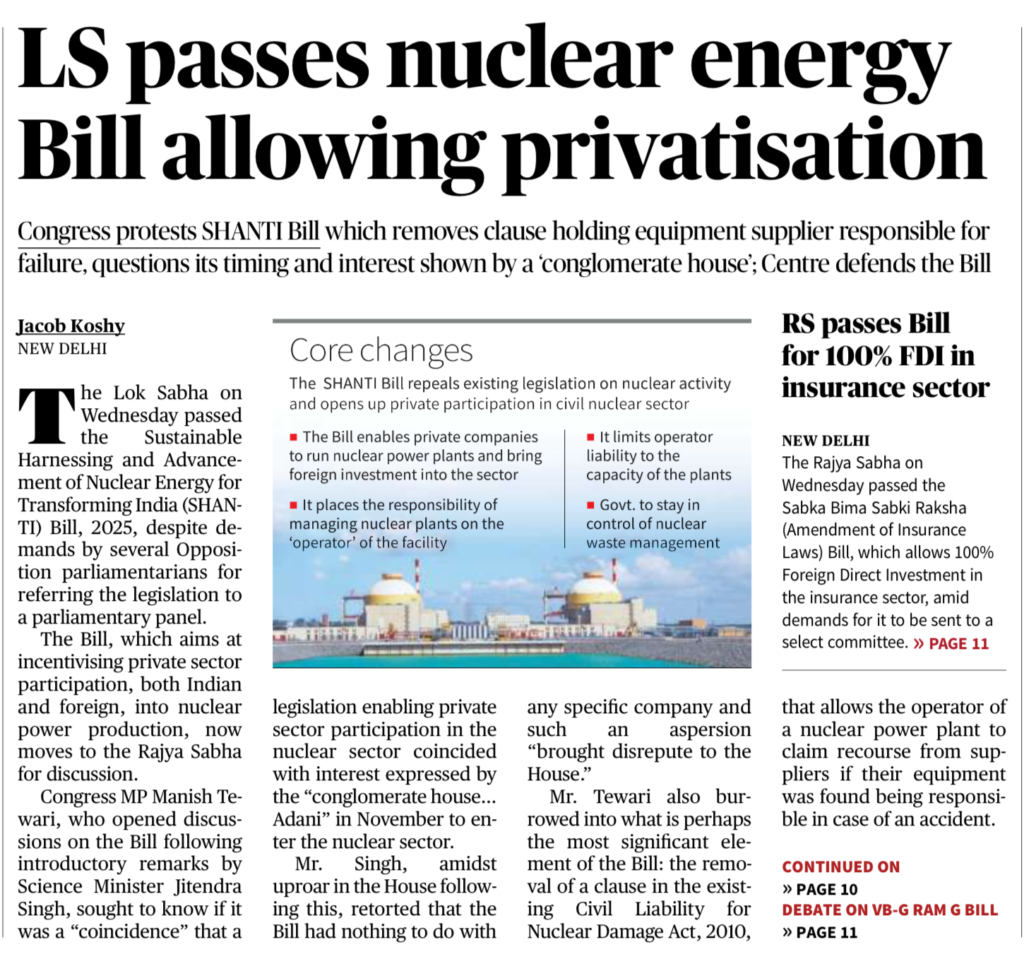
The Lok Sabha passed the Sustainable Harnessing and Advancement of Nuclear Energy for Transforming India (SHANTI) Bill, 2025, which proposes opening India’s civil nuclear sector to private and foreign participation and amending the existing nuclear liability framework. The Bill triggered sharp debate in Parliament, with the Opposition raising concerns over liability dilution and lack of scrutiny.

KEY PROVISIONS
• The Bill allows private Indian and foreign companies to set up and operate civil nuclear power plants, a sector so far dominated by public sector entities.
• It opens the civil nuclear sector to foreign investment, aimed at mobilising capital and facilitating faster nuclear capacity expansion.
• The Bill places the responsibility for managing nuclear power plants on the operator, making the operator accountable for plant functioning.
• It limits the liability of the operator in case of a nuclear accident to the capacity of the nuclear plant, replacing the earlier open-ended liability framework.
• The Bill removes the provision that allowed operators to seek legal recourse against equipment suppliers under the Civil Liability for Nuclear Damage Act, 2010.
• The government retains control over nuclear waste management, even while permitting private participation in plant operations.

ISSUES AND CONCERNS RAISED
• The Opposition argued that removal of supplier liability weakens accountability, especially if accidents occur due to faulty equipment.
• Concerns were raised that capping operator liability may dilute compensation for victims of nuclear accidents.
• The Opposition alleged that the Bill favours large corporate interests, questioning the timing of the legislation.
• Demand for sending the Bill to a parliamentary standing committee for scrutiny was rejected, leading to criticism over insufficient legislative examination.
• The government countered that the Bill is investment-oriented and not company-specific, and that changes are necessary to make the sector viable.

Nuclear Energy Bill India

SEBI Brokerage Norms: Regulator Reviews Decades-Old Rules

Context
The Securities and Exchange Board of India (SEBI) has reviewed and updated decades-old brokerage and mutual fund regulations with the objective of reducing costs for investors, improving transparency, and simplifying market rules. The decisions were taken in SEBI’s board meeting.

Changes brought by SEBI
• Mutual fund expense ratio reduced by up to 15 basis points.
Benefit: Investors pay less fees, so their returns increase over time.
• Base Expense Ratio (BER) introduced, excluding GST, stamp duty and Securities Transaction Tax.
Benefit: Investors can clearly see what the fund manager is actually charging.
• Additional 5 basis points exit load on early redemption removed.
Benefit: Investors can exit funds without extra penalty.
• Brokerage capped at 6 basis points (cash market) and 2 basis points (derivatives).
Benefit: Traders and investors cannot be overcharged by brokers.
• Research cost included within brokerage; no separate research charge allowed.
Benefit: Investors do not pay twice for brokerage and research.

US Venezuela Relations: US Labels Govt Terrorist, Orders Oil Blockade

Context
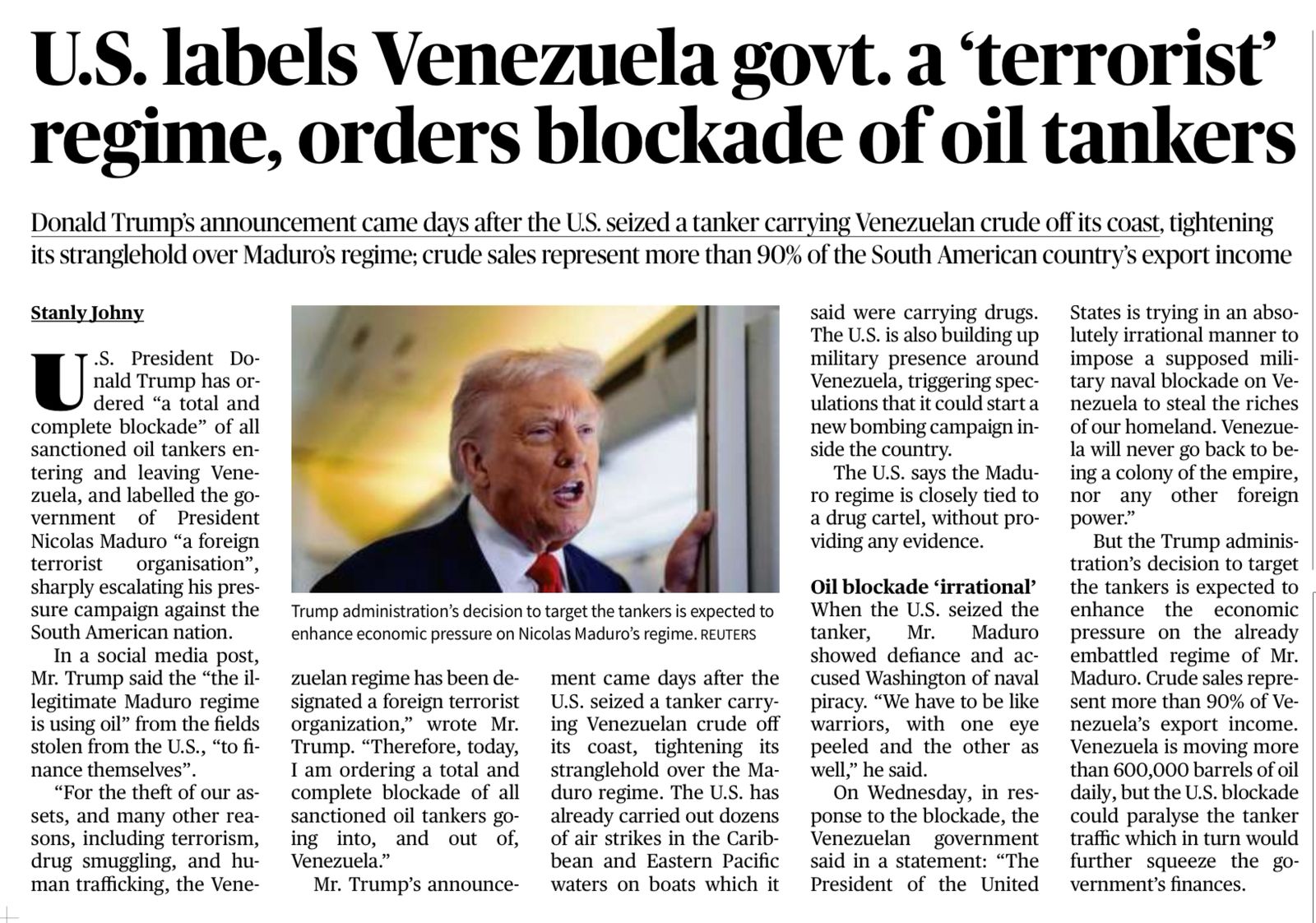
The U.S. has intensified pressure on Venezuela by declaring the Nicolás Maduro government a “foreign terrorist organisation” and ordering a total blockade of oil tankers, tightening economic and military pressure.

USA–Venezuela: Key Developments
• Designation: U.S. President Donald Trump labelled the Maduro government a terrorist regime, alleging links to drug trafficking, terrorism, human trafficking and oil theft.
• Oil blockade: The U.S. ordered a “total and complete blockade” of sanctioned oil tankers entering and leaving Venezuela.
• Trigger: The decision followed the seizure of a Venezuelan crude tanker by the U.S.
• Economic impact: Oil provides over 90% of export earnings; Venezuela exports 600,000+ barrels/day, making the blockade financially severe.
• Military posture: The U.S. has increased military presence around Venezuela, raising escalation concerns.
• Venezuela’s response: President Maduro termed the move “irrational”, accused the U.S. of naval piracy, and rejected foreign domination.

Aravalli Range Conservation: Measures to Protect India’s Oldest Hills

Context
The Supreme Court intervened to protect the Aravalli hills by fixing a uniform definition of the Aravalli range and pausing new mining leases across Delhi, Haryana, Rajasthan and Gujarat due to large-scale ecological damage caused by mining.

Why Aravallis are important
• Act as a barrier against desertification of the Indo-Gangetic plains.
• Help in groundwater recharge, climate regulation and biodiversity protection.
• Support rivers like Chambal, Sabarmati and Luni.

What was the problem
• Excessive and illegal mining over decades.
• States used different definitions of Aravallis to allow mining.
• Blanket bans earlier led to illegal mining mafias.

Supreme Court’s approach
• Accepted a uniform, scientific definition of Aravalli hills.
• Paused fresh mining leases.
• Directed preparation of a Management Plan for Sustainable Mining (MPSM).
• Mining completely banned in ecologically sensitive areas.
• Limited, regulated mining allowed elsewhere.

Government action
• Launched Aravalli Green Wall Project to expand green cover in buffer areas, aims to restore 26 million hectares of degraded land by 2030.

Aravalli Range Conservation
About the UPSC Civil Services Examination (UPSC CSE)

The UPSC Civil Services Examination (CSE) is one of the most competitive and esteemed examinations in India, conducted by the Union Public Service Commission to recruit officers for services such as the Indian Administrative Service (IAS), Indian Police Service (IPS), Indian Foreign Service (IFS), and others. The exam comprises three stages — Prelims, Mains, and the Personality Test (Interview) — designed to test a candidate’s knowledge, aptitude, decision-making, and leadership skills.


How to Prepare Effectively for UPSC CSE

Cracking the UPSC CSE requires a deep understanding of the syllabus, consistent revision, structured answer writing, and smart test-taking strategies. The Prelims test analytical and conceptual clarity, the Mains focuses on critical thinking, articulation, and subject mastery, while the Interview assesses presence of mind, ethical judgment, and personality traits relevant to public service.

At Understand UPSC, we empower aspirants with a personalized and focused approach to each stage of the exam.


Why Choose Understand UPSC?

Understand UPSC is a mentorship-driven platform offering a clear, clutter-free strategy to tackle the Civil Services Examination. Our programs like Transform (for beginners and intermediate learners) and Conquer (for advanced mains preparation) provide structured study plans, syllabus-wise video content, interactive live sessions, and answer writing support.

We emphasize:

  • Concept clarity through topic-wise lectures

  • Test series designed around real UPSC standards

  • Personalized mentorship in small groups

  • Regular performance tracking and peer benchmarking

  • Doubt-clearing sessions, current affairs analysis, and monthly magazines


Join the Understand UPSC Learning Community

Our mission is to make UPSC preparation less overwhelming and more strategic. We combine mentorship, discipline, and academic rigor to help you clear CSE with confidence. Whether you’re preparing from Delhi, Mumbai, Bangalore, or a remote village — our online-first model ensures quality guidance reaches every corner of India.

Join the thousands of aspirants who trust Understand UPSC to guide their journey toward becoming civil servants.

Stay connected with us through our Telegram, YouTube, and Instagram channels for daily tips, strategies, and updates.

Copyright © 2025 USARAMBHA EDUCATION (UnderStand UPSC). All Rights Reserved.

Join the Success Journey!