Right to Disconnect and Work-Life Balance Debate

Context
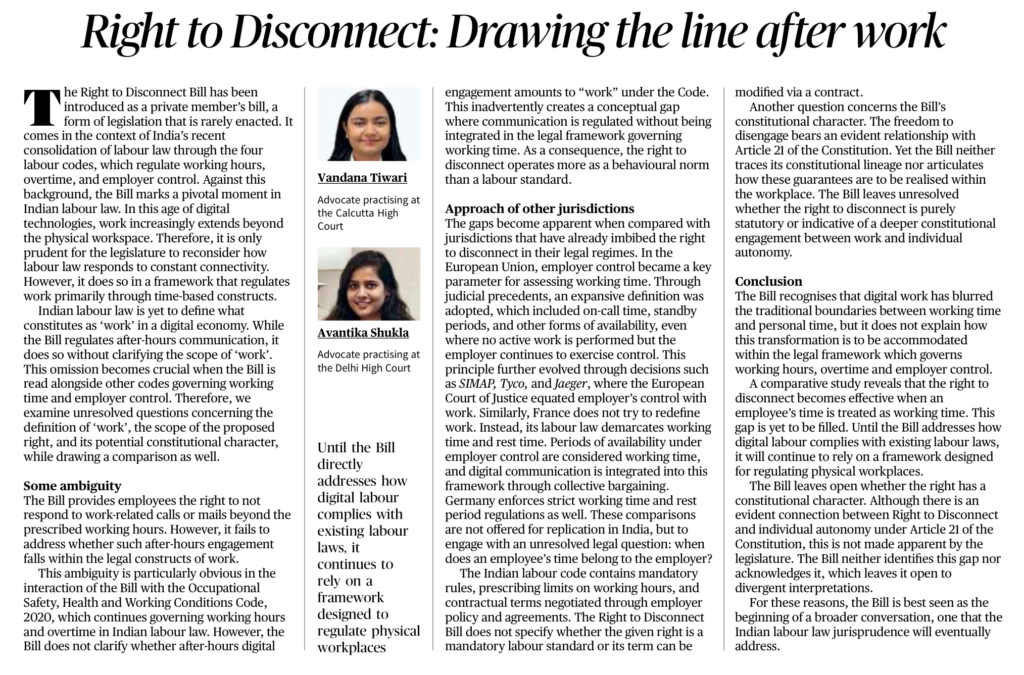
The Right to Disconnect Bill, introduced as a private member’s Bill, comes amid rapid digitalisation of work and India’s consolidation of labour laws into four labour codes. With work extending beyond physical workplaces and fixed hours, the Bill seeks to address constant digital connectivity.

Core Issue
Indian labour law continues to define work through time-based and physical constructs. The Bill regulates after-hours communication but does not redefine “work” for the digital economy, creating a mismatch with existing labour codes.

Key Gaps in the Bill
• Allows employees to ignore work-related calls/emails beyond working hours but does not clarify whether such digital engagement counts as “work”.
• Not aligned with the Occupational Safety, Health and Working Conditions Code, 2020, which governs working time and overtime.
• Regulates communication without integrating it into the legal framework of working time, making the right largely behavioural rather than enforceable.
• Does not specify whether the right is a mandatory labour standard or a contractual right that can be modified by agreement.

Comparative International Practice
• European Union: Employer control determines what qualifies as work, including on-call and standby time.
• France: Clear demarcation between working time and rest time; digital communication regulated through collective bargaining.
• Germany: Strict enforcement of working-hour limits and rest periods.
• These systems embed digital communication within working-time regulation, unlike India.

Constitutional Dimension
• The freedom to disconnect is closely linked to personal autonomy under Article 21.
• The Bill does not clearly articulate this constitutional linkage or explain how autonomy is protected at the workplace.
• Leaves ambiguity on whether the right is statutory or reflects a deeper constitutional guarantee.

Conclusion
The Bill is an important starting point, but without redefining work in the digital age, aligning with labour codes, and clarifying its legal and constitutional status, it remains inadequate. Indian labour law continues to rely on a framework designed for physical workplaces, limiting the effectiveness of the right to disconnect.

Right to Disconnect
Right to Disconnect
About the UPSC Civil Services Examination (UPSC CSE)

The UPSC Civil Services Examination (CSE) is one of the most competitive and esteemed examinations in India, conducted by the Union Public Service Commission to recruit officers for services such as the Indian Administrative Service (IAS), Indian Police Service (IPS), Indian Foreign Service (IFS), and others. The exam comprises three stages — Prelims, Mains, and the Personality Test (Interview) — designed to test a candidate’s knowledge, aptitude, decision-making, and leadership skills.


How to Prepare Effectively for UPSC CSE

Cracking the UPSC CSE requires a deep understanding of the syllabus, consistent revision, structured answer writing, and smart test-taking strategies. The Prelims test analytical and conceptual clarity, the Mains focuses on critical thinking, articulation, and subject mastery, while the Interview assesses presence of mind, ethical judgment, and personality traits relevant to public service.

At Understand UPSC, we empower aspirants with a personalized and focused approach to each stage of the exam.


Why Choose Understand UPSC?

Understand UPSC is a mentorship-driven platform offering a clear, clutter-free strategy to tackle the Civil Services Examination. Our programs like Transform (for beginners and intermediate learners) and Conquer (for advanced mains preparation) provide structured study plans, syllabus-wise video content, interactive live sessions, and answer writing support.

We emphasize:

  • Concept clarity through topic-wise lectures

  • Test series designed around real UPSC standards

  • Personalized mentorship in small groups

  • Regular performance tracking and peer benchmarking

  • Doubt-clearing sessions, current affairs analysis, and monthly magazines


Join the Understand UPSC Learning Community

Our mission is to make UPSC preparation less overwhelming and more strategic. We combine mentorship, discipline, and academic rigor to help you clear CSE with confidence. Whether you’re preparing from Delhi, Mumbai, Bangalore, or a remote village — our online-first model ensures quality guidance reaches every corner of India.

Join the thousands of aspirants who trust Understand UPSC to guide their journey toward becoming civil servants.

Stay connected with us through our Telegram, YouTube, and Instagram channels for daily tips, strategies, and updates.

Copyright © 2025 USARAMBHA EDUCATION (UnderStand UPSC). All Rights Reserved.

Join the Success Journey!