1. What is Child Trafficking in India?
• Defined internationally by the Palermo Protocol (2000).
• In India, defined under Section 143, Bharatiya Nyaya Sanhita (BNS), 2023.
• Includes recruitment, transport, harbouring or receipt of children for exploitation (forced labour, sexual exploitation, slavery, servitude, organ removal), irrespective of consent.
2. International Framework
• Palermo Protocol: UN protocol to prevent, suppress and punish trafficking in persons, especially women and children.
• India is a signatory.
3. Constitutional Provisions
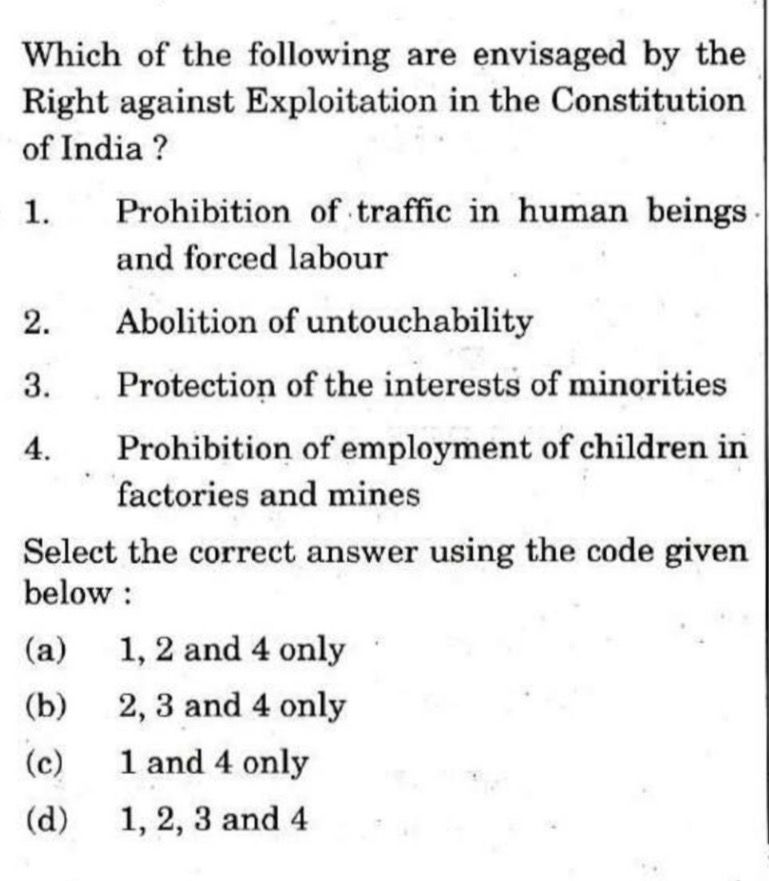
• Article 23: Prohibits human trafficking, begar, forced labour.
• Article 24: Prohibits employment of children in hazardous industries.
• Article 21: Right to life and dignity (interpreted to include protection from trafficking).
4. Key Indian Laws
• BNS, 2023: Comprehensive definition of trafficking (replaces IPC provisions).
• POCSO Act, 2012: Sexual offences against children; special courts and stringent punishment.
• Juvenile Justice (Care and Protection of Children) Act, 2015: Care, protection, rehabilitation of rescued children.
• Immoral Traffic (Prevention) Act, 1956: Prevents trafficking for sexual exploitation.
5. Supreme Court’s Stand
• K.P. Kiran Kumar vs State (recent):
• Held that child trafficking grossly violates fundamental rights.
• Issued strict guidelines for prevention, rescue, rehabilitation and prosecution.
6. Judicial & Institutional Measures
• Around 400 fast-track courts set up for POCSO cases.
• Target of 165 cases per court per year.
• Emphasis on victim-centric, humanitarian approach.
7. Scale of the Problem (Data)
• NCRB: Thousands of children rescued annually from trafficking, child labour and kidnapping.
• Conviction rates remain low, indicating enforcement gaps.
8. Key Challenges Identified
• Poverty, migration, disasters, family breakdown.
• Online platforms enabling recruitment.
• Weak Centre–State coordination.
9. Way Forward (as per article)
• Strong Centre–State cooperation.
• Focus on socio-economic rehabilitation, not only criminal prosecution.
• Strengthening institutions for child protection.