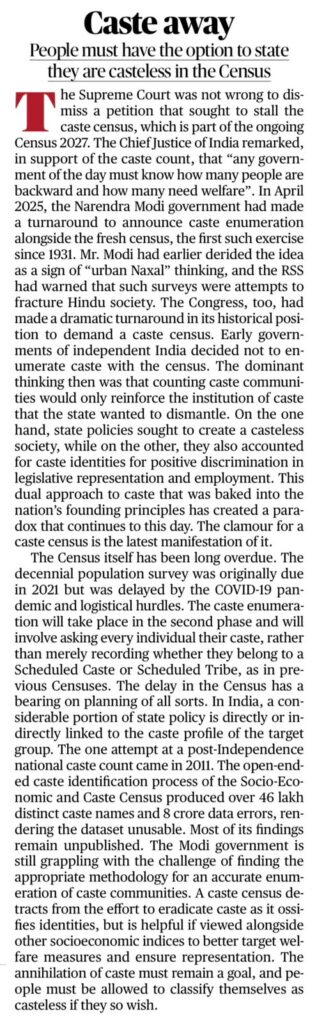
Context: Debate has intensified over caste enumeration in Census 2027, with supporters viewing it as essential for evidence-based welfare and representation, while critics argue it may reinforce caste identities against the constitutional vision of a casteless society.
1. Caste Census
- Census 2027 to include caste enumeration along with regular population census
- First comprehensive caste count since 1931 Census
- Post-Independence Census mainly recorded only Scheduled Castes (SCs) and Scheduled Tribes (STs)
2. Socio-Economic and Caste Census (SECC), 2011
- Conducted separately from regular Census
- Intended to identify socio-economic and caste profile of households
- Faced major data inconsistencies, duplication and classification issues
- Much of caste data remained unpublished
3. Importance
- Helps targeted welfare delivery and evidence-based policymaking
- Assists reservation, representation and affirmative action policies
- Provides updated data on Socially and Educationally Backward Classes (SEBCs) and other marginalised communities
4. Concerns
- May deepen caste consciousness and political mobilisation
- Challenges in accurate caste classification and standardisation
- Risk of competitive reservation demands and social fragmentation
5. Constitutional Dimension
- Article 15 & 16: Special provisions for socially and educationally backward classes
- Article 46: Promotion of educational and economic interests of weaker sections
- Constitutional vision balances social justice through affirmative action with the long-term goal of equality and annihilation of caste