
Context
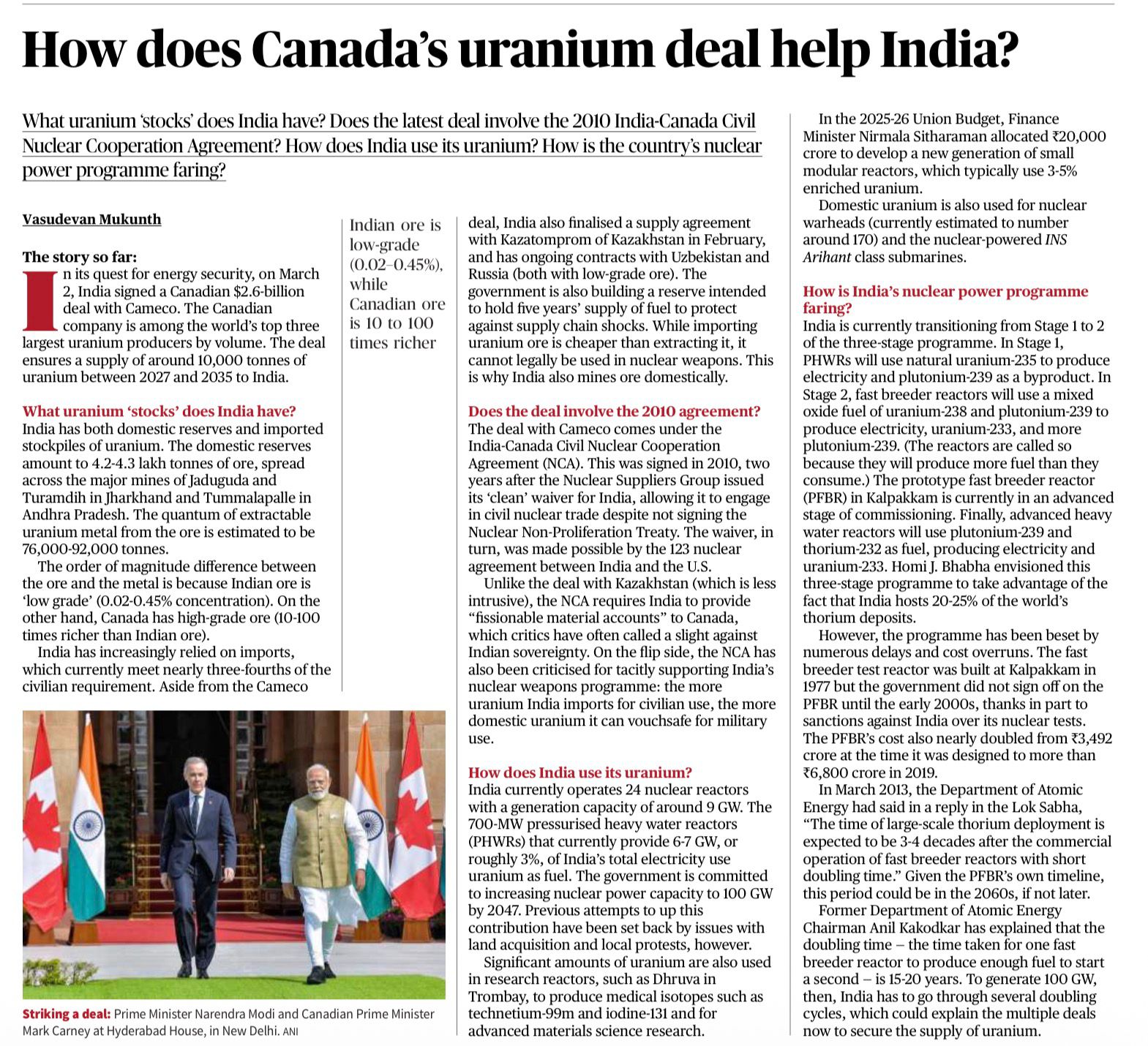
India signed a $2.6-billion uranium supply agreement with Canada to secure long-term fuel for its civilian nuclear power programme (2027–2035) under the 2010 India–Canada Civil Nuclear Cooperation Agreement.
Importance
• Strengthens energy security by ensuring steady uranium supply for nuclear expansion.
• Diversifies imports; India also sources uranium from Kazakhstan (Kazatomprom), Uzbekistan and Russia.
• Imported uranium supports civilian reactors, helping conserve domestic uranium for strategic use.
• Canadian ore is richer than India’s low-grade ore, improving efficiency.
Key Facts
• India’s domestic uranium reserves (~4.2–4.3 lakh tonnes ore) lie mainly at Jaduguda, Turamdih (Jharkhand) and Tummalapalle (Andhra Pradesh).
• Imports meet nearly three-fourths of civilian uranium demand.
• India operates 24 nuclear reactors (~9 GW); most are Pressurised Heavy Water Reactors (PHWRs) which primarily use natural uranium.
Supports India’s Three-Stage Nuclear Programme
- Pressurised Heavy Water Reactors (natural uranium fuel)
- Fast Breeder Reactors (plutonium-based mixed oxide fuel)
- Future thorium-based reactors leveraging India’s large thorium reserves