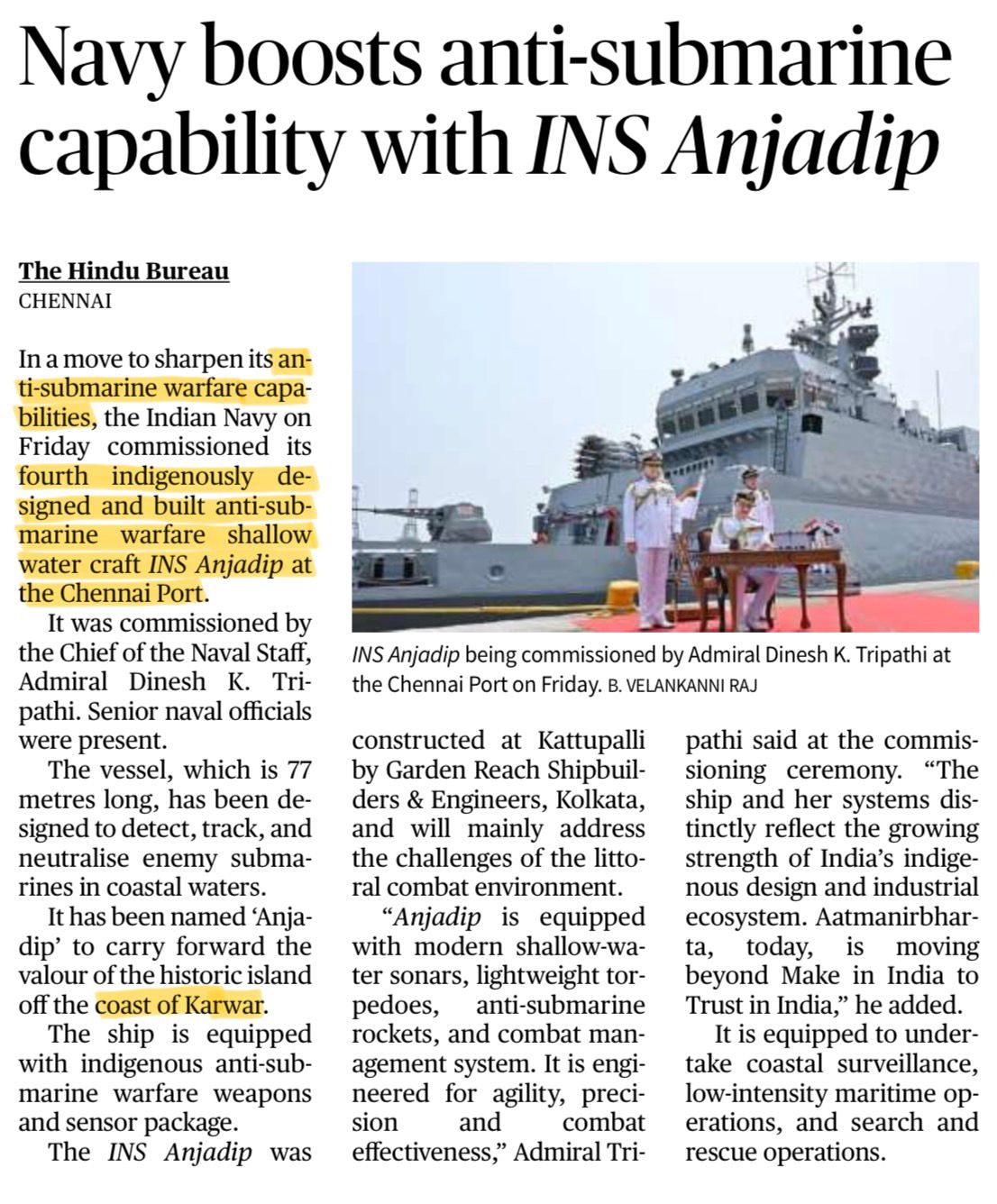

Type: Anti-Submarine Warfare Shallow Water Craft (ASW-SWC)
This class of vessels is specifically designed to operate in shallow coastal waters where larger destroyers or frigates may face limitations.
Service: Indian Navy
Commissioned: 2026 (Chennai)
Builder: Garden Reach Shipbuilders & Engineers (GRSE), Kolkata
Project: Part of the 16-ship ASW-SWC programme aimed at boosting coastal defence.
Role
• Detects, tracks and destroys enemy submarines operating close to India’s coastline.
• Enhances India’s littoral Anti-Submarine Warfare (ASW) capability, especially in shallow waters where submarine threats are harder to track.
Key Systems
• Hull-mounted sonar optimised for shallow water detection.
• Lightweight torpedoes for precise submarine targeting.
• Anti-submarine rocket systems for rapid response.
• Integrated Combat Management System (CMS) for coordinated operations.
• Search and Rescue (SAR) capability to support humanitarian missions as well.
Significance
• Strengthens India’s ability to counter submarine threats in coastal zones.
• Enhances maritime security in the Arabian Sea, a region of growing strategic competition.
• Reflects progress in indigenous defence manufacturing under Aatmanirbhar Bharat.
Earlier ASW-SWCs Commissioned
• INS Arnala
• INS Androth
• INS Agray
INS Anjadip is the fourth ship inducted under this programme, gradually building a layered coastal defence network.
Anjadip Island – Historical Importance
• Located off the Karwar coast of Karnataka in the Arabian Sea.
• Served as an early Portuguese maritime base in the 16th century.
• Played a supporting role during Operation Vijay (1961), India’s operation to liberate Goa, helping consolidate control over the western seaboard after liberation.