
Context
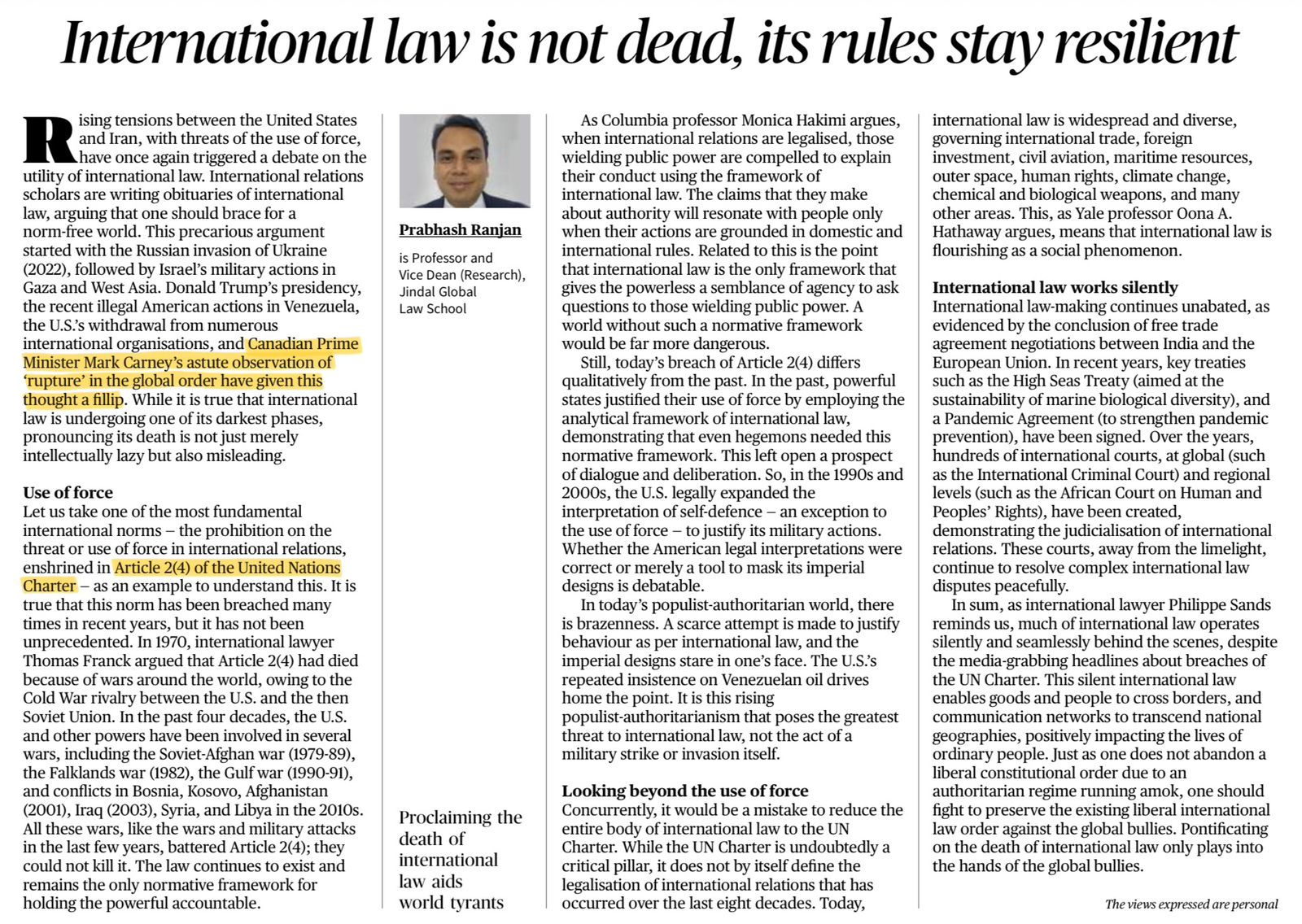
In the backdrop of the Russia–Ukraine war, the Gaza conflict, U.S. actions in Venezuela and rising great-power rivalry, scholars argue that international law is weakening. The editorial counters this claim by emphasising its continued resilience.
UN Charter – Article 2(4)
• Prohibits the threat or use of force against the territorial integrity or political independence of states.
• Forms the foundation of the post-World War II international order.
Exceptions
• Article 51 permits self-defence if an armed attack occurs.
• The UN Security Council may authorise use of force.
Even when states violate these norms, they typically justify actions within the legal framework, indicating that international law continues to shape behaviour.
Summary of Argument
- Repeated Violations Yet Survival
• Conflicts such as the Falklands War (1982), Gulf War (1990–91), Iraq War (2003), Libya and Syria strained Article 2(4).
• Despite breaches, the broader legal system endured. - Legal Justification by Powerful States
• In the 1990s–2000s, the U.S. expanded interpretations of self-defence to justify interventions.
• This demonstrates that even powerful states seek legal legitimacy. - Current Concern
• A growing disregard for legal justification in populist-authoritarian politics may undermine norms more seriously than isolated violations. - International Law Beyond War
International law also governs:
• Trade
• Aviation
• Climate agreements
• Human rights
• Maritime law
• Outer space
• Biological and chemical weapons
Examples cited:
• High Seas Treaty
• Pandemic Agreement
• International Criminal Court
• Regional human rights courts
These institutions continue functioning despite geopolitical instability.