Context
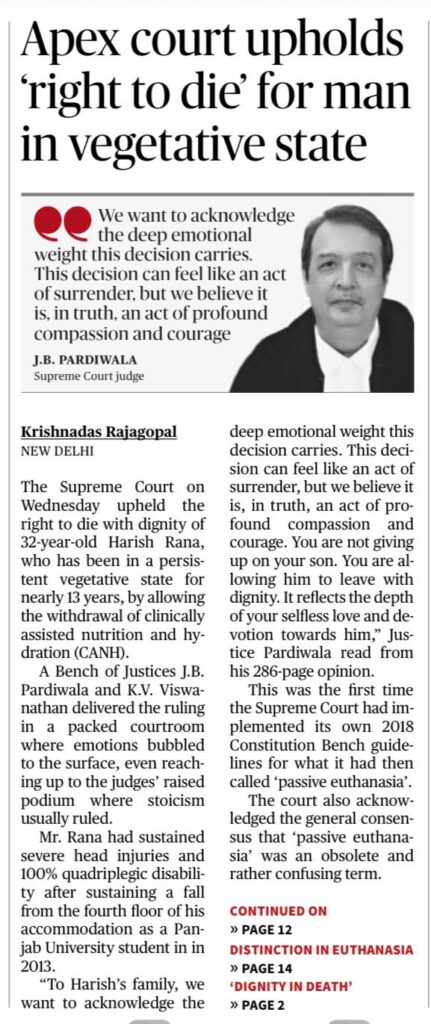
The Supreme Court allowed the withdrawal of clinically assisted nutrition and hydration (CANH) for a man in a persistent vegetative state, reaffirming that the right to die with dignity flows from Article 21 of the Constitution.
Passive Euthanasia
• Passive euthanasia refers to withdrawal or withholding of life-sustaining treatment, such as ventilators, feeding tubes or critical medicines.
• It allows natural death to occur when recovery is medically impossible.
• Importantly, there is no direct act to cause death, unlike active euthanasia.
• In India, passive euthanasia is permitted with strict safeguards under Article 21.
Historical Evolution
• Aruna Shanbaug Case (2011)
- The Supreme Court first recognised passive euthanasia.
- However, strict approval from courts was required.
• Common Cause vs Union of India (2018)
- The Court ruled that Article 21 includes the right to die with dignity.
- It also legally recognised the concept of a Living Will, allowing individuals to specify medical decisions in advance.
Present Case
• The recent ruling is not the first recognition of passive euthanasia.
• However, it is one of the first major instances where the Supreme Court itself applied the 2018 safeguards to permit withdrawal of CANH.
Key Observations of the Court
• Artificially prolonging life without the possibility of recovery violates the dignity guaranteed under Article 21.
• Withdrawal of CANH was permitted after medical confirmation of an irreversible and long-term vegetative condition.
Safeguards
The Court mandated safeguards before withdrawal of life-support:
• Approval from a medical board of doctors.
• Consent of the family.
• Judicial oversight to ensure the decision is ethical and voluntary.