
Context: Rabindranath Tagore
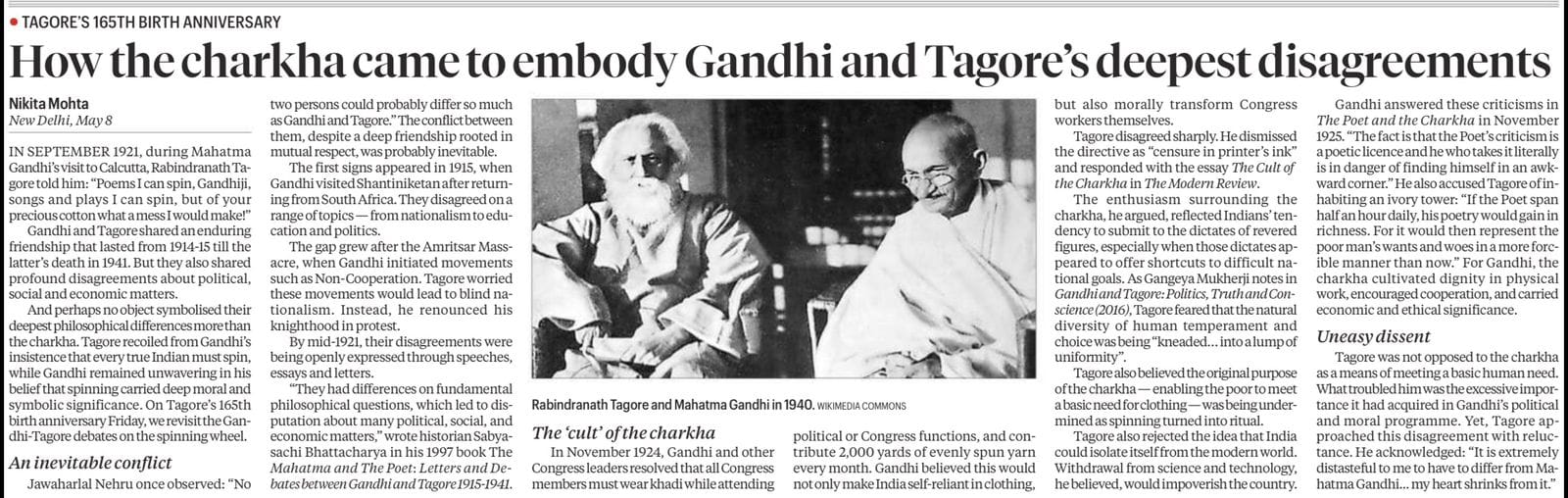
On the 165th birth anniversary of Rabindranath Tagore, discussions have revived around his literary contributions, educational philosophy and ideological debates with Mahatma Gandhi over nationalism and the charkha.
Key Facts About Rabindranath Tagore
1. Birth & Identity
- Born on 7 May 1861 in Kolkata.
- Poet, philosopher, novelist, dramatist, painter, composer and educationist.
- Popularly known as “Gurudev.”
- Major figure of the Bengal Renaissance.
2. Nobel Prize
- Became the first Asian Nobel laureate by winning the Nobel Prize in Literature (1913) for Gitanjali.
3. Major Literary Works
- Poetry: Gitanjali, Balaka, Manasi
- Novels: Gora, Ghare-Baire, Chokher Bali
- Plays: Dak Ghar, Raktakarabi
- Songs: Composed over 2,000 songs collectively known as Rabindra Sangeet.
4. National Anthems
- Wrote India’s National Anthem — “Jana Gana Mana.”
- Wrote Bangladesh’s National Anthem — “Amar Sonar Bangla.”
- Inspired the tune and spirit of Sri Lanka’s national anthem as well.
5. Educational Contributions
- Founded Visva-Bharati University (1921) at Santiniketan.
- Advocated open, nature-based, creative and internationally oriented education.
- Promoted cultural exchange between East and West.
6. Knighthood & Jallianwala Bagh
- Received a Knighthood from the British Crown in 1915.
- Returned it in 1919 after the Jallianwala Bagh Massacre as a protest against British brutality.
- In his famous letter to the Viceroy, Tagore stated that “the time has come when badges of honour make our shame glaring.”
7. Political & Philosophical Views
- Supported India’s freedom struggle but criticised extreme nationalism and mass hysteria.
- Opposed narrow nationalism and warned against aggressive identity politics.
- Favoured humanism, internationalism and intellectual freedom.
8. Debate with Gandhi on Charkha
- Gandhi saw the charkha as a symbol of self-reliance, dignity of labour and Swadeshi.
- Tagore feared its excessive glorification could discourage scientific progress and individual creativity.
- Despite disagreements, Gandhi called Tagore the “Great Sentinel”, while Tagore gave Gandhi the title “Mahatma.”







