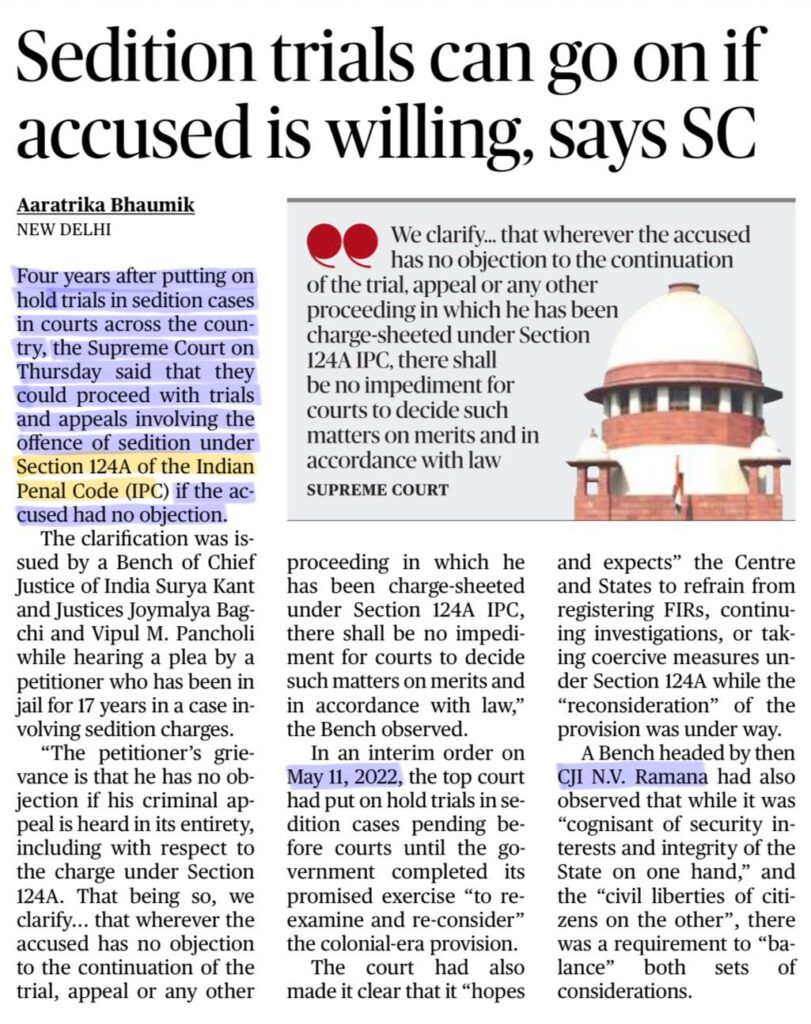
Context: The Supreme Court allowed continuation of sedition trials and appeals where the accused has no objection, while the constitutional validity and scope of the colonial-era sedition provision remain under reconsideration.
1. Sedition Framework
- Section 124A IPC (1870) criminalised disaffection, hatred or contempt against government
- Under Bharatiya Nyaya Sanhita (BNS), 2023, related offences now covered under Section 152
- Section 152 targets acts threatening sovereignty, unity and integrity of India through secession, armed rebellion or subversive activities
- Punishment may extend to life imprisonment
2. Supreme Court Position
- May 2022: Supreme Court kept Section 124A proceedings in abeyance after Centre agreed to reconsider the law
- Fresh FIRs and coercive action were discouraged during reconsideration process
- Present clarification: ongoing trials/appeals may proceed if accused does not object
3. Key Judgment — Kedar Nath Singh v. State of Bihar (1962)
- Five-judge Constitutional Bench upheld validity of sedition law
- Restricted application only to incitement to violence, public disorder or threat to State security
- Mere criticism of government or political dissent not sedition
4. Constitutional & Democratic Debate
- Article 19(1)(a): Freedom of speech and expression
- Article 19(2): Reasonable restrictions on sovereignty, security and public order
- Critics view sedition as a colonial-era provision prone to misuse against journalists, activists and opposition voices, raising concerns over free speech and democratic dissent