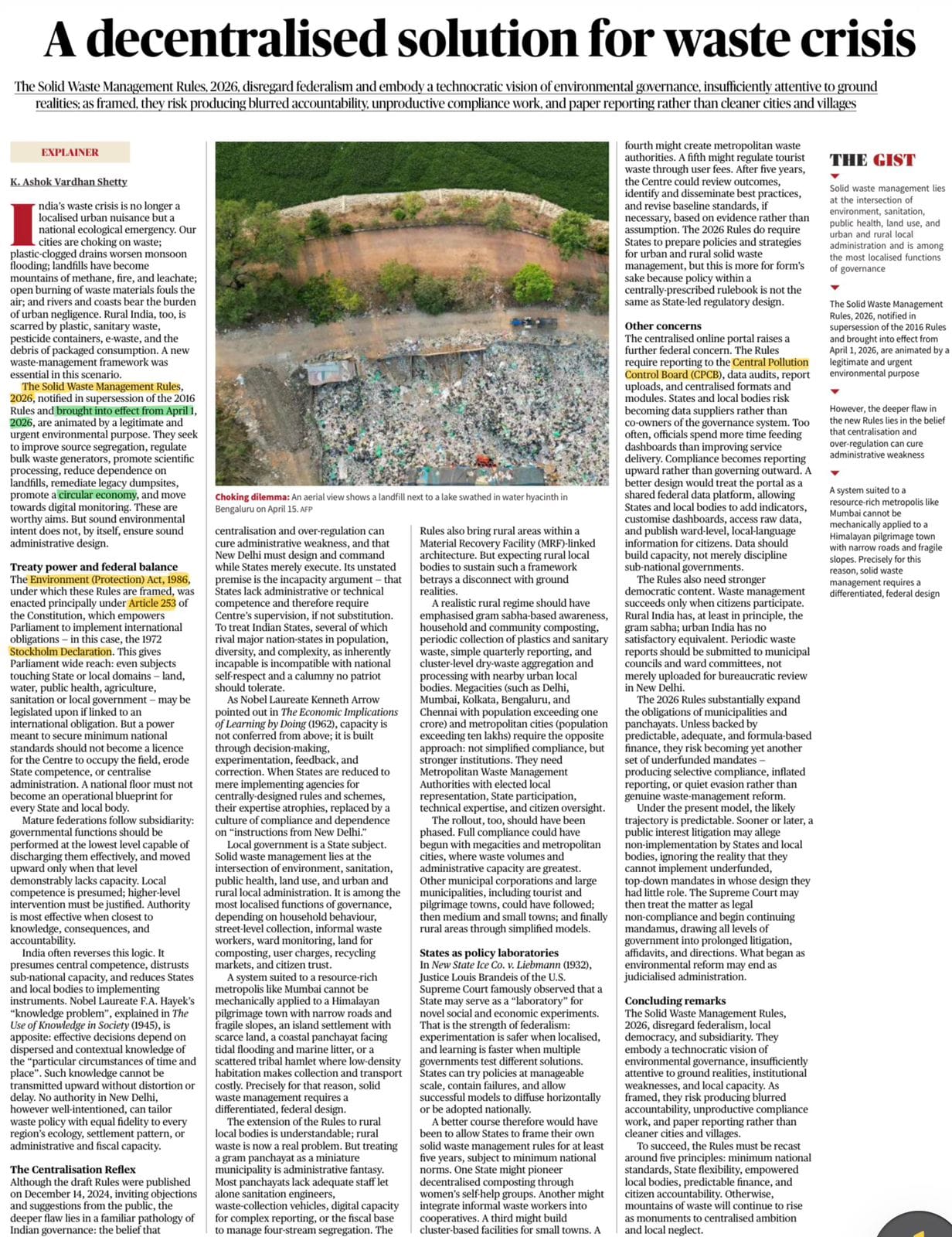
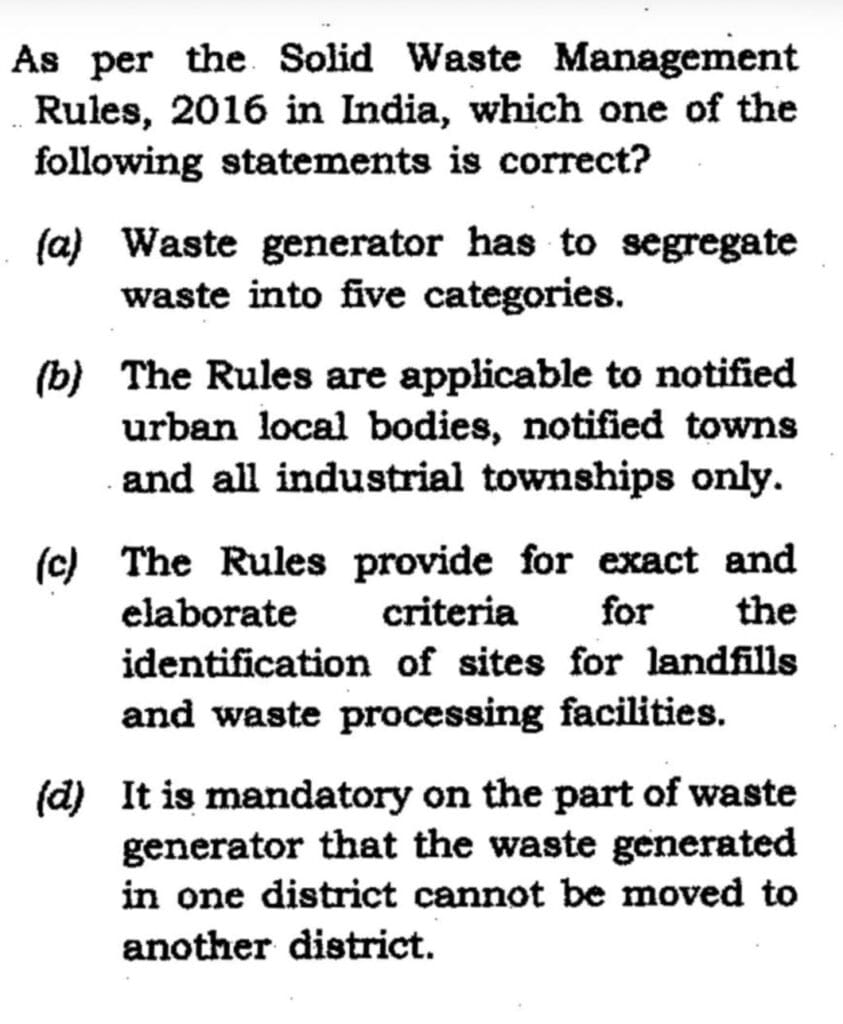
Context: Solid Waste Management Rules 2026
The Centre notified the Solid Waste Management Rules, 2026 replacing the 2016 Rules to strengthen scientific waste processing, recycling and circular economy practices amid rising urban and rural waste challenges.
Solid Waste Management Rules
Notified under Environment (Protection) Act, 1986.
Ministry: Ministry of Environment, Forest and Climate Change (MoEFCC).
Cover segregation, collection, recycling, composting, processing and scientific disposal of solid waste across urban and rural areas.
Major Improvements in SWM Rules, 2026
Greater emphasis on source segregation and scientific processing of waste.
Stronger focus on circular economy and reduction in landfill dependence.
Wider integration of rural waste management systems.
Expansion of Material Recovery Facility (MRF)-based recycling systems.
Improved compliance tracking through digital reporting and audits.
Enhanced monitoring role of CPCB.
Major Issues & Concerns
Excessive centralisation through centrally designed compliance systems, dashboards and audits may reduce flexibility for States and local bodies.
Uniform national standards may not suit diverse local realities such as Himalayan towns, coastal regions, megacities and rural panchayats.
Larger role of CPCB may weaken autonomy of State Pollution Control Boards and urban local bodies.
Heavy compliance and reporting requirements may increase paperwork instead of improving actual waste processing outcomes.
Rural local bodies may lack finances, technical manpower and digital infrastructure for implementation.
Greater dependence on digital systems may create implementation gaps in low-connectivity regions.
Concerns over inadequate consultation with States and local bodies before notification of Rules.
Compliance-heavy framework may burden smaller municipalities and gram panchayats disproportionately.
Weak clarity on financial support and capacity-building mechanisms for local institutions.
Constitutional, Legal & International Basis
Article 253 empowers Parliament to legislate for implementing international treaties and agreements.
Stockholm Declaration, 1972 laid foundation for modern environmental governance globally.
Environment (Protection) Act, 1986 enacted after Bhopal Gas Tragedy serves as India’s umbrella environmental legislation.
Principle of Subsidiarity: governance functions should be handled at the lowest effective level closest to citizens and local realities.