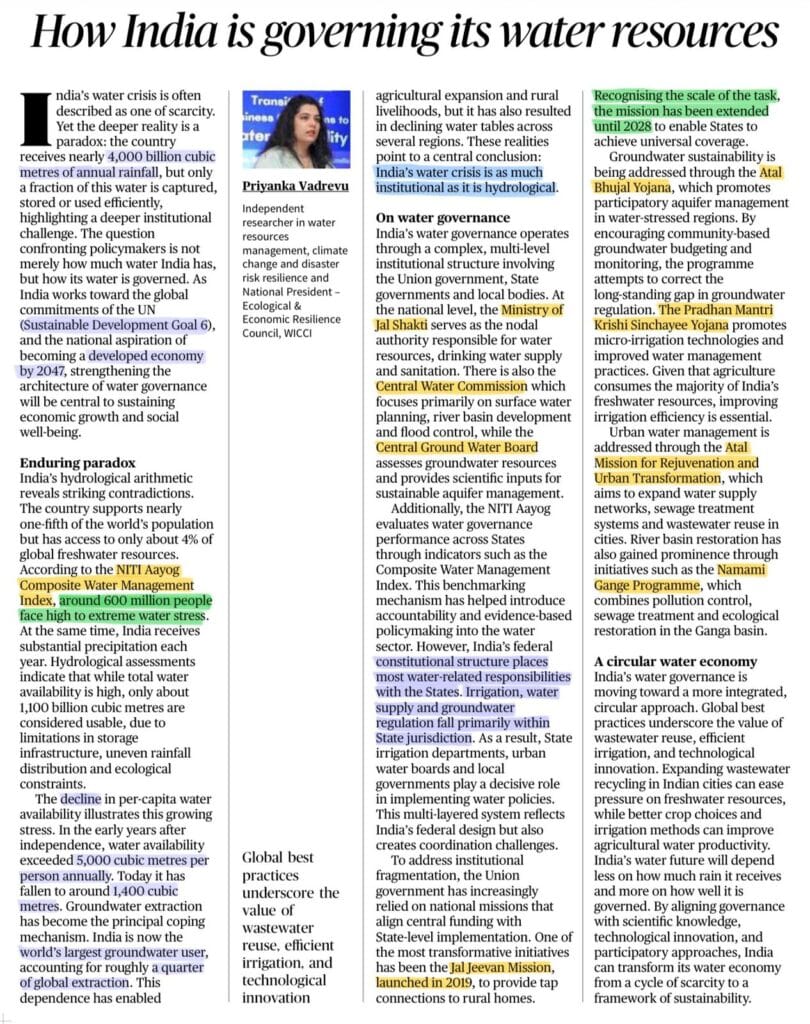
Context: Water Governance in India
India’s water crisis is increasingly seen as a governance and management challenge rather than only a scarcity issue. The article argues that long-term water security depends on efficient institutions, groundwater regulation, irrigation efficiency, wastewater reuse, and better Centre-State-local coordination.
Key Data
- India receives nearly 4,000 BCM of annual rainfall, but only around 1,100 BCM is utilisable due to runoff, evaporation, uneven distribution, and storage limitations.
- India has only about 4% of global freshwater resources despite supporting nearly 18% of world population.
- Around 600 million people face high to extreme water stress.
- Per capita water availability declined from over 5,000 cubic metres/year after Independence to nearly 1,400 cubic metres/year today.
- India is the world’s largest groundwater user, accounting for nearly 25% of global groundwater extraction.
Key Water Governance Institutions
- Ministry of Jal Shakti (2019) → Nodal ministry for water resources, drinking water, and sanitation.
- Central Water Commission (CWC) (1945)
- Surface water planning, flood control, river basin management.
- Not a statutory body.
- Central Ground Water Board (CGWB) (1970)
- Groundwater assessment and aquifer management.
- Not a statutory body.
Major Schemes
- Jal Jeevan Mission (JJM) (2019)
- Ministry: Ministry of Jal Shakti
- Aim: Functional tap water connection to every rural household.
- Atal Bhujal Yojana (ATAL JAL) (2019)
- Ministry: Ministry of Jal Shakti
- Aim: Community-led groundwater management in water-stressed areas.
- Ministry: Ministry of Agriculture & Farmers Welfare
- Aim: Irrigation efficiency and “Per Drop More Crop”.
- Ministry: Ministry of Housing & Urban Affairs
- Aim: Urban water supply, sewerage, and wastewater treatment.
- Namami Gange Programme (2014)
- Ministry: Ministry of Jal Shakti / National Mission for Clean Ganga (NMCG)
- Aim: Pollution control and rejuvenation of River Ganga.