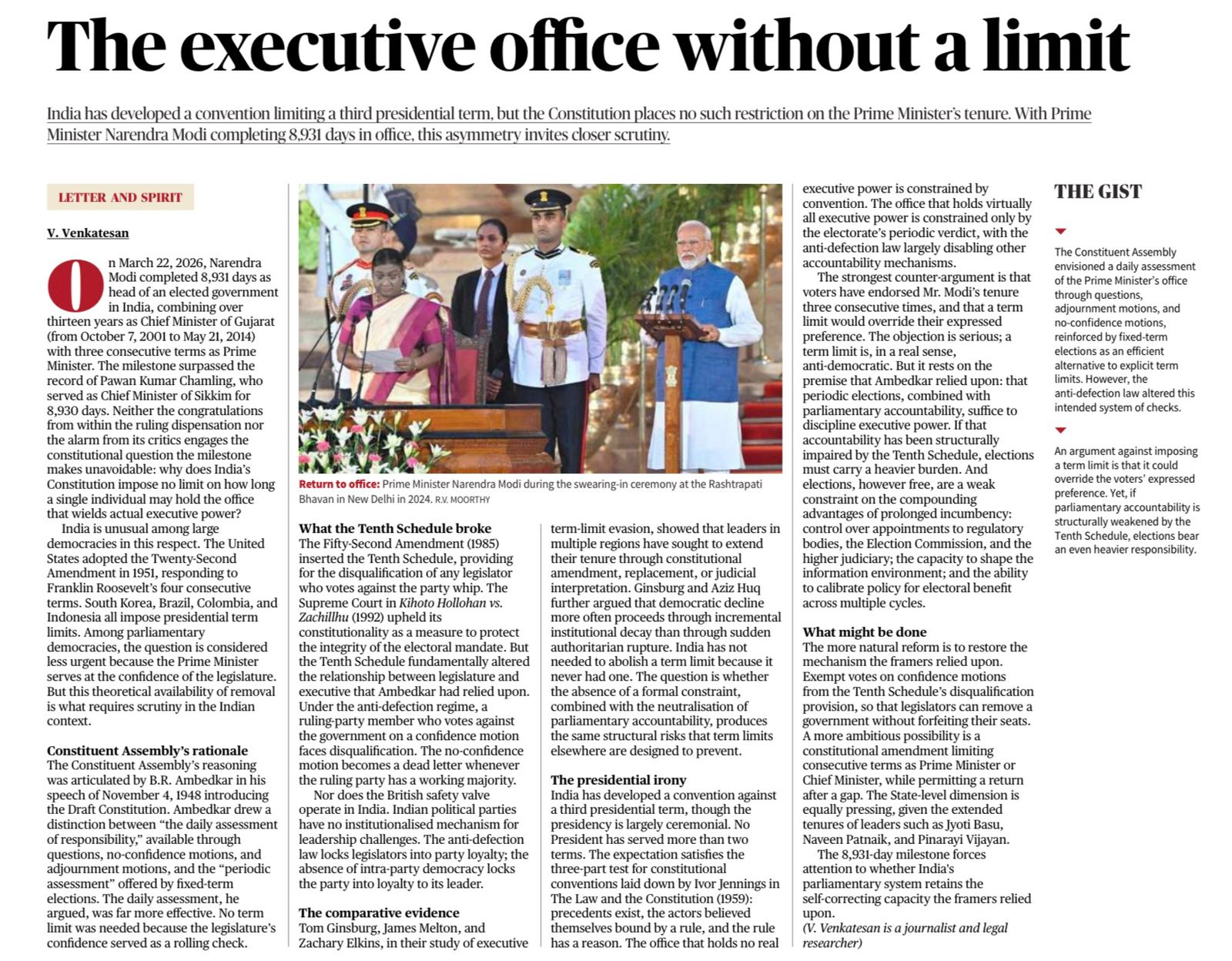
India has no constitutional limit on the Prime Minister’s tenure; with weakening institutional checks, long incumbency raises concerns of concentrated executive power.
Core Argument
No term limit works only if Parliament + elections act as strong checks, but these checks have weakened, making prolonged tenure a concern.
Key Points
No term limit for PM → unlike many countries; only an informal limit exists for President.
Original safeguard (Ambedkar’s view) → accountability through Parliament (questions, no-confidence) + elections.
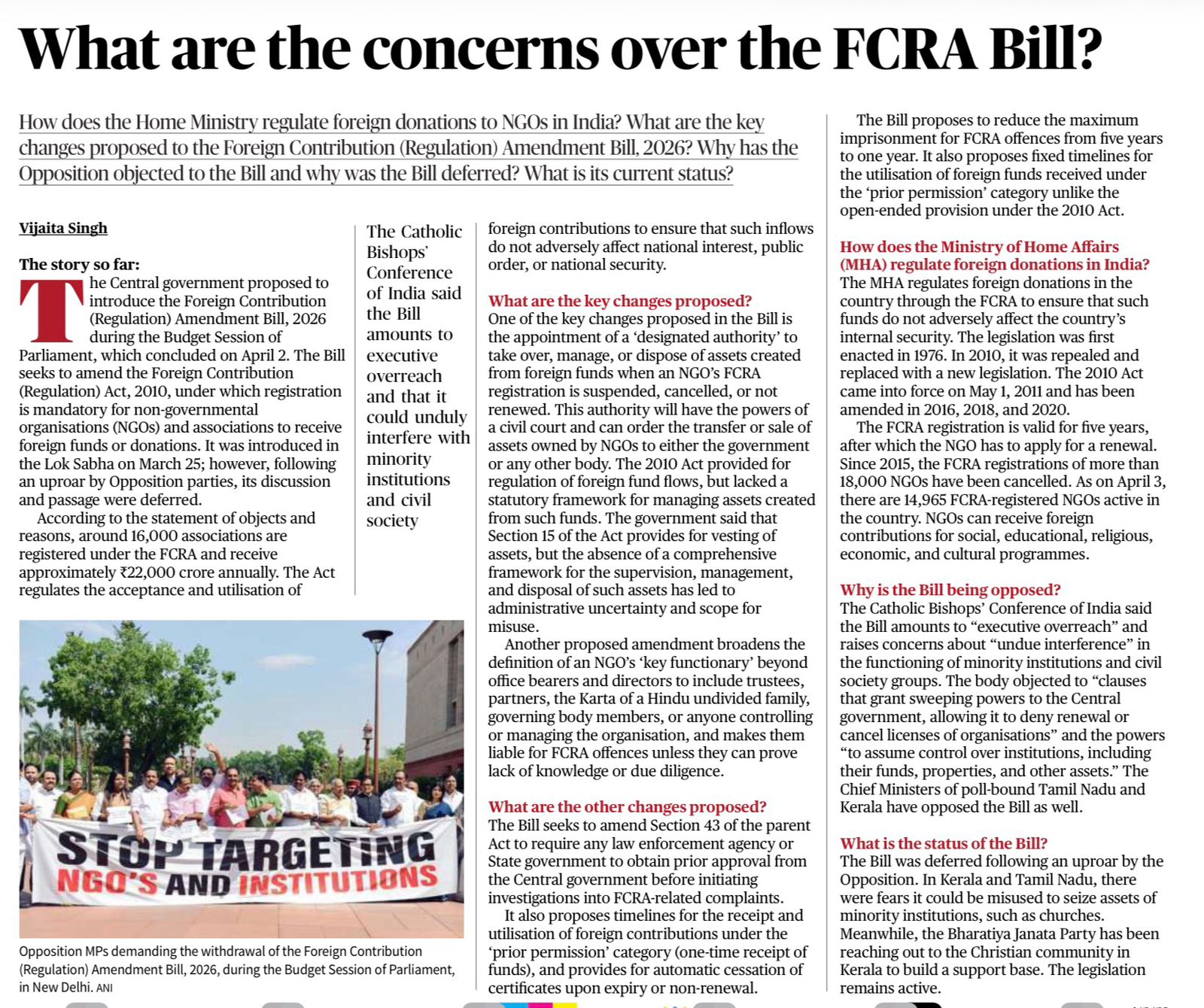
The Union government proposed the Foreign Contribution (Regulation) Amendment Bill, 2026 to tighten regulation of foreign funding to NGOs under the existing Foreign Contribution (Regulation) Act, 2010, but the Bill was deferred after opposition over concerns of excessive state control.
Key Changes in FCRA Amendment
Creation of a designated authority A new authority can take over, manage or dispose of assets created from foreign funds when an NGO’s registration is suspended or cancelled.
Expanded definition of key functionary Now includes trustees, partners, governing body members and anyone controlling the organisation, making them liable for violations.
Prior approval for investigations Any law enforcement agency or State government must take Central government approval before initiating FCRA-related investigations.
Fixed timelines for fund utilisation Foreign funds under “prior permission” must be used within specified timelines, unlike earlier open-ended use.
Reduced punishment Maximum imprisonment reduced from 5 years to 1 year for offences.
Good Aspects
Better accountability of foreign funds Stronger monitoring ensures funds are used for intended purposes and do not affect national security.
Clarity in asset management Earlier, there was no clear framework for handling NGO assets after licence cancellation → new authority fills this gap.
Defined responsibility Expanding “key functionary” ensures no one escapes liability within NGO management.
Time-bound utilisation of funds Prevents misuse or indefinite parking of foreign contributions.
Regulatory tightening for security concerns Helps government track foreign influence in sensitive sectors.
Concerns / Issues
Excessive centralisation of power Government can take control of NGO assets and operations, raising fear of misuse.
Impact on civil society and NGOs Broad definition of functionaries may discourage participation and increase compliance burden.
Restriction on federal structure States and agencies need Central approval for investigation, limiting autonomy.
Risk to minority institutions Concerns that powers can be used to target minority-run organisations.
Reduced deterrence Lower punishment may weaken seriousness of violations.
Discretionary powers in licence renewal/cancellation Government gets wider authority to deny or cancel registration, increasing uncertainty.
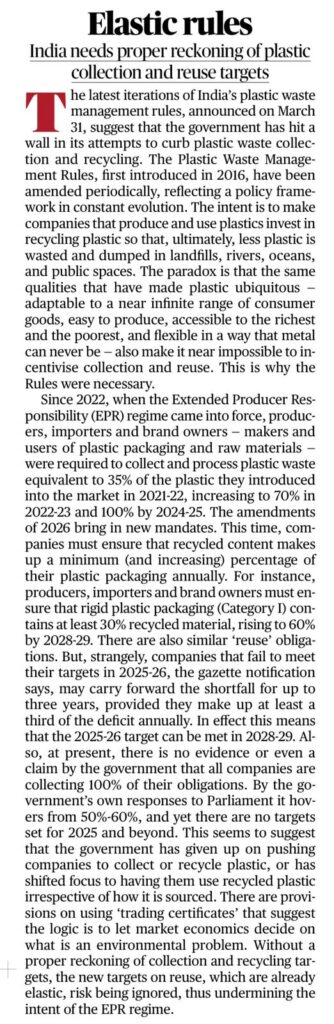
The recent amendment to India’s plastic waste framework indicates a shift from strict enforcement of waste collection to a more flexible, compliance-based system, raising concerns about actual outcomes.
The Plastic Waste Management Rules, 2016
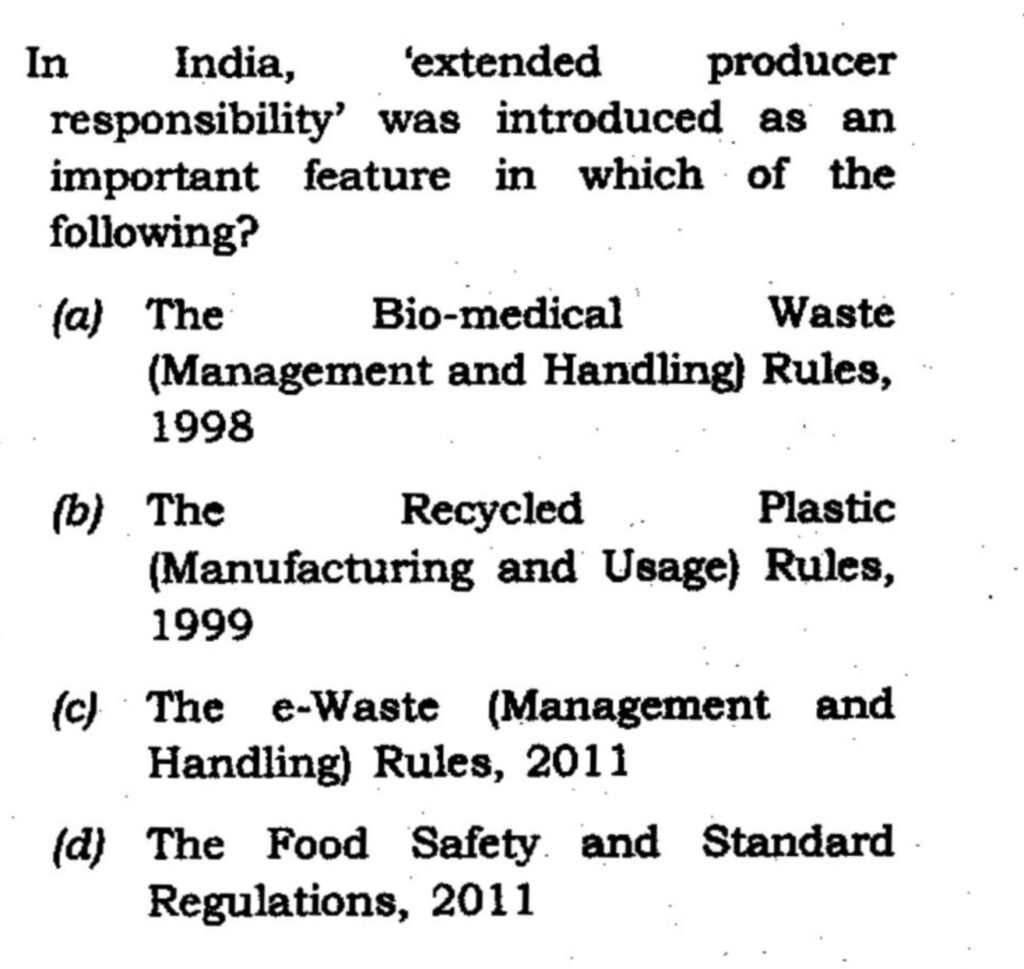
Foundation: Extended Producer Responsibility Producers, importers and brand owners are legally responsible to collect and process plastic waste equivalent to what they introduce.
Primary focus: Physical waste management Emphasis on actual collection, recycling and safe disposal, to prevent plastic leakage into environment.
Time-bound escalating targets • 35% (2021-22) → 70% (2022-23) → 100% (2024-25) Aim: Achieve full accountability in a phased manner.
Compliance philosophy: Direct and strict Responsibility was non-transferable and outcome-based → companies had to create real collection systems.
The Plastic Waste Management Rules, 2026 Amendment
Shift in focus: From collection to recycled content Mandates use of recycled plastic in packaging: • 30% initially → 60% by 2028-29 Focus moves to input composition rather than waste recovery.
Flexible compliance mechanism introduced • Shortfall allowed to be carried forward for 3 years • Only one-third gap needs annual correction → Reduces immediacy of compliance.
Dilution of timelines Targets meant for 2025-26 effectively extend to 2028-29, weakening enforcement pressure.
Market-based compliance tools Introduction of trading certificates → obligations can be met indirectly through market exchange.
Lack of forward clarity No defined targets beyond 2025-26, creating uncertainty in long-term waste management strategy.
Ground Reality (Critical Gap)
Actual collection remains limited Only about 50%-60% of plastic waste is being processed against targets.
No evidence of full compliance Even as 100% target approaches, no confirmation of achievement.
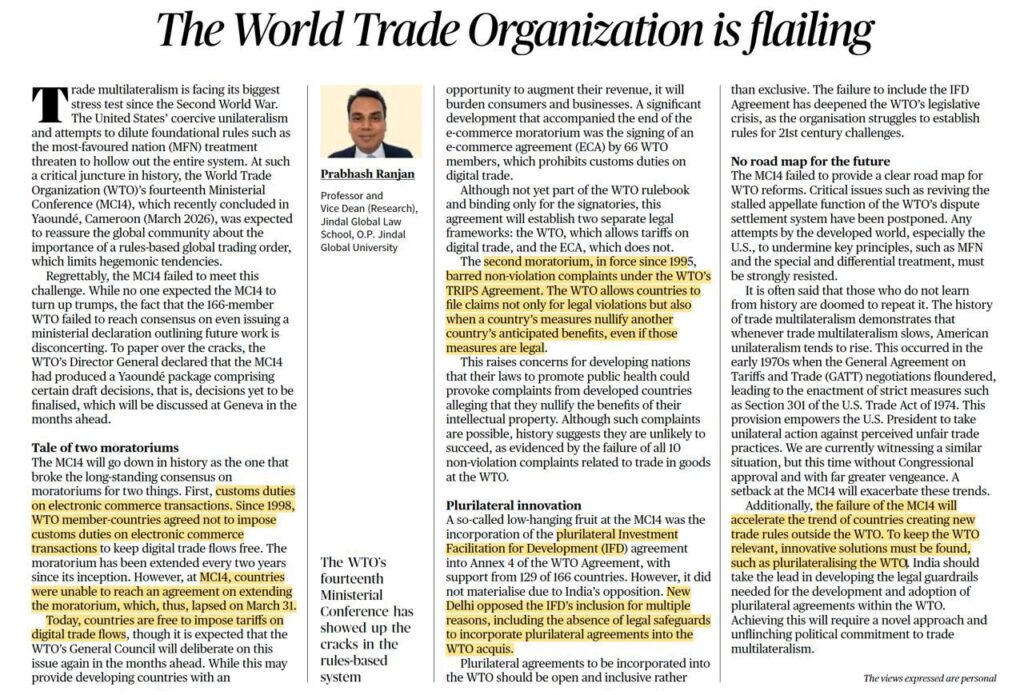
The World Trade Organization is under stress after its 14th Ministerial Conference failed to deliver consensus, showing weakening of the rules-based global trade system.
Key Issues
Breakdown of two important moratoriums • E-commerce moratorium (1998): No customs duties on digital trade → now lapsed → countries can impose tariffs, increasing costs and fragmenting digital trade. • TRIPS (Trade-Related Aspects of Intellectual Property Rights) non-violation moratorium (1995): Earlier, countries could not file complaints without rule violation → weakening of this protection allows disputes even when policies are legally valid → risk for developing countries.
Dispute settlement system not working • WTO’s appellate body is non-functional → no final dispute resolution. • Result: Rules exist but enforcement is weak.
Rise of plurilateral approach • Push for Investment Facilitation for Development (IFD) agreement. • Issue: Not supported by all members → breaks consensus-based system. • Concern: WTO shifting from inclusive multilateralism → selective rule-making.
Increasing unilateral actions • Major economies taking independent trade measures. • Undermines core principles like Most Favoured Nation (MFN).
No clear reform direction • No roadmap on dispute settlement revival or institutional reforms. • Issues like special and differential treatment for developing countries remain unresolved.
Declining relevance of WTO • Countries increasingly relying on regional and bilateral trade agreements. • WTO’s central role in global trade governance weakening.
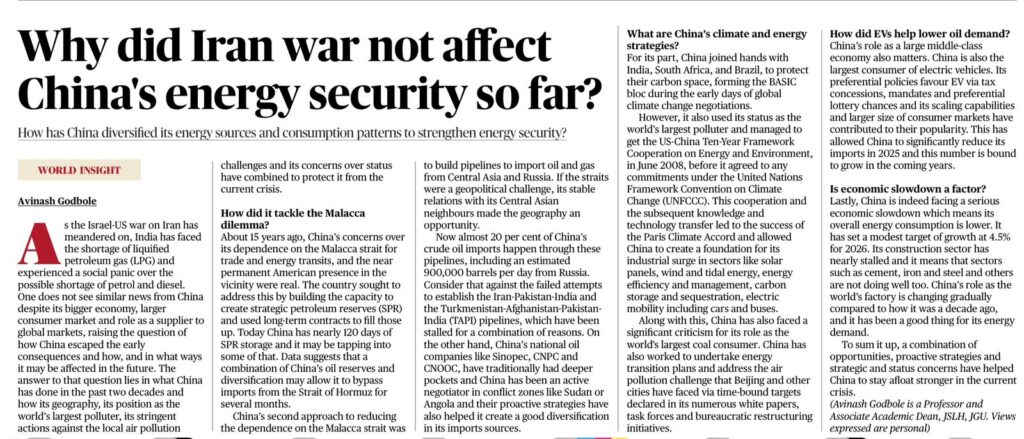
West Asia tensions and risks around the Strait of Hormuz did not significantly disrupt China because it had already strengthened its energy system through diversification, secure supply mechanisms, and reduced demand pressure.
China energy security strategy
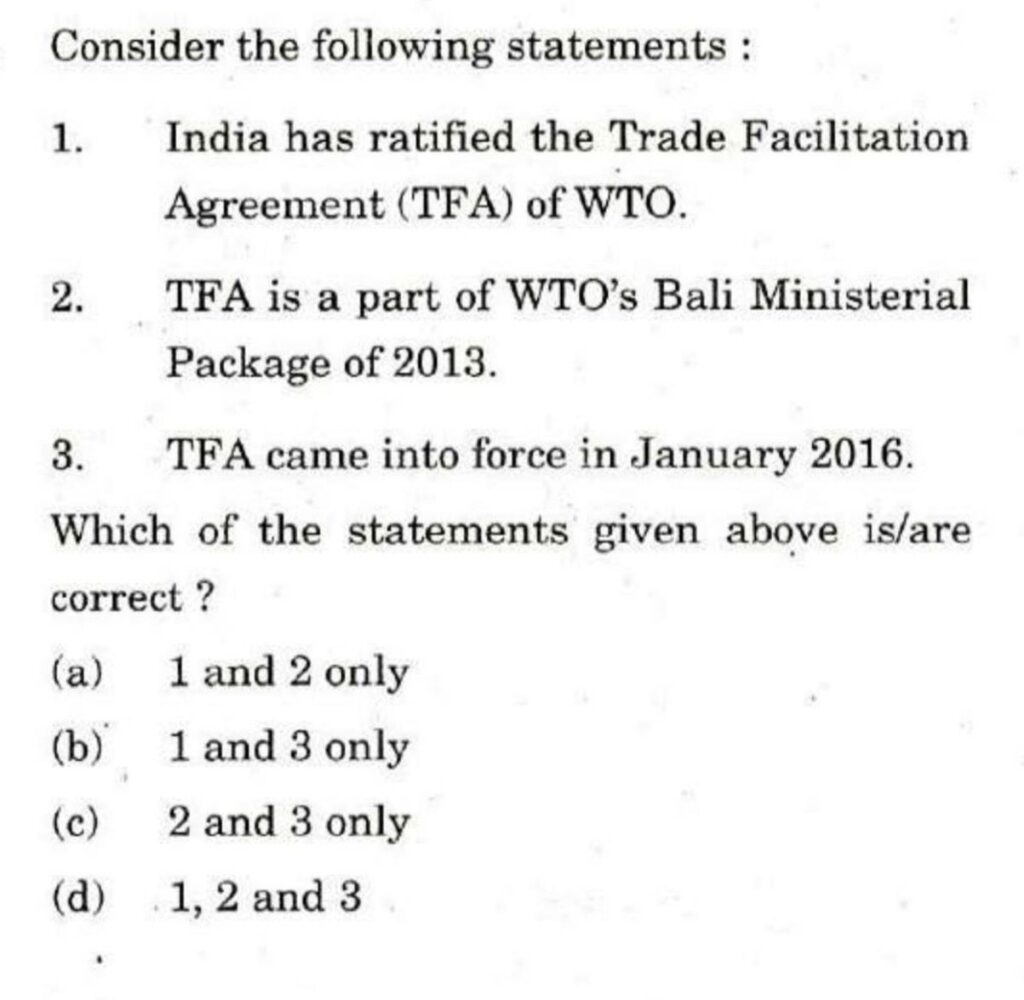
PYQ – 2023, Ans – A
1. Diversification and supply security
Geographical spread of imports: China sources oil from Russia, Central Asia, and Africa, reducing reliance on West Asia.
Pipeline-based imports: Land pipelines from Russia and Central Asia carry a significant share of crude, avoiding maritime chokepoints.
Strategic petroleum reserves: Around 120 days of storage provides a buffer during global supply disruptions.
Long-term contracts by state companies: CNPC, Sinopec, and CNOOC secure stable supplies through long-duration agreements.
Overseas oil asset investments: Ownership stakes in oil fields abroad ensure partial control over production and supply chains.
2. Demand management
Expansion of electric vehicles: Large EV adoption reduces oil consumption, especially in transport.
Renewable energy growth: Increased use of solar and wind energy lowers dependence on fossil fuels.
Energy efficiency measures: Industrial and urban policies reduce overall energy intensity.
Slower economic growth: Moderation in industrial sectors like steel and construction reduces incremental energy demand.
A Platform OF The Students For The Students By The Students