30 Jan 2026 | Daily Current Affairs

UNSC Resolution 2803 and India’s Stand on Gaza Conflict

Context
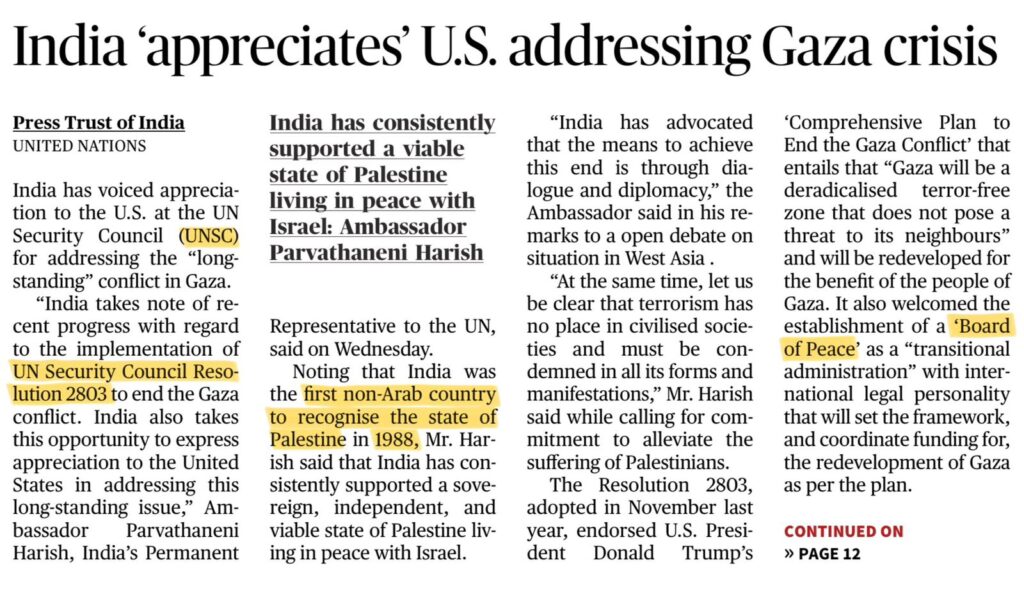
India welcomed recent U.S. moves at the United Nations Security Council (UNSC) to address the Gaza conflict and noted progress under UNSC Resolution 2803.

UNSC Resolution 2803
• Adopted: November 2023
• Aim:
• End Gaza conflict
• Create a terror-free, de-radicalised zone
• Ensure redevelopment
• Coordinate international support
• Includes creation of a “Board of Peace” as a transitional administration

India’s position on Palestine
• First non-Arab country to recognise the State of Palestine (1988)
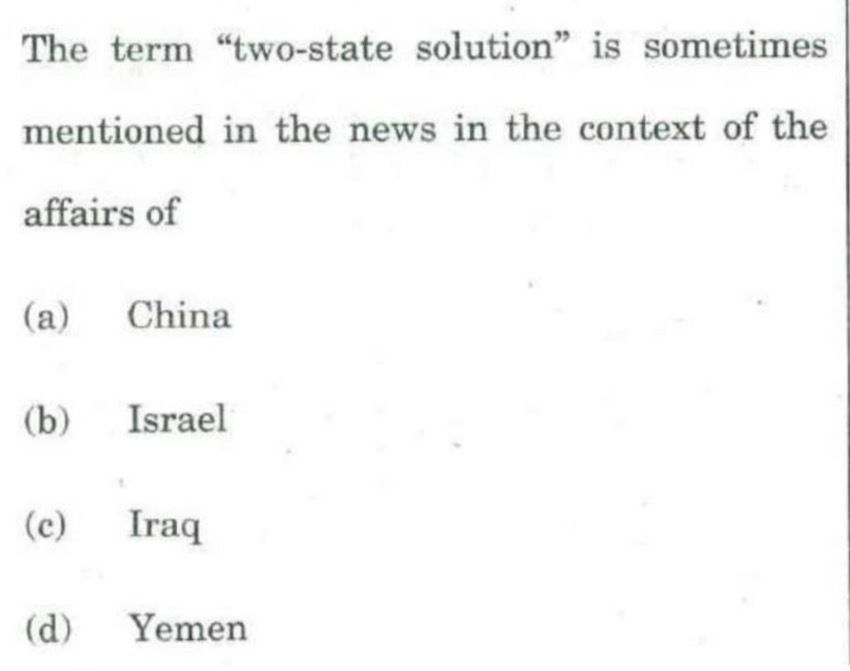
• Supports a sovereign, independent and viable Palestine living in peace with Israel

Arab Peace Initiative
• Proposed by Saudi Arabia (2002)
• Core idea:
• Two-state solution
• Full normalisation with Israel if it withdraws to pre-1967 borders
• East Jerusalem as capital of Palestine
UNSC Resolution 2803
PYQ – 2023, Ans – C
PYQ – 2018, Ans – B

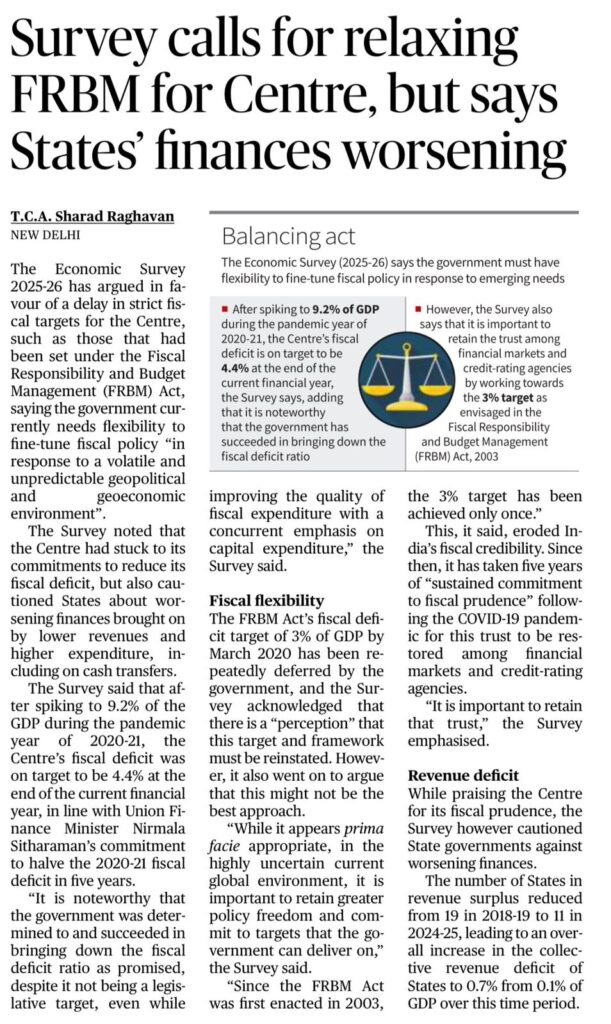
FRBM Act Review: Centre Flexibility and States’ Fiscal Stress

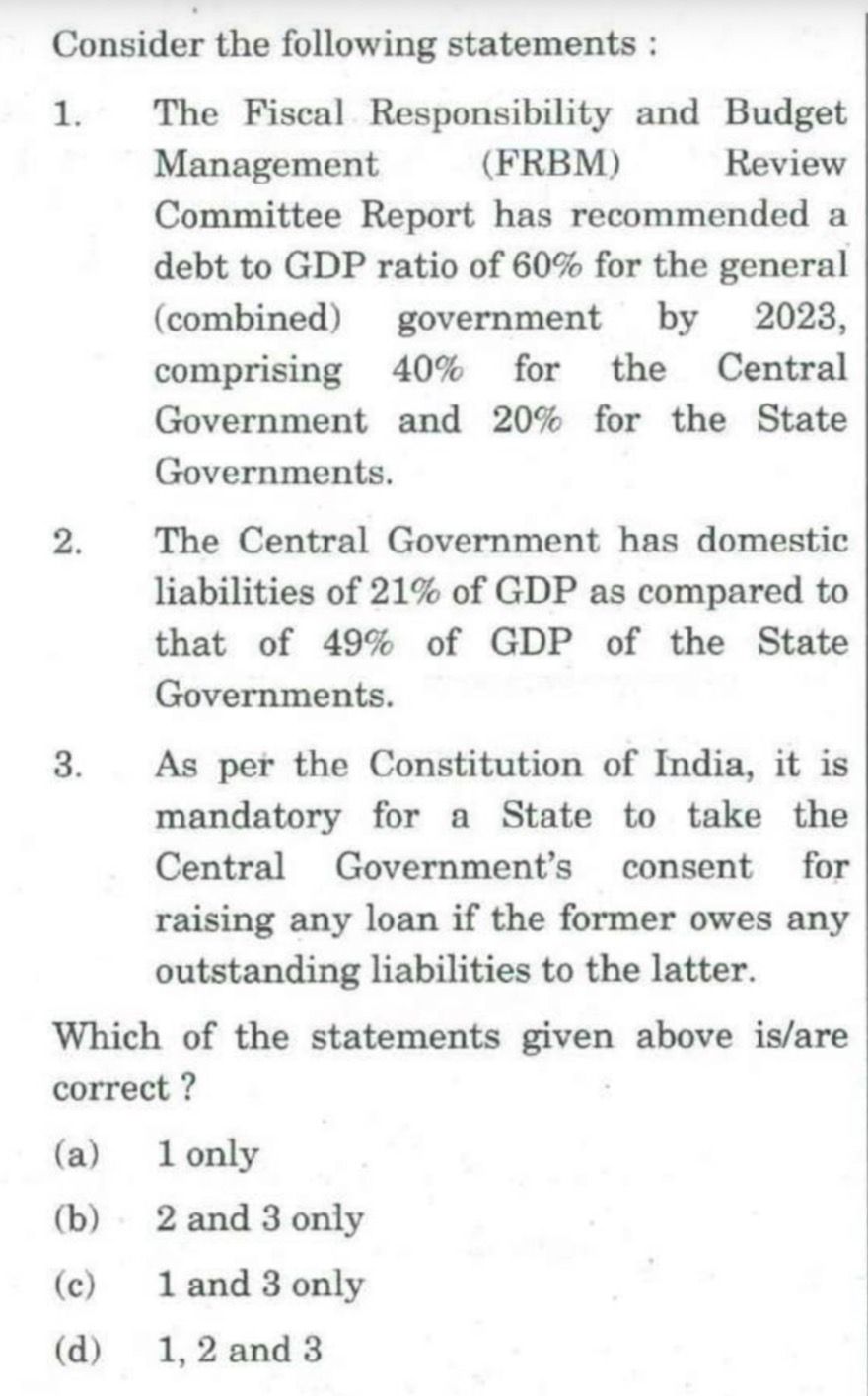
FRBM Act
Fiscal Responsibility and Budget Management Act, 2003 aims to ensure fiscal discipline by:
• Reducing fiscal deficit, revenue deficit and public debt
• Increasing transparency in fiscal operations
• Promoting long-term macroeconomic stability

Escape Clause (FRBM)
Allows temporary deviation from fiscal targets during severe shocks such as:
• National calamity
• National security threats
• Large structural reforms
• Sharp economic slowdown

During COVID-19
• Government invoked the escape clause
• Significant deviation from FRBM targets due to extraordinary conditions

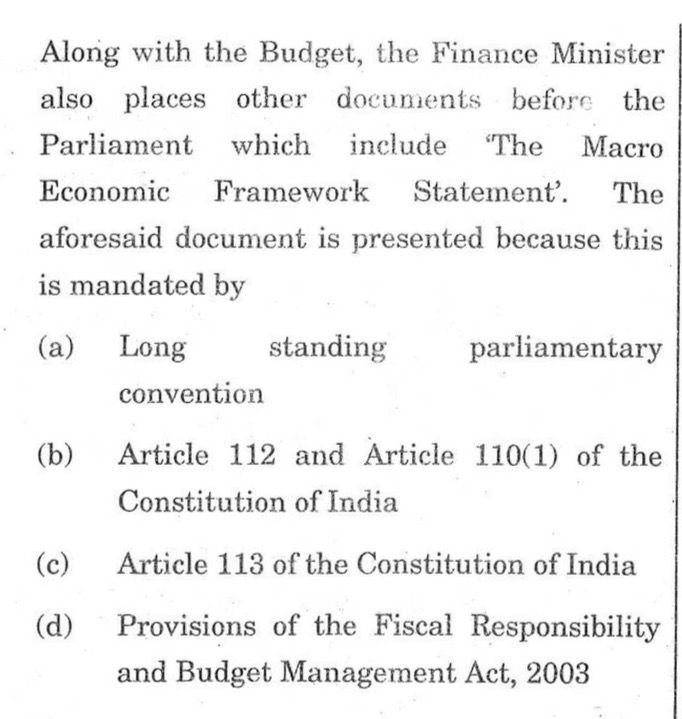
Documents presented with the Budget (FRBM)

  1. Medium-Term Fiscal Policy (MTFP) Statement
  2. Fiscal Policy Strategy (FPS) Statement
  3. Macro-Economic Framework (MEF) Statement
  4. Medium-Term Expenditure Framework (MTEF) Statement (tabled later)
FRBM Act
FRBM Act
PYQ – 2020, Ans – D
PYQ – 2018, Ans – C

Ethanol Blending and Its Impact on India’s Food Security

Context
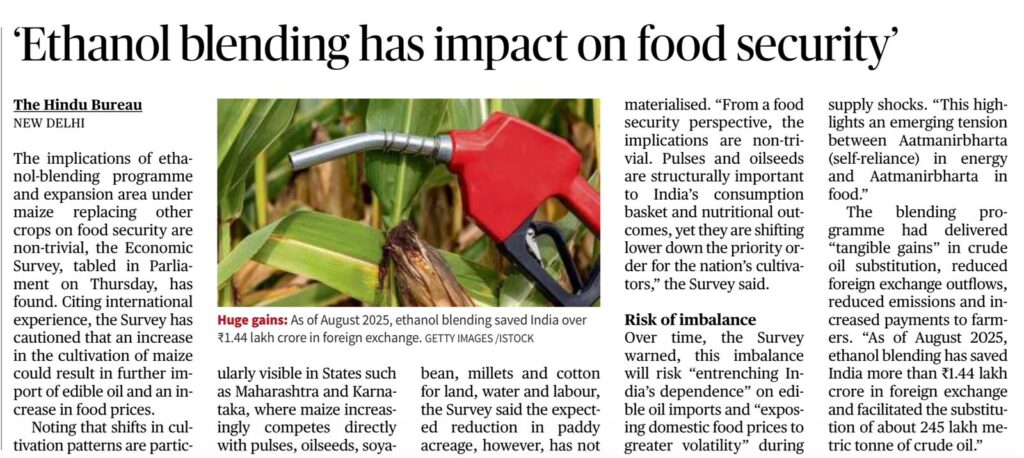
Economic Survey flags that expansion of ethanol blending—especially maize-based ethanol—is affecting food security.

Critical points
• Shift towards maize cultivation driven by ethanol demand
• Reduction in area under pulses and oilseeds
• Increased dependence on edible-oil imports
• Higher domestic food-price volatility
• Greater vulnerability during supply shocks
• Tension between energy self-reliance (ethanol) and food self-reliance

Ethanol blending gains (till Aug 2025)
• Forex savings: ₹1.44 lakh crore
• Crude oil substituted: ~245 lakh tonnes

Basics of ethanol
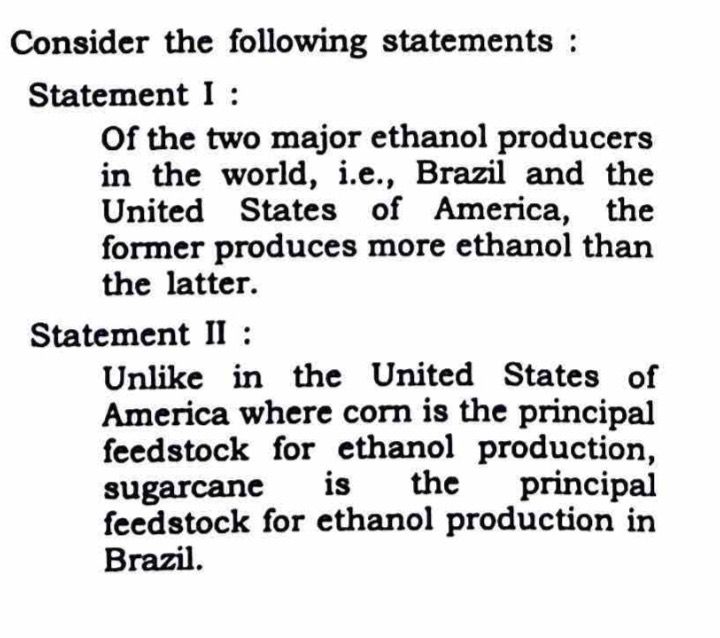
• Biofuel (alcohol) used for blending with petrol
• Produced via fermentation of biomass (sugar/starch-based)
• Blending reduces crude-oil imports and emissions

Ethanol Blending
PYQ – 2025, Ans – D

Oil Import Diversification to Reduce India’s Geopolitical Risks

Context
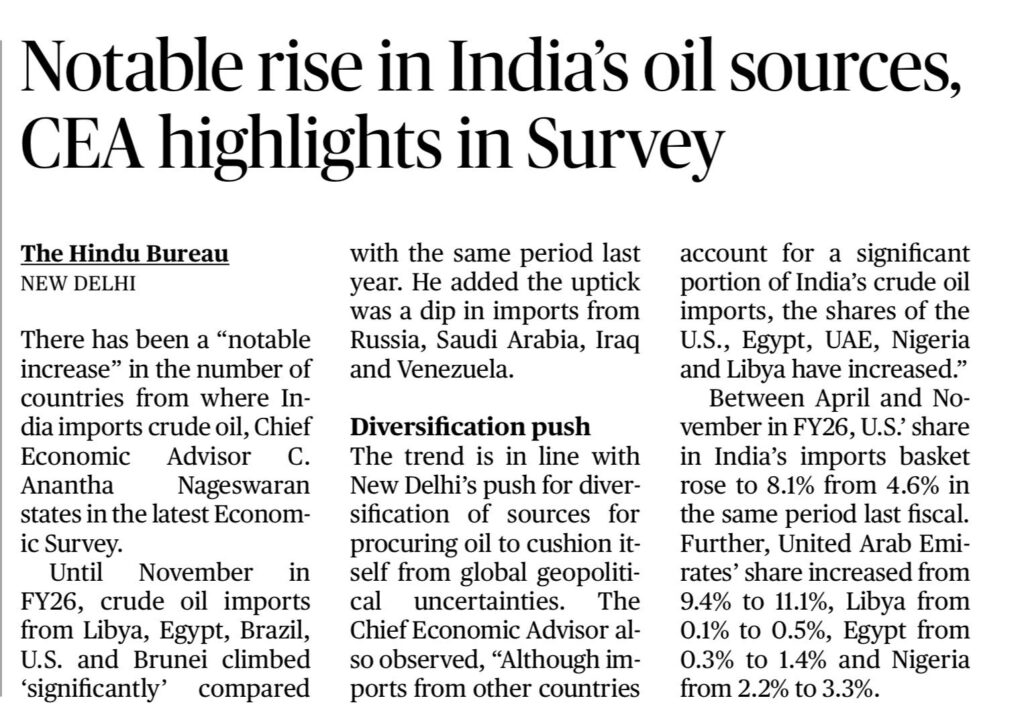
Economic Survey (FY26) notes that India is diversifying crude-oil import sources to reduce geopolitical risk exposure.

Key facts
• Rising imports from: Libya, Egypt, Brazil, U.S., Brunei
• Declining imports from: Russia, Saudi Arabia, Iraq, Venezuela

Import-share changes (Apr–Nov FY26 vs previous year)
• U.S.: 4.6% → 8.1%
• UAE: 9.4% → 11.1%
• Libya: 0.1% → 0.5%
• Egypt: 0.3% → 1.4%
• Nigeria: 2.2% → 3.3%

Oil Import Diversification

Economic Survey 2025-26: India Growth Outlook and Global Risks

Economic Survey 2025-26: Growth Outlook
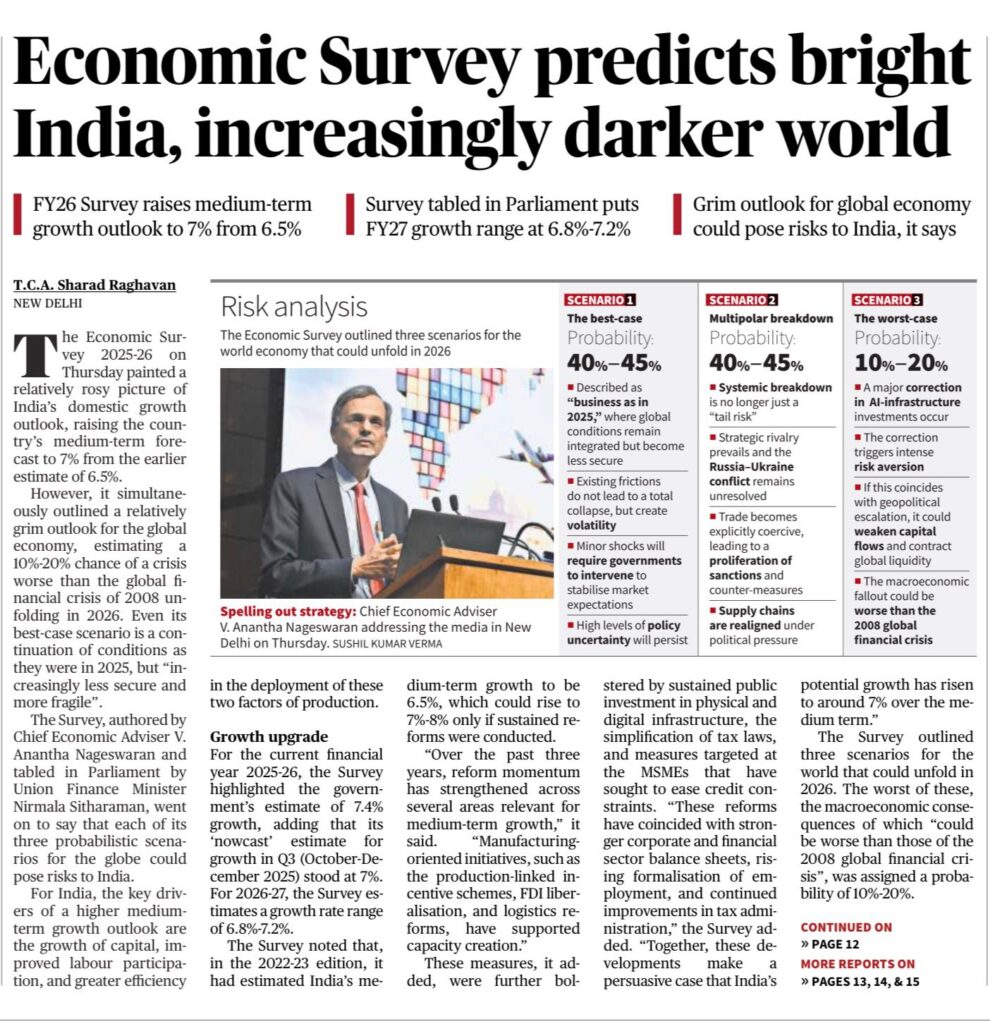
• FY26 (2025-26): Medium-term growth forecast raised to 7%
• FY27 (2026-27): Growth projected between 6.8% – 7.2%

Three global scenarios for 2026

Scenario 1 – Best case (40–45%)
• Business as usual
• Global tensions ease somewhat
• Volatility persists
• Government interventions stabilise markets

Scenario 2 – Multipolar breakdown (40–45%)
• Geopolitical rifts persist
• Trade conflicts and counter-sanctions
• Supply-chain realignments
• Prolonged uncertainty

Scenario 3 – Worst case (10–20%)
• Major global correction, especially in AI-infrastructure investments
• Spike in risk aversion
• Macro fallout worse than the 2008 crisis

Economic Survey 2025-26
About the UPSC Civil Services Examination (UPSC CSE)

The UPSC Civil Services Examination (CSE) is one of the most competitive and esteemed examinations in India, conducted by the Union Public Service Commission to recruit officers for services such as the Indian Administrative Service (IAS), Indian Police Service (IPS), Indian Foreign Service (IFS), and others. The exam comprises three stages — Prelims, Mains, and the Personality Test (Interview) — designed to test a candidate’s knowledge, aptitude, decision-making, and leadership skills.


How to Prepare Effectively for UPSC CSE

Cracking the UPSC CSE requires a deep understanding of the syllabus, consistent revision, structured answer writing, and smart test-taking strategies. The Prelims test analytical and conceptual clarity, the Mains focuses on critical thinking, articulation, and subject mastery, while the Interview assesses presence of mind, ethical judgment, and personality traits relevant to public service.

At UnderStand UPSC, we empower aspirants with a personalized and focused approach to each stage of the exam.


Why Choose UnderStand UPSC?

UnderStand UPSC is a mentorship-driven platform offering a clear, clutter-free strategy to tackle the Civil Services Examination. Our programs like Transform (for beginners and intermediate learners) and Conquer (for advanced mains preparation) provide structured study plans, syllabus-wise video content, interactive live sessions, and answer writing support.

We emphasize:

  • Concept clarity through topic-wise lectures

  • Test series designed around real UPSC standards

  • Personalized mentorship in small groups

  • Regular performance tracking and peer benchmarking

  • Doubt-clearing sessions, current affairs analysis, and monthly magazines


Join the UnderStand UPSC Learning Community

Our mission is to make UPSC preparation less overwhelming and more strategic. We combine mentorship, discipline, and academic rigor to help you clear CSE with confidence. Whether you’re preparing from Delhi, Mumbai, Bangalore, or a remote village — our online-first model ensures quality guidance reaches every corner of India.

Join the thousands of aspirants who trust UnderStand UPSC to guide their journey toward becoming civil servants.

Stay connected with us through our Telegram, YouTube, and Instagram channels for daily tips, strategies, and updates.

Copyright © 2026 USARAMBHA EDUCATION (UnderStand UPSC). All Rights Reserved.

Join the Success Journey!