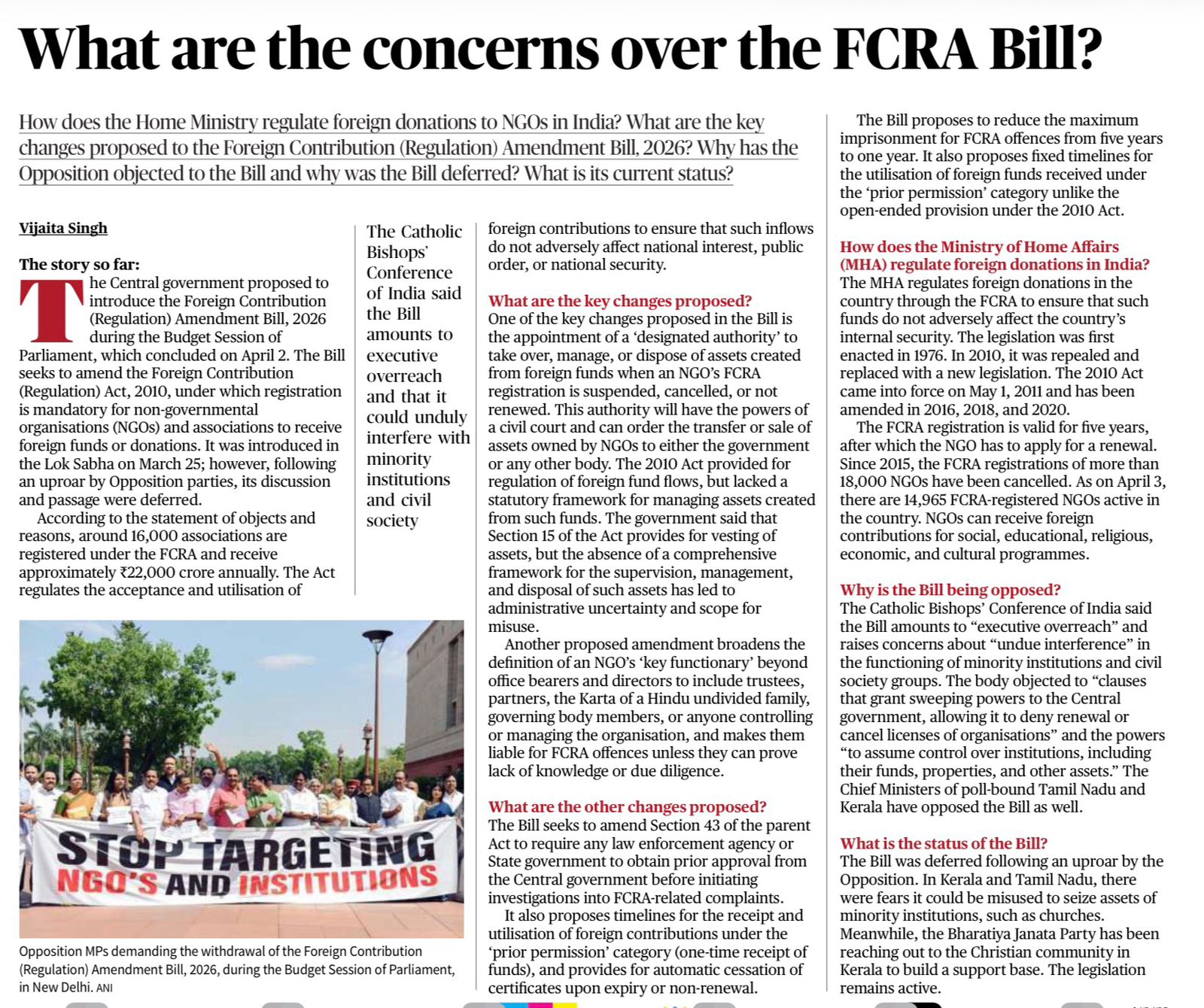
Context: FCRA Amendment Bill 2026
The Union government proposed the Foreign Contribution (Regulation) Amendment Bill, 2026 to tighten regulation of foreign funding to NGOs under the existing Foreign Contribution (Regulation) Act, 2010, but the Bill was deferred after opposition over concerns of excessive state control.
Key Changes in FCRA Amendment
- Creation of a designated authority
A new authority can take over, manage or dispose of assets created from foreign funds when an NGO’s registration is suspended or cancelled. - Expanded definition of key functionary
Now includes trustees, partners, governing body members and anyone controlling the organisation, making them liable for violations. - Prior approval for investigations
Any law enforcement agency or State government must take Central government approval before initiating FCRA-related investigations. - Fixed timelines for fund utilisation
Foreign funds under “prior permission” must be used within specified timelines, unlike earlier open-ended use. - Reduced punishment
Maximum imprisonment reduced from 5 years to 1 year for offences.
Good Aspects
- Better accountability of foreign funds
Stronger monitoring ensures funds are used for intended purposes and do not affect national security. - Clarity in asset management
Earlier, there was no clear framework for handling NGO assets after licence cancellation → new authority fills this gap. - Defined responsibility
Expanding “key functionary” ensures no one escapes liability within NGO management. - Time-bound utilisation of funds
Prevents misuse or indefinite parking of foreign contributions. - Regulatory tightening for security concerns
Helps government track foreign influence in sensitive sectors.
Concerns / Issues
- Excessive centralisation of power
Government can take control of NGO assets and operations, raising fear of misuse. - Impact on civil society and NGOs
Broad definition of functionaries may discourage participation and increase compliance burden. - Restriction on federal structure
States and agencies need Central approval for investigation, limiting autonomy. - Risk to minority institutions
Concerns that powers can be used to target minority-run organisations. - Reduced deterrence
Lower punishment may weaken seriousness of violations. - Discretionary powers in licence renewal/cancellation
Government gets wider authority to deny or cancel registration, increasing uncertainty.