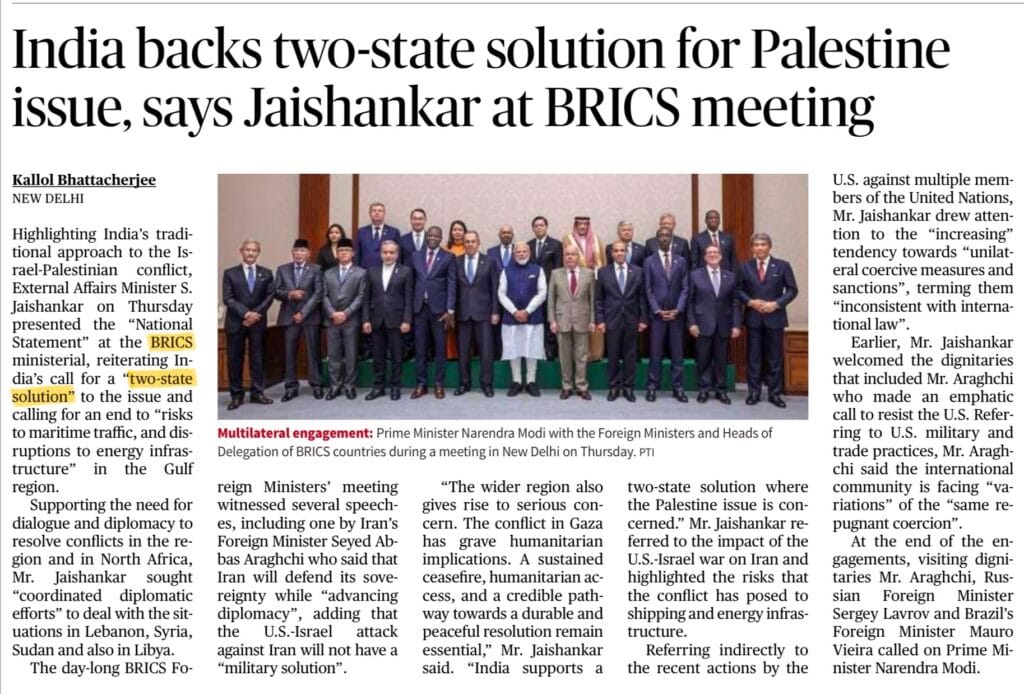
Context: Two-State Solution
At the BRICS Foreign Ministers’ meeting, External Affairs Minister S. Jaishankar reiterated India’s support for a two-state solution on Palestine, raised concerns over the West Asia crisis and criticised unilateral sanctions outside the UN framework.
Key Takeaways
Two-State Solution
- Supports an independent Palestine coexisting peacefully with Israel within secure, internationally recognised borders.
- East Jerusalem is often proposed as the Palestinian capital.
- India backed dialogue-based resolution of the conflict.
Gaza & West Asia Crisis
- BRICS expressed concern over the humanitarian crisis in Gaza and instability in West Asia.
- It called for ceasefire and humanitarian access.
Opposition to Unilateral Sanctions
- India criticised non-UN sanctions.
- Such sanctions were described as inconsistent with the UN Charter and harmful for developing countries and global trade.
Related UN Charter Provisions
- Article 2(1): Sovereign equality of states
- Article 2(4): Non-use of coercion
- Article 41: UNSC authorises sanctions
Energy & Maritime Security
- India highlighted risks to Strait of Hormuz shipping, oil supply chains and energy infrastructure due to the conflict.
Russian Oil & Multilateralism
- India defended Russian oil imports on energy-security grounds.
- It stressed diplomacy, dialogue and multipolar global governance.