6 Dec, 2025

Cheaper loans likely as repo rate cut by 25 bps

Context

• RBI’s MPC cut the repo rate by 25 bps to 5.25%.
• Driven by strong GDP growth (8.2% in Q2) and sharp fall in inflation (1.7%).
• Indicates shift towards easing borrowing costs.

Reasons for Rate Cut

1. Inflation well below target
• Inflation down to 1.7%, below RBI’s 4% target.
• Allowed policy easing without risking stability.

2. Robust economic growth
• GDP at 8.2%, showing momentum.
• Rate cut to sustain growth and make loans cheaper.

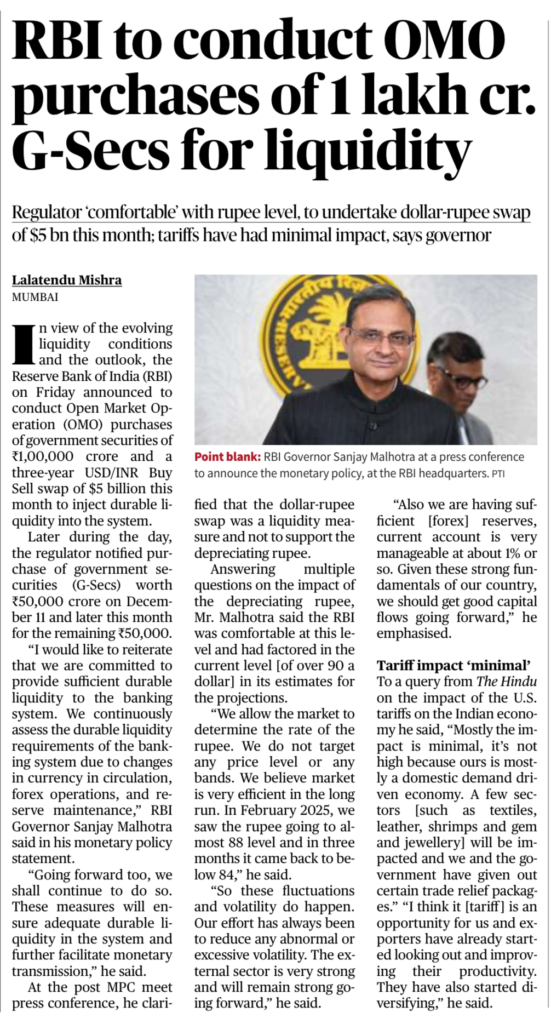
RBI to conduct OMO purchases of ₹1 lakh crore G-Secs

Context

RBI to conduct OMO purchases of ₹1 lakh crore + USD/INR buy–sell swap of $5 billion.
• Aim: inject liquidity, support monetary transmission, stabilise financial system.
• RBI clarified it is not intended to support rupee levels.

What are OMOs?

• Buying/selling of G-Secs by RBI.
• RBI buying G-Secs → liquidity increases.

Dollar–Rupee Swap

• RBI buys dollars now, sells later at maturity.
• Injects rupee liquidity without permanently raising money supply.

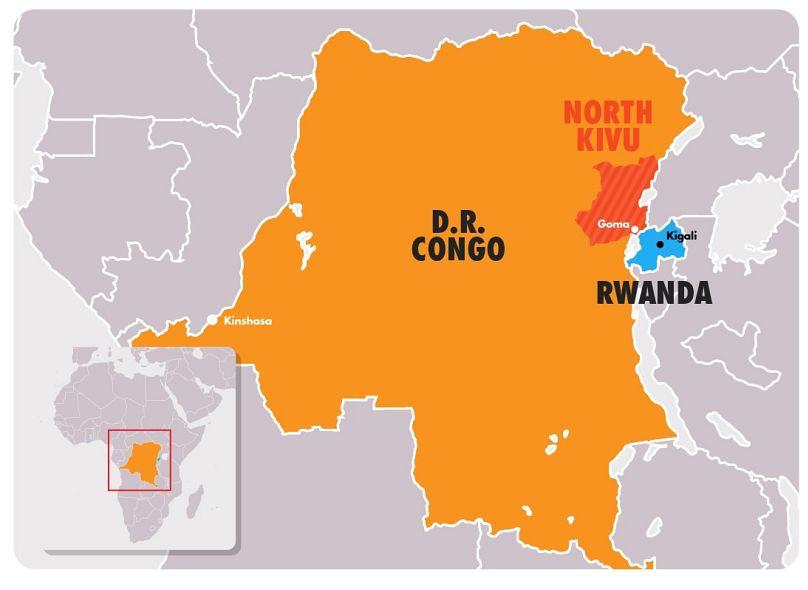
Deal without peace (Congo–Rwanda conflict)

Context

• U.S. announced a peace accord between Rwanda & Congo.
• But core conflict involving M23 rebel group remains unresolved.

Why Is the Announcement Premature?

  1. Fighting Continues — Violence ongoing.
  2. Ethnic Tensions Persist — Tutsi–Hutu tensions since 1994 genocide.
  3. Rebels Not Included — M23 not part of deal.
  4. Past Failures — Similar agreements collapsed earlier.

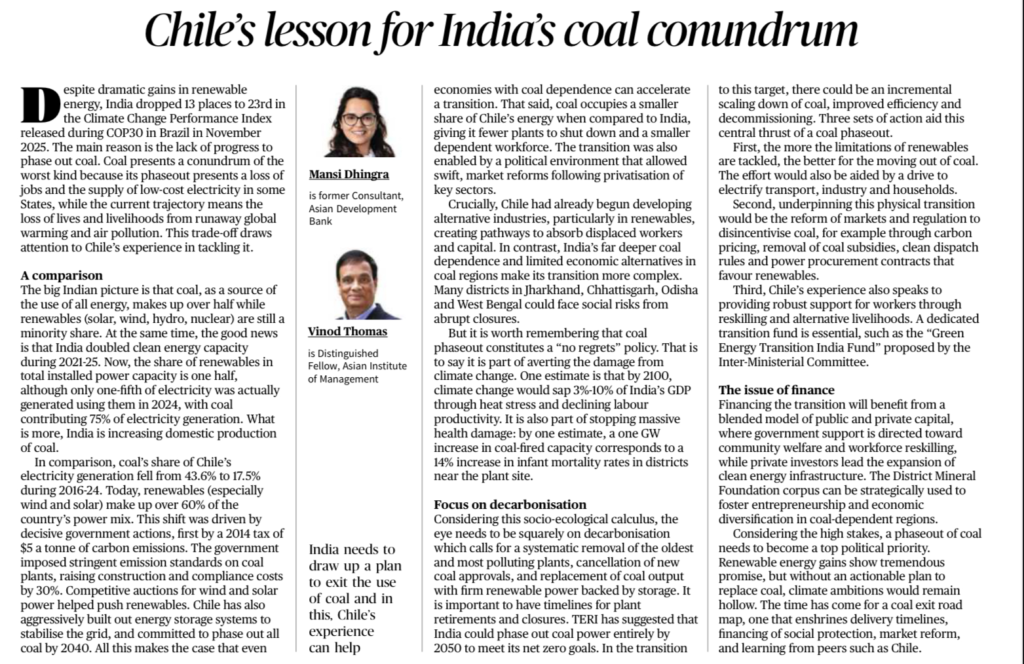
Chile’s lesson for India’s coal conundrum

Context

• India dropped 13 places to Rank 23 in CCPI 2025 (Climate Change Performance Index).
• Rank fell due to slow coal phase-down.

Summary

1. India’s Core Challenge: Coal Dependence

• Renewables rising, but coal = ¾ of electricity generation.
• Imbalance hurts climate performance.

2. Chile’s Transition Lessons

• Chile cut coal share 43.6% → 17.5% (2016–24).
• Tools used: carbon pricing, emission norms, renewable auctions, early grid planning.
• Target: phase out coal by 2040.

3. India’s Transition Harder

• Coal-dependent regions (Jharkhand, Chhattisgarh, Odisha, WB).
• Abrupt cuts cause socio-economic distress.

4. Benefits of Coal Exit

• Reduced climate risks (3–10% projected GDP loss by 2100).
• Cuts air pollution deaths.
• Improves energy security.

5. What India Must Do

• Time-bound coal exit roadmap.
• Retire old plants, stop new coal approvals.
• Expand renewables + storage.
• Reform pricing & subsidies.

6. Financing + Just Transition

• Blended finance model + “Green Energy Transition India Fund”.
• Reskilling + economic diversification of coal regions.

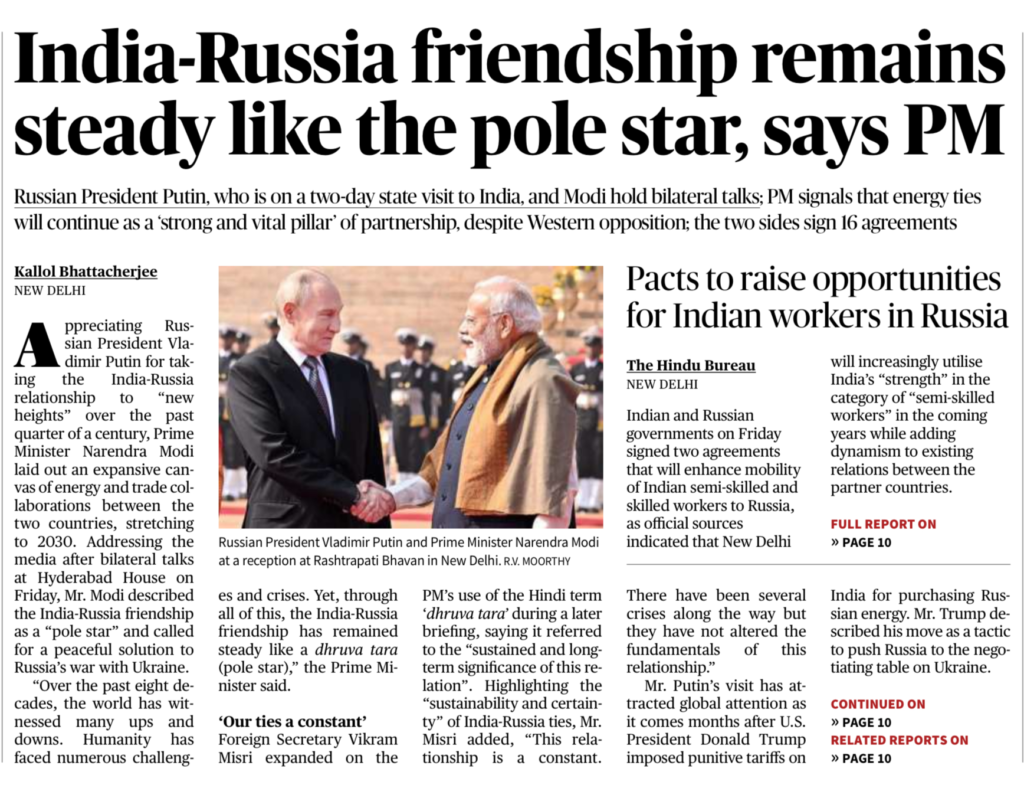
India–Russia friendship remains steady like the pole star, says PM

1. Context

• 23rd Annual Summit held in New Delhi to reinforce a time-tested partnership amid the Ukraine war and global geopolitical pressure.

2. Strategic Stability

• PM calls the relationship “steady like the pole star,” signalling reliability, continuity, and strategic autonomy.

3. Labour Mobility

• Agreements to send Indian semi-skilled/skilled workers to Russia (demand ~5 lakh).
• Framework to ensure welfare and prevent irregular migration.

4. People-to-People

• 30-day e-tourist visa + group tourist visa for Russians.
• Strengthens tourism and social linkages.

5. Arctic Cooperation

• Pact to enhance consultations on Arctic issues—research, shipping routes, scientific exploration.

6. Nuclear Energy

• Russia delivers advanced fuel for Kudankulam Unit-3; reaffirmed cooperation on nuclear safety and reactor supply chain.

7. Energy Security

• India reiterates continuation of Russian crude imports and long-term energy ties despite Western pressures.

Additional Outcomes 

8. National Currency Trade

• Push for rupee–ruble settlement to bypass sanctions hurdles and reduce dollar dependence.
• Trade target reaffirmed: $100 billion by 2030.

9. Trade Balance

• India raises concern over widening deficit; both sides agree to remove logistics and market barriers.

10. Media & Academic

• MoUs in media, cultural exchange, academic collaboration.
• Launch of India edition of Russia Today (RT) magazine.

11. Defence Cooperation

• Continuity in long-term defence partnership — maintenance, spare parts, ongoing joint platforms.

12. Overall Outcome

• Partnership diversifies into labour mobility, energy, nuclear, Arctic, cultural, and financial sectors — strengthening a multidimensional relationship.

Why India–Russia Ties Matter 

• Historical trust + steady partnership (“Pole Star” analogy).
• Russia supports India in defence, nuclear, and energy sectors.
• Labour mobility → new cooperation dimension.
• Rupee–ruble trade → strategic autonomy.
• Arctic cooperation → future geo-economic relevance.
• Helps India maintain space between US and Russia rivalries.

Challenges

• Payment issues due to sanctions
• Over-dependence on Russian defence systems
• Balancing US partnership with Russia ties
• Ukraine war complicates diplomacy

TDF

“In light of the recent India–Russia summit, critically examine how the bilateral partnership is expanding beyond a traditional defence focus into broader strategic, economic, and people-centric domains.”

About the UPSC Civil Services Examination (UPSC CSE)

The UPSC Civil Services Examination (CSE) is one of the most competitive and esteemed examinations in India, conducted by the Union Public Service Commission to recruit officers for services such as the Indian Administrative Service (IAS), Indian Police Service (IPS), Indian Foreign Service (IFS), and others. The exam comprises three stages — Prelims, Mains, and the Personality Test (Interview) — designed to test a candidate’s knowledge, aptitude, decision-making, and leadership skills.


How to Prepare Effectively for UPSC CSE

Cracking the UPSC CSE requires a deep understanding of the syllabus, consistent revision, structured answer writing, and smart test-taking strategies. The Prelims test analytical and conceptual clarity, the Mains focuses on critical thinking, articulation, and subject mastery, while the Interview assesses presence of mind, ethical judgment, and personality traits relevant to public service.

At Understand UPSC, we empower aspirants with a personalized and focused approach to each stage of the exam.


Why Choose Understand UPSC?

Understand UPSC is a mentorship-driven platform offering a clear, clutter-free strategy to tackle the Civil Services Examination. Our programs like Transform (for beginners and intermediate learners) and Conquer (for advanced mains preparation) provide structured study plans, syllabus-wise video content, interactive live sessions, and answer writing support.

We emphasize:

  • Concept clarity through topic-wise lectures

  • Test series designed around real UPSC standards

  • Personalized mentorship in small groups

  • Regular performance tracking and peer benchmarking

  • Doubt-clearing sessions, current affairs analysis, and monthly magazines


Join the Understand UPSC Learning Community

Our mission is to make UPSC preparation less overwhelming and more strategic. We combine mentorship, discipline, and academic rigor to help you clear CSE with confidence. Whether you’re preparing from Delhi, Mumbai, Bangalore, or a remote village — our online-first model ensures quality guidance reaches every corner of India.

Join the thousands of aspirants who trust Understand UPSC to guide their journey toward becoming civil servants.

Stay connected with us through our Telegram, YouTube, and Instagram channels for daily tips, strategies, and updates.

Copyright © 2025 USARAMBHA EDUCATION (UnderStand UPSC). All Rights Reserved.

Join the Success Journey!