13 Dec, 2025 | Daily Current Affairs

MGNREGS Renaming: Govt May Rename Scheme as Pujya Bapu Gramin Rozgar Yojana

Mahatma Gandhi National Rural Employment Guarantee Act, 2005
(Originally enacted as the National Rural Employment Guarantee Act – NREGA; “Mahatma Gandhi” added in 2009.)

Core Provisions of the Act (2005)
• Legal right to employment (demand-driven).
• 100 days of unskilled manual work per rural household per year.
• Employment within 15 days, else unemployment allowance.
• Decentralised implementation via Gram Panchayats.
• Minimum wages, DBT payments, social audit mandatory.
• At least one-third women beneficiaries.
• Focus on durable rural assets (water, land, livelihoods).

Provisions Likely to Change Under Proposed Amendment
• Name change: MGNREGA → Pujya Bapu Gramin Rozgar Yojana.
• Workdays cap: Possible increase from 100 to 125 days.
• Targeting approach: Shift from universal demand-driven model to selective eligibility.
• Exclusion criteria based on State-level economic indices.

India FTAs Strategy: Why Free Trade Agreements Matter for Growth

Summary
• India has signed 20 Free Trade Agreements (World Trade Organization data), excluding the recent agreements with the United Kingdom and the European Free Trade Association.
• Trade negotiations are ongoing with the United States, European Union, Canada and Southern African Customs Union, accelerated by United States tariffs of up to 50% on certain Indian exports.
• India exited the Regional Comprehensive Economic Partnership in 2019 due to risks to agriculture and weak rules of origin.

Problem with past FTAs
• Agreements with the Association of Southeast Asian Nations, Japan and South Korea led to rising trade deficits.
ASEAN trade deficit increased from about 10 billion US dollars in 2017 to around 44 billion US dollars in 2023.
• Imports of high-value goods grew faster than India’s exports.

Reasons for weak outcomes
• Poor handling of standards, certifications, non-tariff barriers and rules of origin.
• FTAs not aligned with India’s export capabilities.
• Limited industry consultation and low utilisation of FTA benefits.

Positive signal
• India–United Arab Emirates Comprehensive Economic Partnership Agreement performed better.
• Non-oil bilateral trade reached about 100 billion US dollars in Financial Year 2025 (Directorate General of Foreign Trade).

Key focus areas ahead
• United States: services, engineering goods, textiles, seafood.
• European Union: iron, steel and cement due to the Carbon Border Adjustment Mechanism.

Conclusion
Free Trade Agreements are only an entry point. Without strengthening export competitiveness, standards compliance and domestic support systems, they risk widening trade deficits instead of boosting growth.

Nuclear Sector Private Participation: Cabinet Clears Entry, 100% FDI in Insurance

Insurance Sector Reform
• Cabinet approved a Bill to raise Foreign Direct Investment limit from 74% to 100% in insurance companies.
• Objective: higher capital inflow, better penetration, competition and technology transfer.
• Condition: At least one among Chairman, Managing Director or Chief Executive Officer must be an Indian citizen.

Nuclear Power Sector Reform
• Approval of the SHANTI Bill (Sustainable Harnessing and Advancement of Nuclear Energy for Transforming India).
• Enables private sector participation in nuclear power generation.
• Supports India’s goal of adding 100 gigawatt nuclear capacity by 2047.

Small Modular Reactor (SMR) Mission
• Cabinet approved a Nuclear Energy Mission for Small Modular Reactors.
• Outlay: ₹20,000 crore.
• Target: At least five indigenously developed SMRs operational by 2033.

What is a Small Modular Reactor (SMR)?
• A compact nuclear reactor with a capacity of up to 300 megawatt electric per unit.
• Factory-fabricated and transported to sites, unlike large conventional reactors.

Advantages
• Lower capital cost.
• Shorter construction time.
• Enhanced safety features.
• Suitable for remote areas and grid flexibility.
• Considered key for clean energy transition.

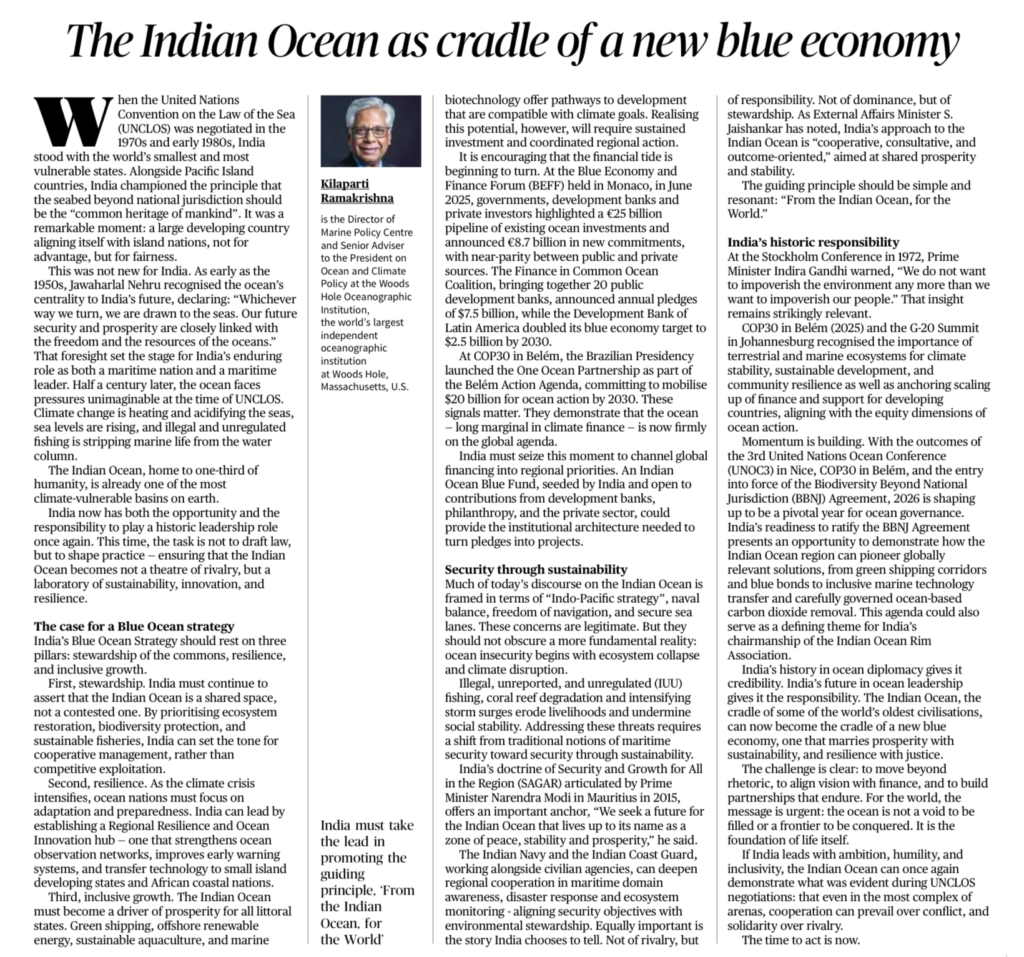
Indian Ocean Blue Economy: Strategic Opportunities for India and the Region

Core Message
The Indian Ocean should emerge as the cradle of a new Blue Economy, where economic growth, ecological sustainability and regional stability advance together, with India providing leadership.

Why the Indian Ocean Matters
• Home to one-third of the world’s population.
• Among the most climate-vulnerable ocean regions.
• Threats arise more from climate change and ecosystem degradation than from military rivalry.

India’s Responsibility & Opportunity
• India historically upheld the ocean as a shared global commons during United Nations Convention on the Law of the Sea negotiations.
• Today, India must shape practice, not just principles, in ocean governance.

Blueprint of a New Blue Economy

1. Stewardship
• Treat the Indian Ocean as a shared space, not a contested arena.
• Focus on ecosystem protection, biodiversity and sustainable fisheries.

2. Resilience
• Prioritise climate adaptation, early warning systems and disaster preparedness.
• Support vulnerable island and coastal nations.

3. Inclusive Growth
• Use the ocean to generate broad-based prosperity.
• Key areas: green shipping, offshore renewable energy, sustainable aquaculture, marine.

Global Momentum
• Rising global finance for ocean action through climate and development platforms.
• Oceans now recognised as central to climate stability and sustainable development.

India’s Way Forward
• Channel global finance into Indian Ocean region priorities.
• Promote cooperation over competition, and sustainability as the basis of security.

Conclusion
The Indian Ocean can become a model region where prosperity, sustainability and stability coexist. India’s leadership can ensure the ocean is not a zone of rivalry, but a foundation of shared future.

About the UPSC Civil Services Examination (UPSC CSE)

The UPSC Civil Services Examination (CSE) is one of the most competitive and esteemed examinations in India, conducted by the Union Public Service Commission to recruit officers for services such as the Indian Administrative Service (IAS), Indian Police Service (IPS), Indian Foreign Service (IFS), and others. The exam comprises three stages — Prelims, Mains, and the Personality Test (Interview) — designed to test a candidate’s knowledge, aptitude, decision-making, and leadership skills.


How to Prepare Effectively for UPSC CSE

Cracking the UPSC CSE requires a deep understanding of the syllabus, consistent revision, structured answer writing, and smart test-taking strategies. The Prelims test analytical and conceptual clarity, the Mains focuses on critical thinking, articulation, and subject mastery, while the Interview assesses presence of mind, ethical judgment, and personality traits relevant to public service.

At Understand UPSC, we empower aspirants with a personalized and focused approach to each stage of the exam.


Why Choose Understand UPSC?

Understand UPSC is a mentorship-driven platform offering a clear, clutter-free strategy to tackle the Civil Services Examination. Our programs like Transform (for beginners and intermediate learners) and Conquer (for advanced mains preparation) provide structured study plans, syllabus-wise video content, interactive live sessions, and answer writing support.

We emphasize:

  • Concept clarity through topic-wise lectures

  • Test series designed around real UPSC standards

  • Personalized mentorship in small groups

  • Regular performance tracking and peer benchmarking

  • Doubt-clearing sessions, current affairs analysis, and monthly magazines


Join the Understand UPSC Learning Community

Our mission is to make UPSC preparation less overwhelming and more strategic. We combine mentorship, discipline, and academic rigor to help you clear CSE with confidence. Whether you’re preparing from Delhi, Mumbai, Bangalore, or a remote village — our online-first model ensures quality guidance reaches every corner of India.

Join the thousands of aspirants who trust Understand UPSC to guide their journey toward becoming civil servants.

Stay connected with us through our Telegram, YouTube, and Instagram channels for daily tips, strategies, and updates.

Copyright © 2025 USARAMBHA EDUCATION (UnderStand UPSC). All Rights Reserved.

Join the Success Journey!