

FCRA Amendment Bill 2026: Key Changes and Concerns Explained

Context: FCRA Amendment Bill 2026

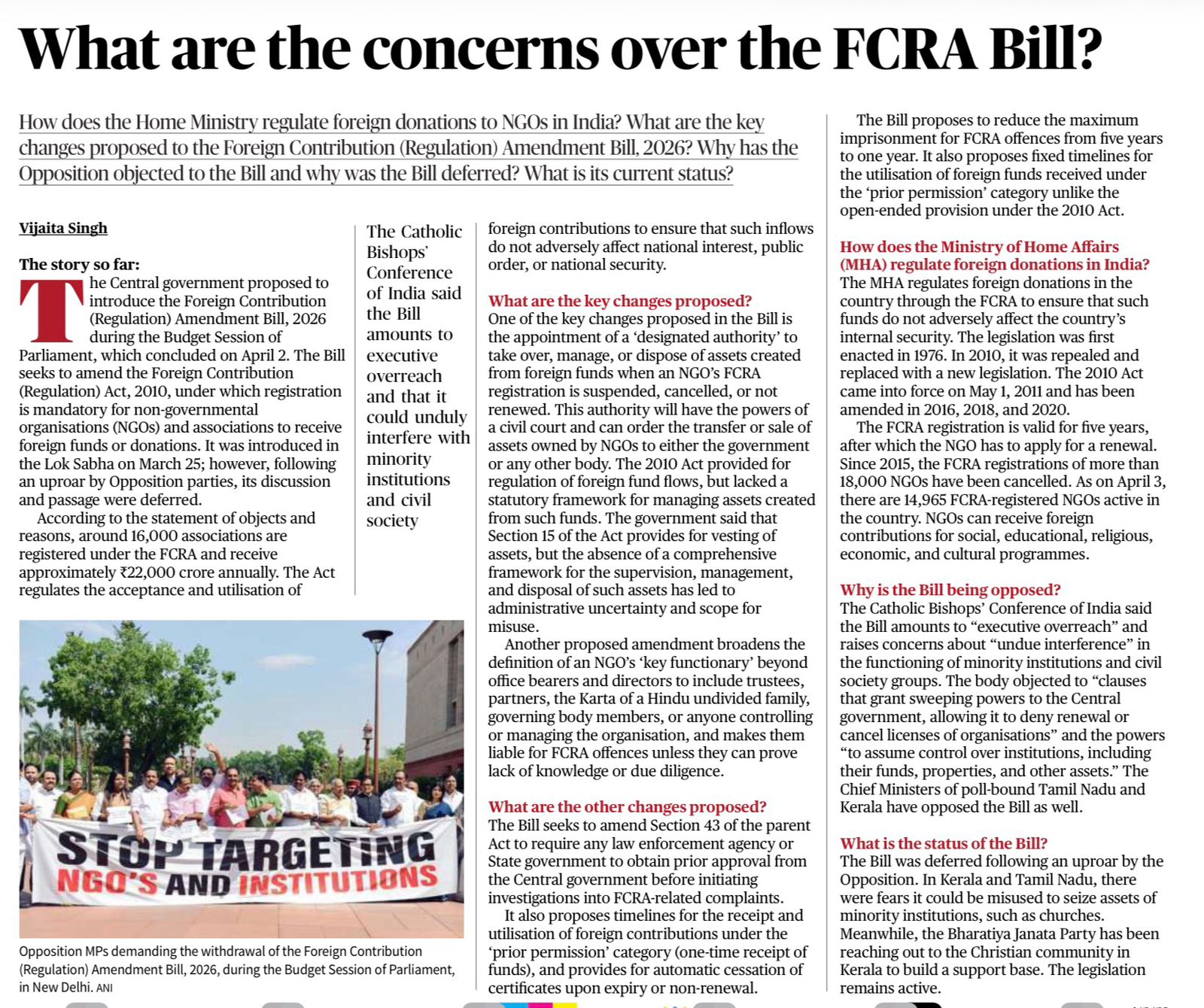
The Union government proposed the Foreign Contribution (Regulation) Amendment Bill, 2026 to tighten regulation of foreign funding to NGOs under the existing Foreign Contribution (Regulation) Act, 2010, but the Bill was deferred after opposition over concerns of excessive state control.

Key Changes in FCRA Amendment

  1. Creation of a designated authority
    A new authority can take over, manage or dispose of assets created from foreign funds when an NGO’s registration is suspended or cancelled.
  2. Expanded definition of key functionary
    Now includes trustees, partners, governing body members and anyone controlling the organisation, making them liable for violations.
  3. Prior approval for investigations
    Any law enforcement agency or State government must take Central government approval before initiating FCRA-related investigations.
  4. Fixed timelines for fund utilisation
    Foreign funds under “prior permission” must be used within specified timelines, unlike earlier open-ended use.
  5. Reduced punishment
    Maximum imprisonment reduced from 5 years to 1 year for offences.

Good Aspects

  1. Better accountability of foreign funds
    Stronger monitoring ensures funds are used for intended purposes and do not affect national security.
  2. Clarity in asset management
    Earlier, there was no clear framework for handling NGO assets after licence cancellation → new authority fills this gap.
  3. Defined responsibility
    Expanding “key functionary” ensures no one escapes liability within NGO management.
  4. Time-bound utilisation of funds
    Prevents misuse or indefinite parking of foreign contributions.
  5. Regulatory tightening for security concerns
    Helps government track foreign influence in sensitive sectors.

Concerns / Issues

  1. Excessive centralisation of power
    Government can take control of NGO assets and operations, raising fear of misuse.
  2. Impact on civil society and NGOs
    Broad definition of functionaries may discourage participation and increase compliance burden.
  3. Restriction on federal structure
    States and agencies need Central approval for investigation, limiting autonomy.
  4. Risk to minority institutions
    Concerns that powers can be used to target minority-run organisations.
  5. Reduced deterrence
    Lower punishment may weaken seriousness of violations.
  6. Discretionary powers in licence renewal/cancellation
    Government gets wider authority to deny or cancel registration, increasing uncertainty.
FCRA Amendment Bill 2026

Leave a Reply

Your email address will not be published. Required fields are marked *

About the UPSC Civil Services Examination (UPSC CSE)

The UPSC Civil Services Examination (CSE) is one of the most competitive and esteemed examinations in India, conducted by the Union Public Service Commission to recruit officers for services such as the Indian Administrative Service (IAS), Indian Police Service (IPS), Indian Foreign Service (IFS), and others. The exam comprises three stages — Prelims, Mains, and the Personality Test (Interview) — designed to test a candidate’s knowledge, aptitude, decision-making, and leadership skills.


How to Prepare Effectively for UPSC CSE

Cracking the UPSC CSE requires a deep understanding of the syllabus, consistent revision, structured answer writing, and smart test-taking strategies. The Prelims test analytical and conceptual clarity, the Mains focuses on critical thinking, articulation, and subject mastery, while the Interview assesses presence of mind, ethical judgment, and personality traits relevant to public service.

At UnderStand UPSC, we empower aspirants with a personalized and focused approach to each stage of the exam.


Why Choose UnderStand UPSC?

UnderStand UPSC is a mentorship-driven platform offering a clear, clutter-free strategy to tackle the Civil Services Examination. Our programs like Transform (for beginners and intermediate learners) and Conquer (for advanced mains preparation) provide structured study plans, syllabus-wise video content, interactive live sessions, and answer writing support.

We emphasize:

  • Concept clarity through topic-wise lectures

  • Test series designed around real UPSC standards

  • Personalized mentorship in small groups

  • Regular performance tracking and peer benchmarking

  • Doubt-clearing sessions, current affairs analysis, and monthly magazines


Join the UnderStand UPSC Learning Community

Our mission is to make UPSC preparation less overwhelming and more strategic. We combine mentorship, discipline, and academic rigor to help you clear CSE with confidence. Whether you’re preparing from Delhi, Mumbai, Bangalore, or a remote village — our online-first model ensures quality guidance reaches every corner of India.

Join the thousands of aspirants who trust UnderStand UPSC to guide their journey toward becoming civil servants.

Stay connected with us through our Telegram, YouTube, and Instagram channels for daily tips, strategies, and updates.

Copyright © 2026 USARAMBHA EDUCATION (UnderStand UPSC). All Rights Reserved.

Join the Success Journey!


