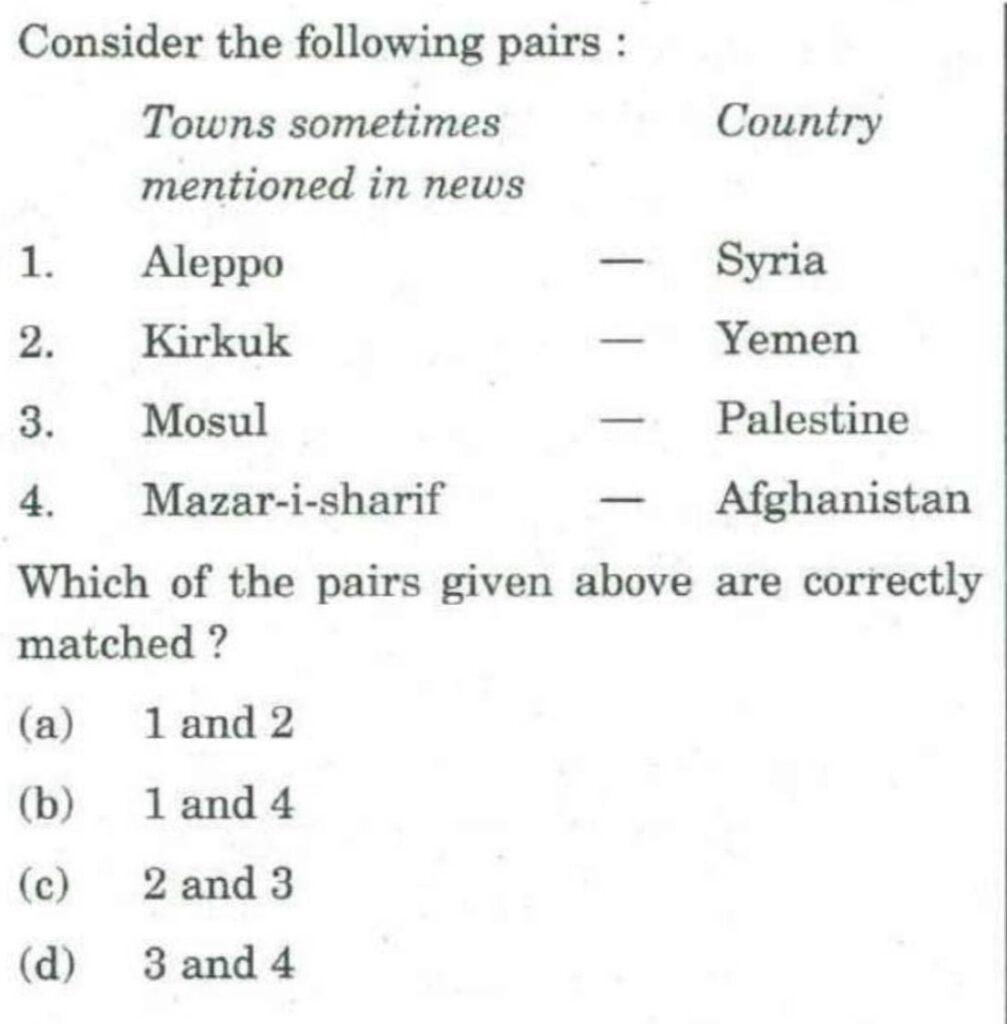
The deadliest clashes so far broke out between Syrian government forces and Kurdish fighters in a contested area of the northern city of Aleppo, as efforts to merge the U.S.-backed Syrian Democratic Forces (SDF) with the national army have shown little progress. SANA said a soldier was killed in an SDF attack.
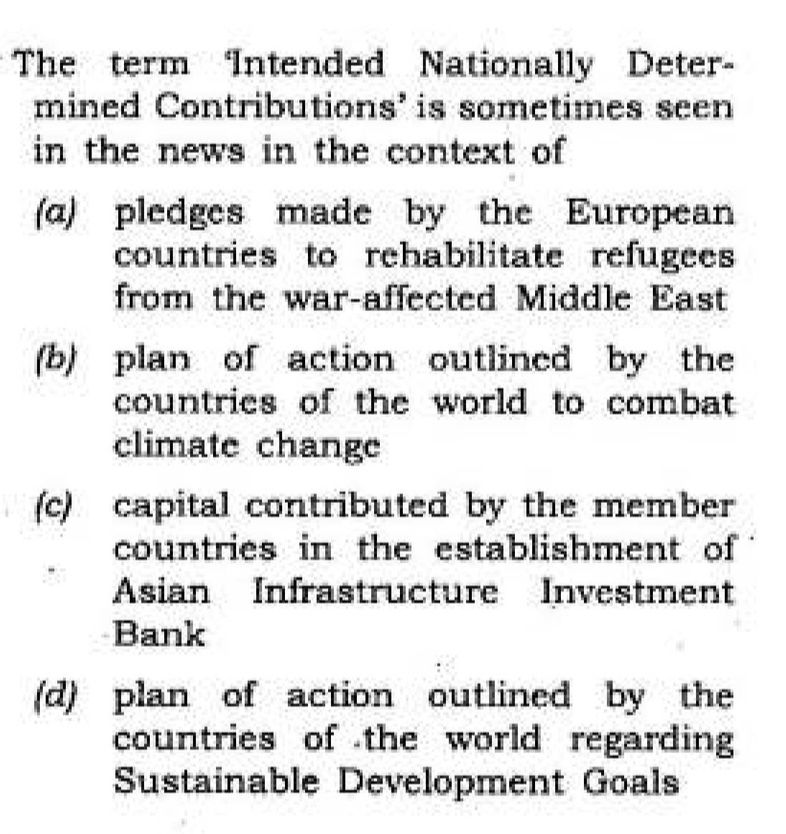
Emission Intensity • Achievement: Emission intensity reduced by ~36% (2005–2020) (Target: 33–35% by 2030 → achieved early) • Issue: Despite efficiency gains, total emissions still rising (India ≈ 3 billion tonnes CO₂e; 3rd largest emitter)
Meaning: Growth is cleaner, but overall pollution is higher.
Non-Fossil Power Capacity • Achievement: Non-fossil sources form ~45% of installed capacity (2024–25) (Paris target: 40% by 2030 → achieved) • Issue: Actual electricity generation from non-fossil is only ~22%
Meaning: Capacity added, but coal still dominates power supply.
Renewable Energy Expansion • Achievement: Solar capacity rose from ~3 GW (2014) to ~110 GW (2025) • Issue: Renewable power is intermittent and limited by storage & grid gaps
Meaning: Fast expansion, but the system is not ready to absorb full output.
Coal Dependence • Achievement: Share of coal in installed capacity is gradually declining • Issue: Coal still accounts for ~50% of installed capacity and most generation
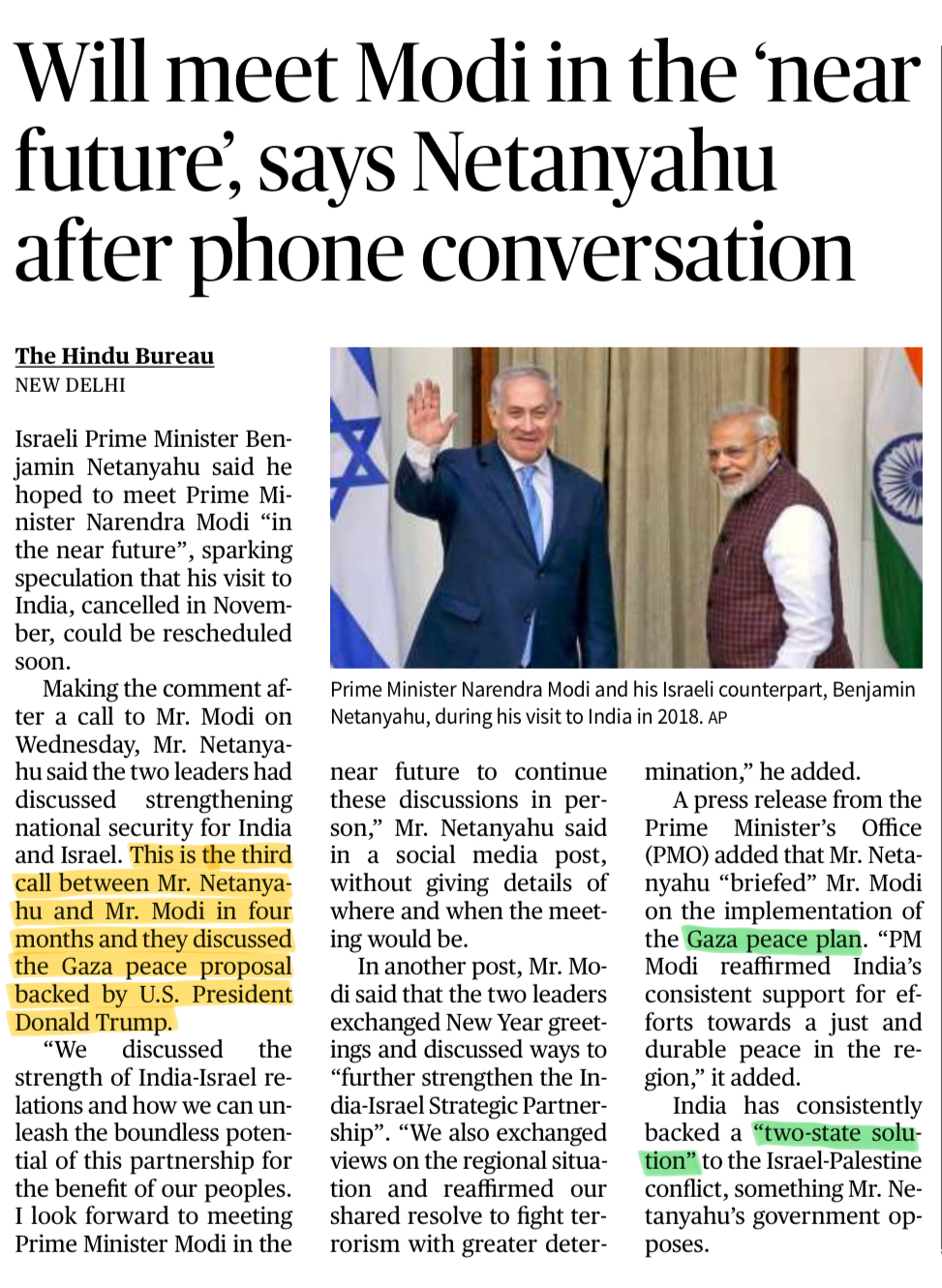
Gaza Peace Plan • Seeks an end to active hostilities in Gaza. • Emphasises humanitarian assistance, reconstruction, and civilian protection. • Proposes security arrangements to prevent future violence. • Supported diplomatically by the U.S., but faces resistance from multiple stakeholders.
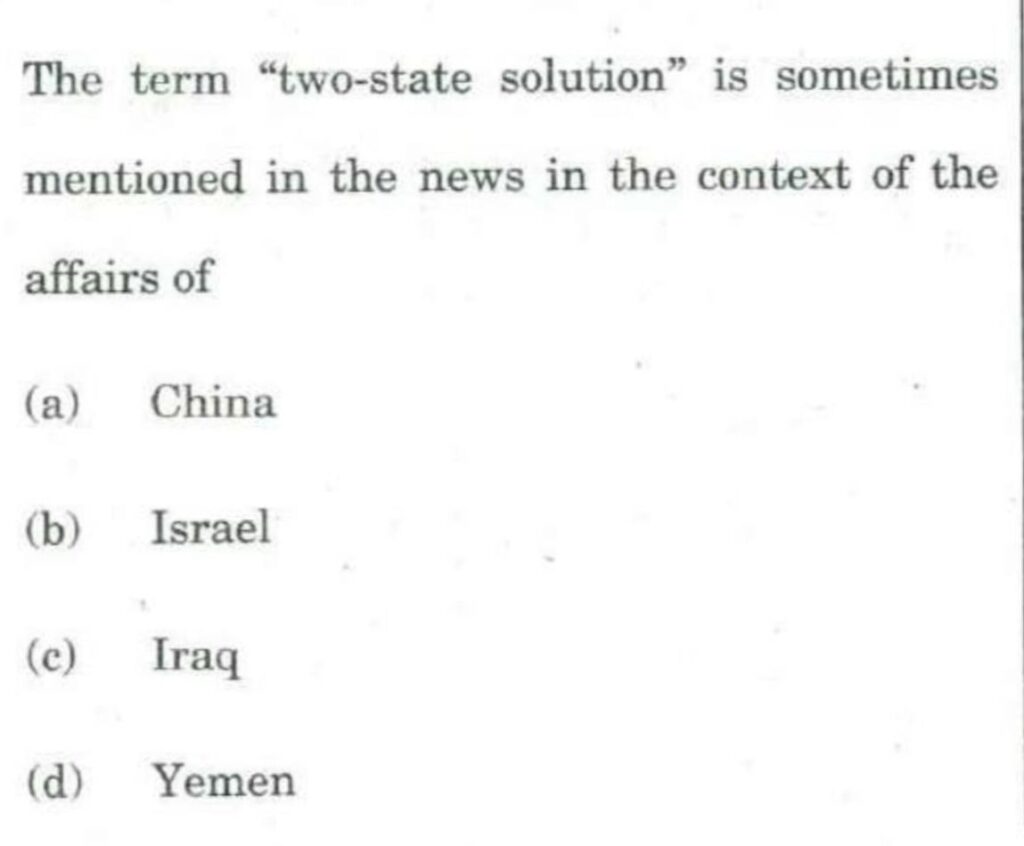
Two-State Solution: • Envisions Israel and Palestine as two independent states, coexisting peacefully. • Palestine with recognized borders, alongside Israel’s security guarantees. • Supported by India and most of the international community.
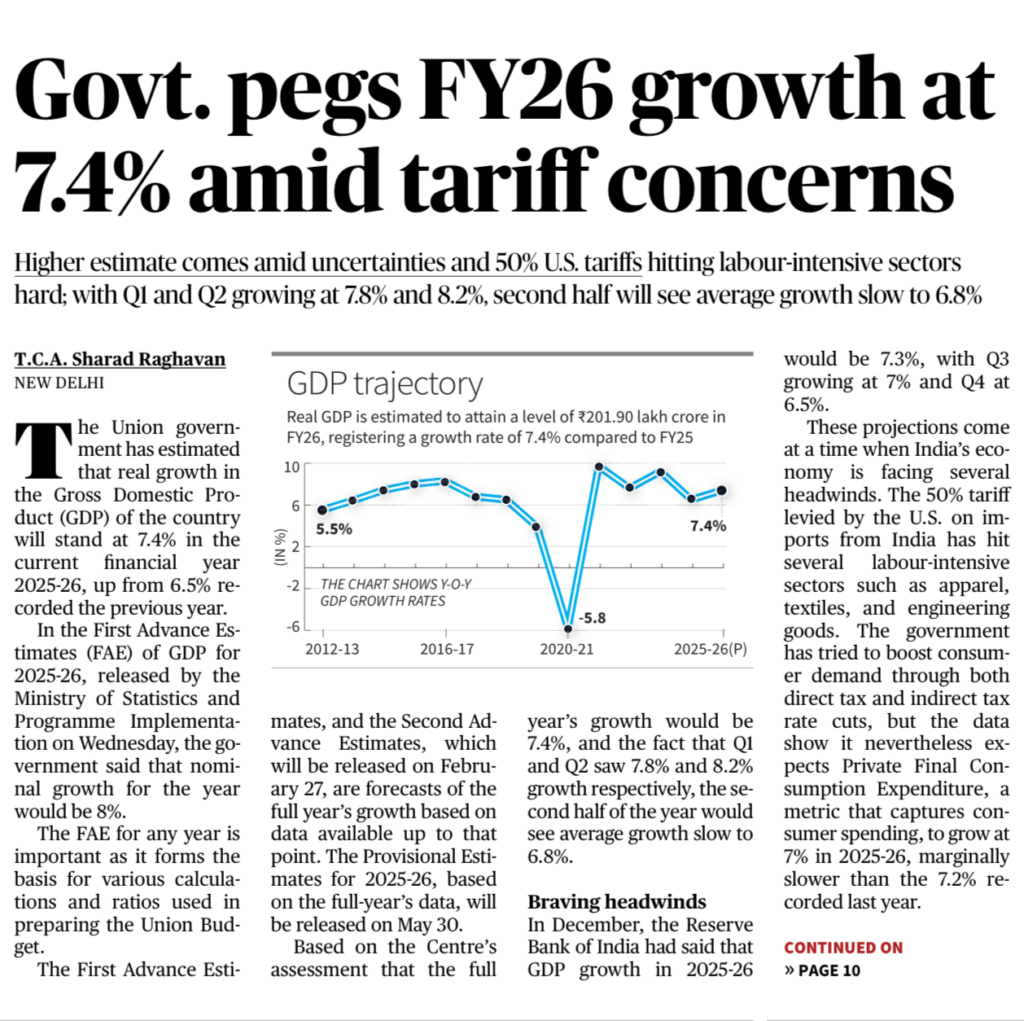
Context: The Union Government has released the First Advance Estimates (FAE) of national income for FY 2025–26, projecting real GDP growth at 7.4%, up from 6.5% in FY25. The estimate comes amid global trade uncertainties, particularly high U.S. tariffs on Indian exports, affecting labour-intensive sectors.
What are First Advance Estimates (FAE)? • Earliest official estimate of annual GDP growth • Released before the financial year ends (early January) • Prepared by the National Statistical Office (NSO), MoSPI • Used as the base document for Budget formulation • Based on partial data (first 7–8 months of the year)
FAE is not final — it is revised later through Second Advance Estimates and Provisional Estimates as more data becomes available.
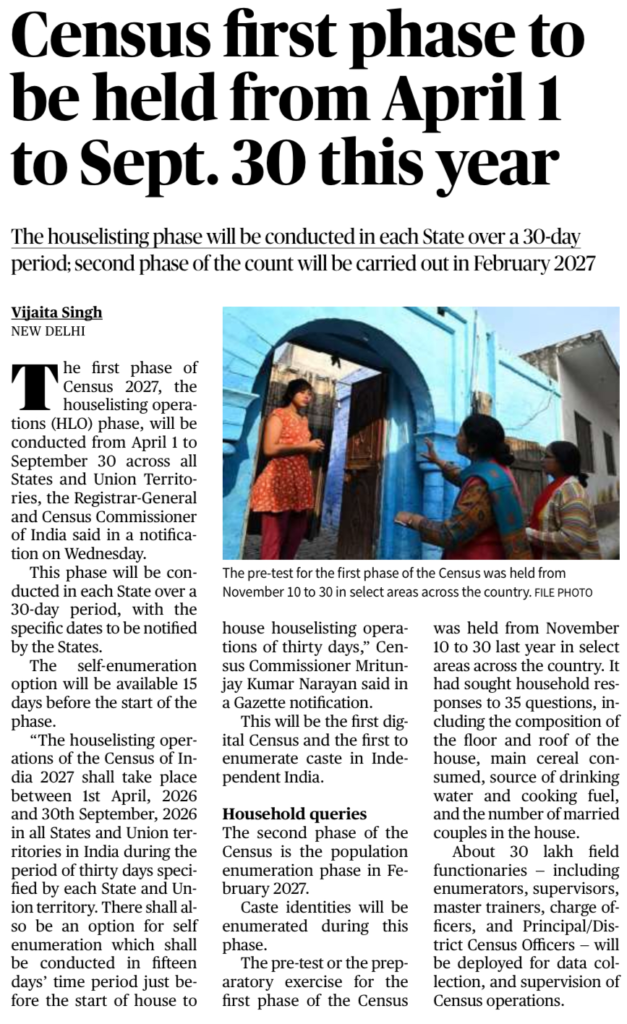
Context The government has notified the first phase of Census 2027, marking India’s first digital Census and the first to include caste enumeration since Independence.
Prelims-Relevant Data Point • Seventh Schedule: Union List – Entry 69 • Phase 1: April 1 – Sept 30, 2026 • Phase 2 (Population Enumeration): February 2027 • Nature: First digital Census of India • New Feature: Caste enumeration included • Coverage: All States & Union Territories • Self-enumeration: Allowed (15 days before HLO starts) • Authority: Registrar General & Census Commissioner of India • Workforce: ~30 lakh enumerators & officials
HLO (Houselisting Operations): First phase of Census that collects data on housing conditions and household assets, not population.
Census 2027 first phase
Ans – D
A Platform OF The Students For The Students By The Students
About the UPSC Civil Services Examination (UPSC CSE)
The UPSC Civil Services Examination (CSE) is one of the most competitive and esteemed examinations in India, conducted by the Union Public Service Commission to recruit officers for services such as the Indian Administrative Service (IAS), Indian Police Service (IPS), Indian Foreign Service (IFS), and others. The exam comprises three stages — Prelims, Mains, and the Personality Test (Interview) — designed to test a candidate’s knowledge, aptitude, decision-making, and leadership skills.
How to Prepare Effectively for UPSC CSE
Cracking the UPSC CSE requires a deep understanding of the syllabus, consistent revision, structured answer writing, and smart test-taking strategies. The Prelims test analytical and conceptual clarity, the Mains focuses on critical thinking, articulation, and subject mastery, while the Interview assesses presence of mind, ethical judgment, and personality traits relevant to public service.
At UnderStand UPSC, we empower aspirants with a personalized and focused approach to each stage of the exam.
Why Choose UnderStand UPSC?
UnderStand UPSC is a mentorship-driven platform offering a clear, clutter-free strategy to tackle the Civil Services Examination. Our programs like Transform (for beginners and intermediate learners) and Conquer (for advanced mains preparation) provide structured study plans, syllabus-wise video content, interactive live sessions, and answer writing support.
We emphasize:
Concept clarity through topic-wise lectures
Test series designed around real UPSC standards
Personalized mentorship in small groups
Regular performance tracking and peer benchmarking
Doubt-clearing sessions, current affairs analysis, and monthly magazines
Join the UnderStand UPSC Learning Community
Our mission is to make UPSC preparation less overwhelming and more strategic. We combine mentorship, discipline, and academic rigor to help you clear CSE with confidence. Whether you’re preparing from Delhi, Mumbai, Bangalore, or a remote village — our online-first model ensures quality guidance reaches every corner of India.
Join the thousands of aspirants who trust UnderStand UPSC to guide their journey toward becoming civil servants.
Stay connected with us through our Telegram, YouTube, and Instagram channels for daily tips, strategies, and updates.