25 April 2026 | Daily Current Affairs

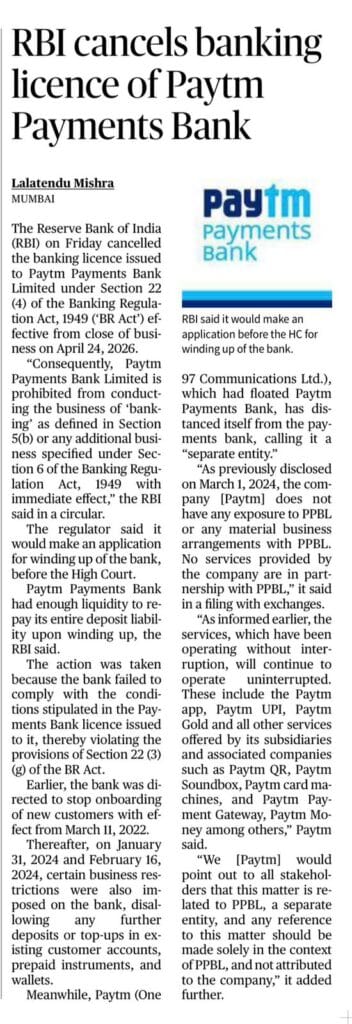
RBI cancels Paytm Payments Bank licence: Reasons, Legal Basis, and Impact for UPSC

Context: RBI cancels Paytm Payments Bank licence

RBI cancelled the licence of Paytm Payments Bank Ltd effective April 24, 2026 after sustained regulatory non-compliance; winding-up proceedings will follow.
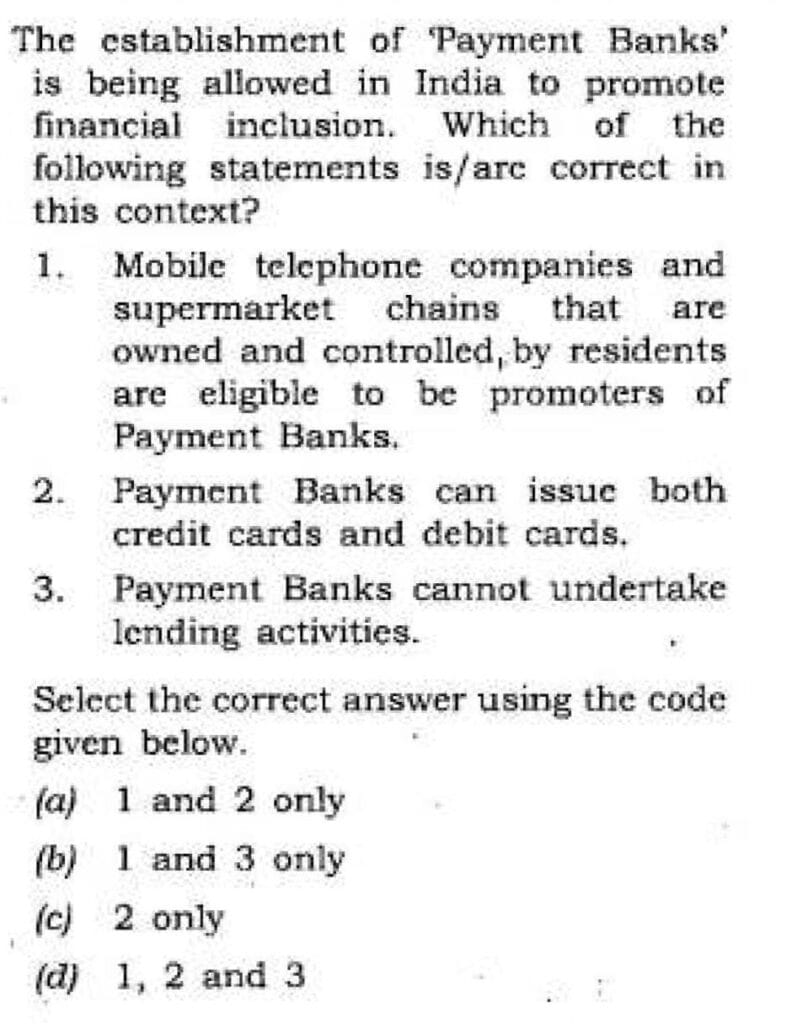
PYQ – 2016, Ans – B

Payments Banks

  • Origin: Nachiket Mor Committee, 2013
  • Purpose: Financial inclusion and low-cost digital payments

Model

Niche banks for deposits and payments, not full-service banking

Key Points

  • Deposits up to ₹2 lakh per customer
  • Savings/current accounts, UPI, remittances
  • Debit/ATM cards allowed
  • No lending or credit cards
  • Funds largely invested in government securities

RBI Action Reasons + Legal Basis

RBI used Section 22(4), Banking Regulation Act, 1949.

Grounds

  • Breach of licence conditions under Section 22
  • Persistent non-compliance despite repeated directions
  • KYC/AML lapses and weak due diligence
  • Deficiencies in governance and internal controls
  • Improper conduct of permissible banking activities under Sections 5(b) and 6
  • Threat to depositors’ interest and public interest

Regulatory Trajectory

  • 2022: Bar on new customers
  • 2024: Operational restrictions
  • 2026: Licence cancellation

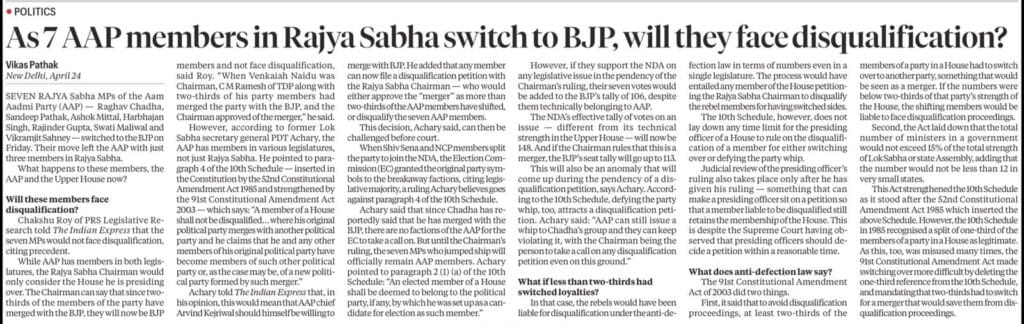
Anti-Defection Law: Will AAP MPs Shift to BJP Lead to Disqualification? UPSC Analysis

Context: Anti-Defection Law

Seven AAP MPs in the Rajya Sabha joined the BJP. The key issue is whether this attracts disqualification under the anti-defection law.

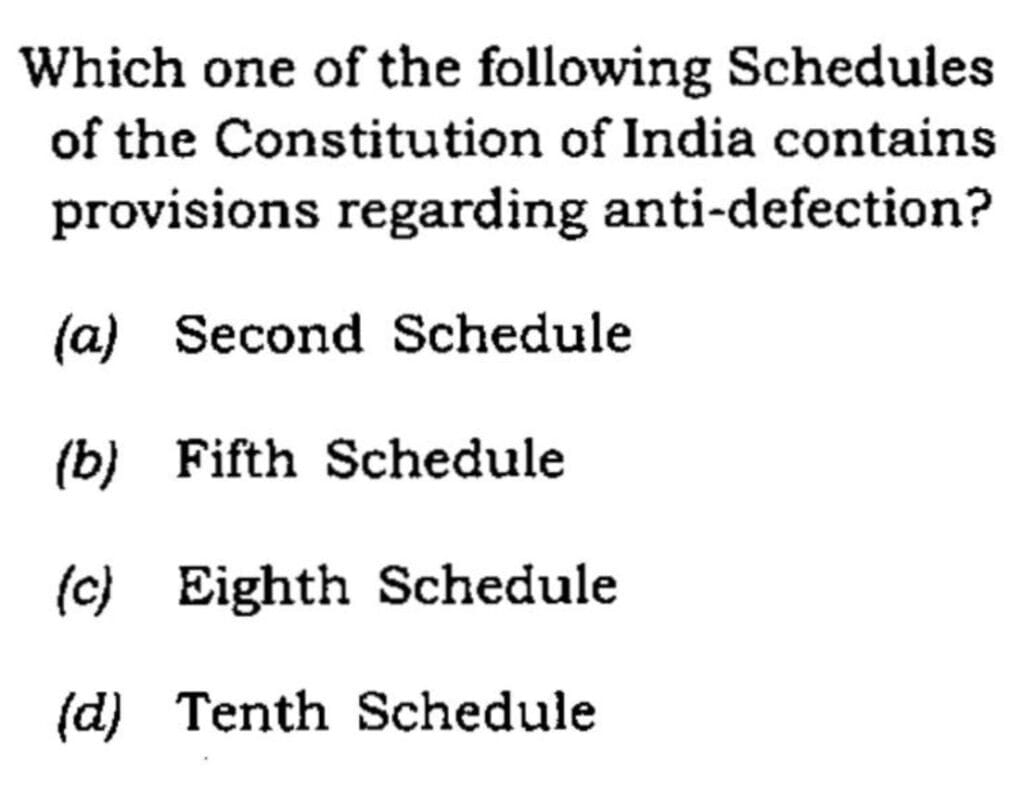
PYQ – 2014, Ans – D

Anti-Defection Law (Tenth Schedule)

Origin and Evolution

Purpose

  • Prevent defections and maintain party discipline

Core Rule

  • A member is disqualified if he/she:
    • Voluntarily gives up party membership
    • Votes or abstains against the party whip

Exception – Merger (Central to this case)

  • Paragraph 4: No disqualification if at least two-thirds of a party’s members in a House agree to merge with another party

91st Amendment (Key Impact)

  • Abolished protection for split (one-third)
  • Only two-thirds merger is a valid safeguard now

Decision Authority

Why disqualification may not apply

  • AAP had 10 MPs in Rajya Sabha; 7 have switched
  • This crosses the two-thirds threshold
  • Therefore, it can be treated as a “merger” under Paragraph 4, not defection
  • If the Chairman accepts this as a merger, no disqualification applies

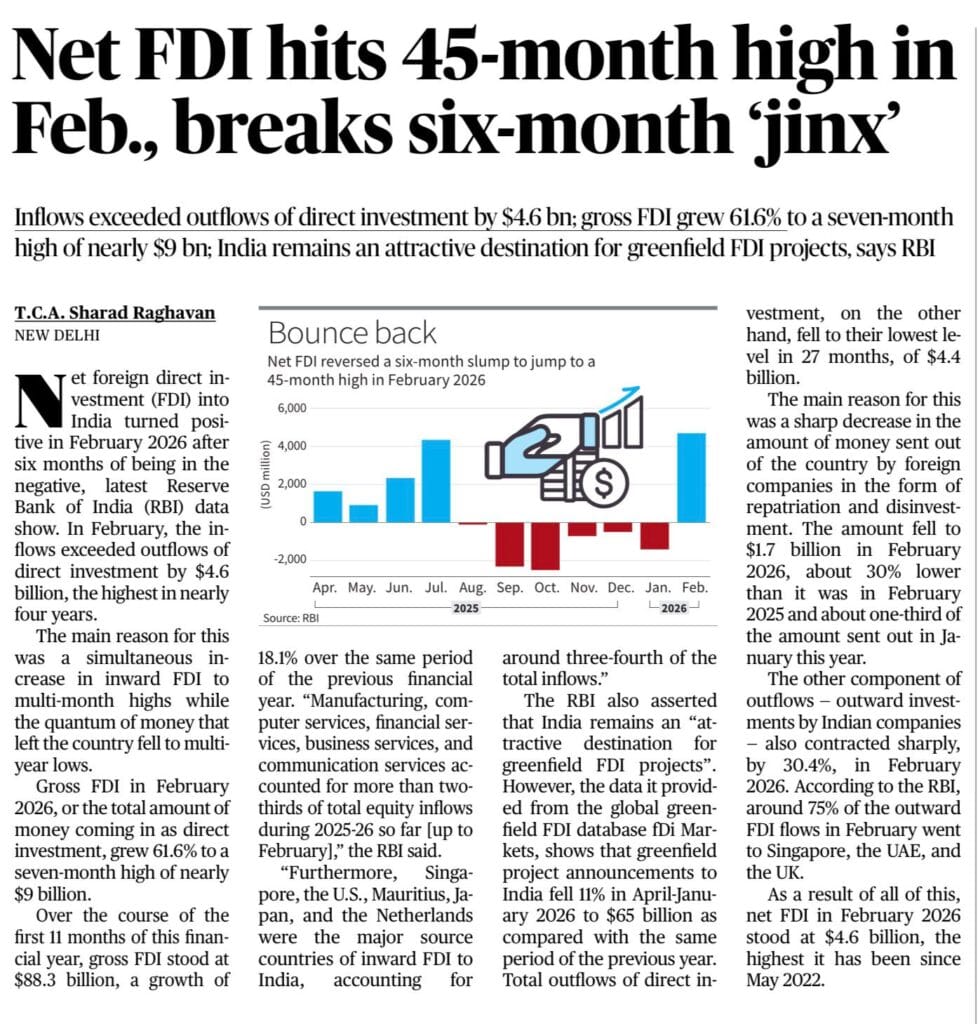
Foreign Direct Investment: Net FDI Hits 45-Month High in Feb 2026 – Key Facts for UPSC

Context: Foreign Direct Investment

Net FDI turned positive in February 2026, reaching a 45-month high after six months of decline.

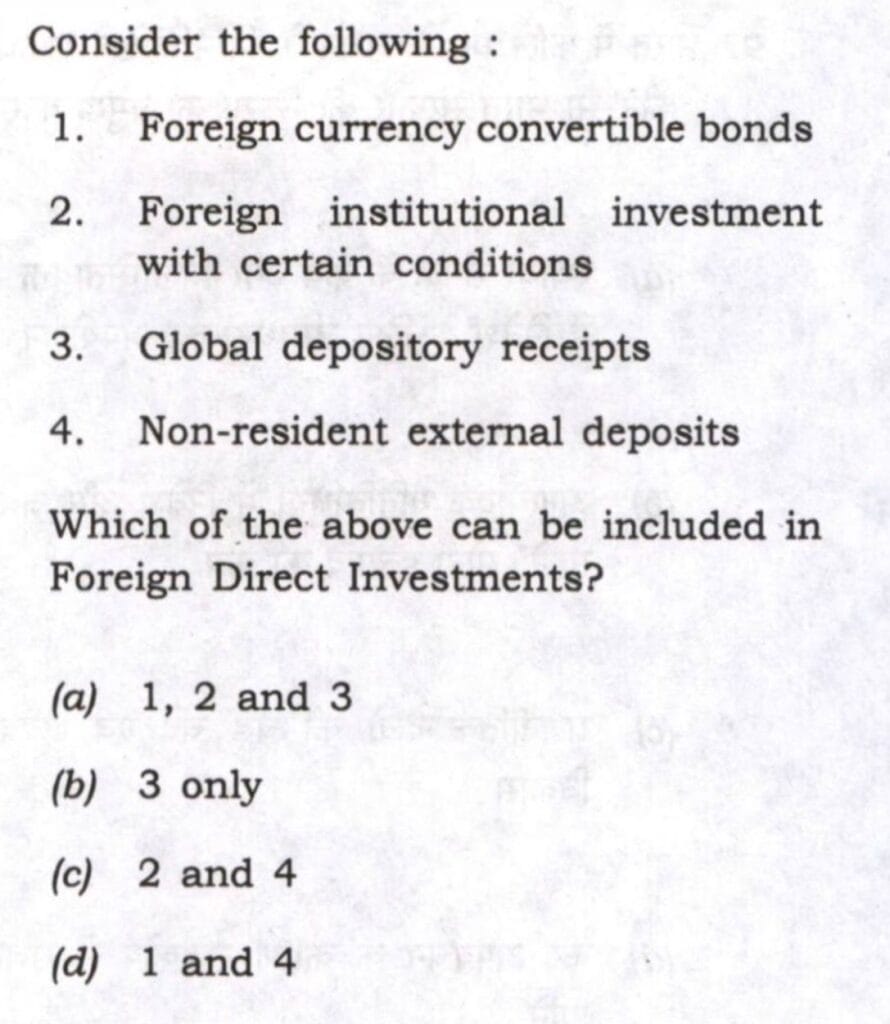
PYQ – 2021, Ans – A

Foreign Direct Investment

  • Definition: Foreign Direct Investment is an investment made by a foreign entity in a domestic enterprise with the objective of establishing lasting interest and significant control (generally 10% or more ownership)
  • Types: Greenfield, Brownfield
  • Components: Equity, reinvested earnings, other capital
  • Significance: Growth, jobs, technology

Key Points

  • Net FDI: $4.6 billion
  • Gross FDI: +61.6% (~$9 billion)
  • Rise mainly due to sharp fall in outflows (lower repatriation + outward FDI)
  • Key sectors: Manufacturing, services
  • Top sources (Economic Survey): Singapore, Mauritius, USA
  • Greenfield attractiveness remains, but announcements declined

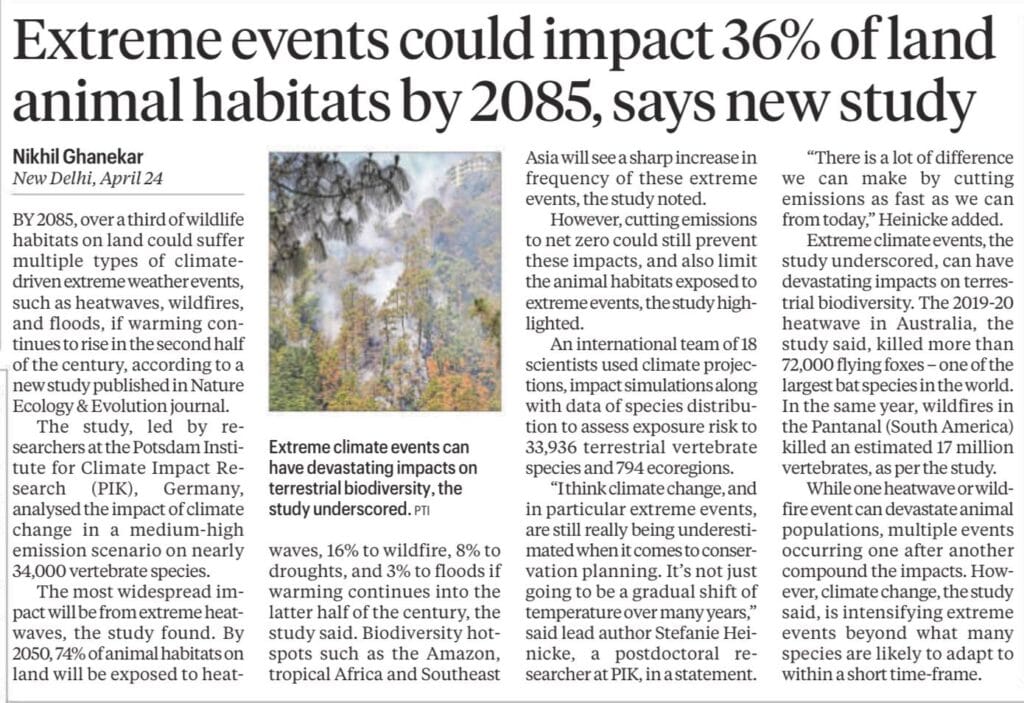
Extreme climate events impact habitats: 36% Land Species at Risk by 2085 – UPSC Study

Context: Extreme climate events impact habitats

A study in Nature Ecology & Evolution finds extreme climate events could affect over one-third of land animal habitats by 2085.

Key Points

  • Magnitude of risk
    • 36% habitats exposed to multiple extreme events by 2085
    • Based on ~34,000 vertebrate species across 794 ecoregions
  • Nature of threat
    • Shift from gradual warming to frequent, intense extreme events
    • Heatwaves most widespread driver of impact
  • Projected exposure
    • By 2050: ~74% habitats exposed to heatwaves
    • Other risks:
      • Wildfires: ~16%
      • Droughts: ~8%
      • Floods: ~3%
  • Geographical concentration
    • High-risk zones: Amazon, Tropical Africa, Southeast Asia
    • Asia to witness a sharp increase in extreme events
  • Compounding effect
    • Sequential or simultaneous events amplify ecosystem damage
    • Greater risk than isolated events
  • Empirical evidence
    • Australia heatwave (2019–20): >72,000 flying foxes died
    • Pantanal wildfires: ~17 million vertebrates lost
  • Key concern
    • Species cannot adapt at the pace of climate change
    • Conservation planning underestimates extreme-event risks
  • Way forward
    • Rapid emission cuts and net-zero transition can significantly limit exposure
    • Need for climate-resilient conservation strategies

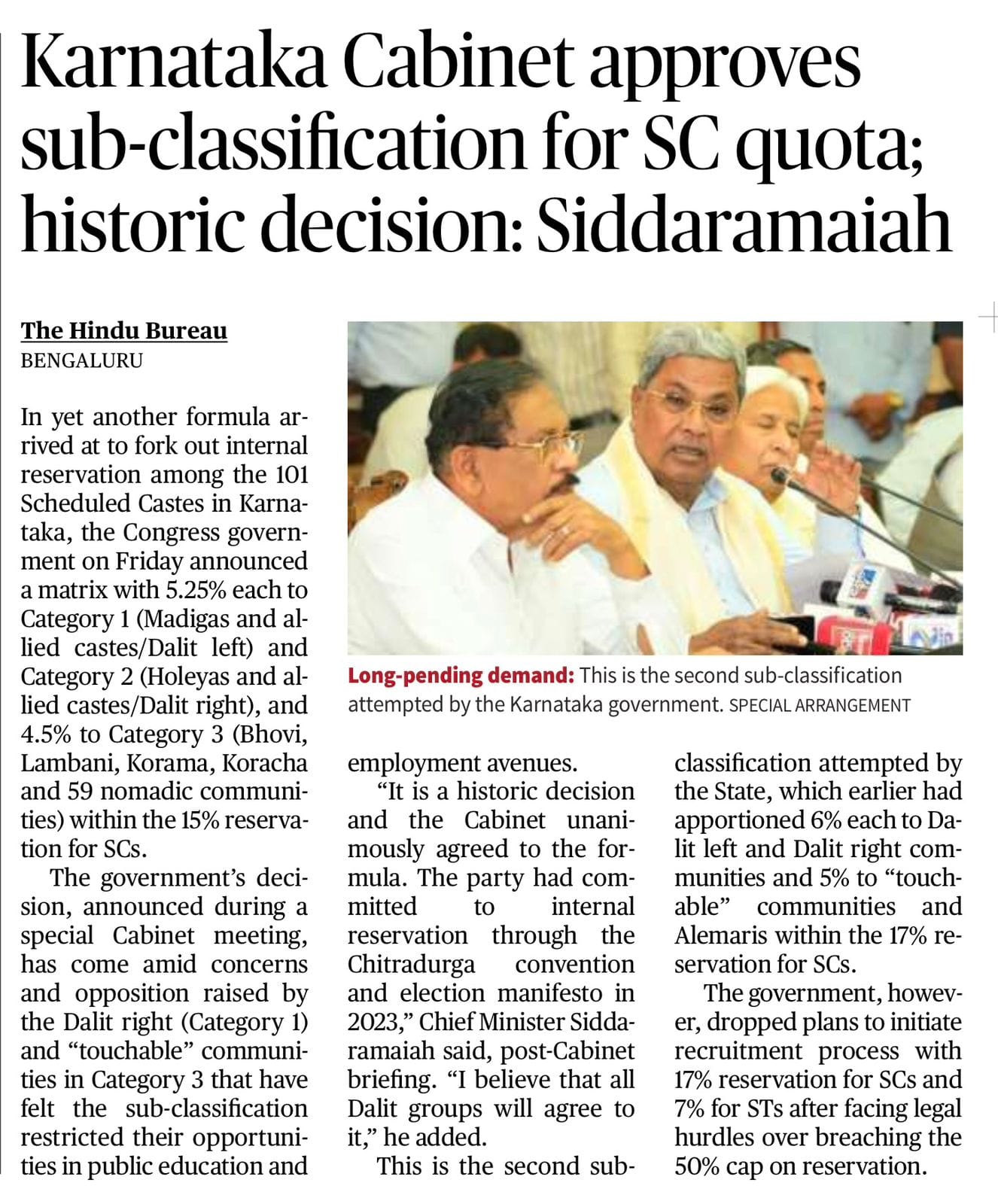
SC quota sub-classification: Karnataka Approves Internal Reservation – Supreme Court View Explained

Context: SC quota sub-classification

Karnataka government approved internal sub-classification within the 15% SC quota to ensure equitable distribution among SC groups, based on commission recommendations.

What Karnataka has done

  • 15% SC quota split as:
    • Category 1 (Madiga & allied): 5.25%
    • Category 2 (Holeya & allied): 5.25%
    • Category 3 (Others incl. Bhovi, Lambani etc.): 4.5%
  • Based on Justice H.N. Nagamohan Das Commission
  • Objective: Address intra-SC inequalities

Supreme Court Position on Sub-classification

  • E.V. Chinnaiah v. State of Andhra Pradesh (2004)
    → SCs treated as a homogeneous class; sub-classification not allowed
  • State of Punjab v. Davinder Singh & Others (2020)
    → Questioned Chinnaiah; held sub-classification may be permissible
    → Referred to a larger Bench
  • State of Punjab v. Davinder Singh (Constitution Bench, 2024)
    → Upheld that States can sub-classify SCs
    → Valid to achieve substantive equality
About the UPSC Civil Services Examination (UPSC CSE)

The UPSC Civil Services Examination (CSE) is one of the most competitive and esteemed examinations in India, conducted by the Union Public Service Commission to recruit officers for services such as the Indian Administrative Service (IAS), Indian Police Service (IPS), Indian Foreign Service (IFS), and others. The exam comprises three stages — Prelims, Mains, and the Personality Test (Interview) — designed to test a candidate’s knowledge, aptitude, decision-making, and leadership skills.


How to Prepare Effectively for UPSC CSE

Cracking the UPSC CSE requires a deep understanding of the syllabus, consistent revision, structured answer writing, and smart test-taking strategies. The Prelims test analytical and conceptual clarity, the Mains focuses on critical thinking, articulation, and subject mastery, while the Interview assesses presence of mind, ethical judgment, and personality traits relevant to public service.

At UnderStand UPSC, we empower aspirants with a personalized and focused approach to each stage of the exam.


Why Choose UnderStand UPSC?

UnderStand UPSC is a mentorship-driven platform offering a clear, clutter-free strategy to tackle the Civil Services Examination. Our programs like Transform (for beginners and intermediate learners) and Conquer (for advanced mains preparation) provide structured study plans, syllabus-wise video content, interactive live sessions, and answer writing support.

We emphasize:

  • Concept clarity through topic-wise lectures

  • Test series designed around real UPSC standards

  • Personalized mentorship in small groups

  • Regular performance tracking and peer benchmarking

  • Doubt-clearing sessions, current affairs analysis, and monthly magazines


Join the UnderStand UPSC Learning Community

Our mission is to make UPSC preparation less overwhelming and more strategic. We combine mentorship, discipline, and academic rigor to help you clear CSE with confidence. Whether you’re preparing from Delhi, Mumbai, Bangalore, or a remote village — our online-first model ensures quality guidance reaches every corner of India.

Join the thousands of aspirants who trust UnderStand UPSC to guide their journey toward becoming civil servants.

Stay connected with us through our Telegram, YouTube, and Instagram channels for daily tips, strategies, and updates.

Copyright © 2026 USARAMBHA EDUCATION (UnderStand UPSC). All Rights Reserved.

Join the Success Journey!