13 May 2026 | Daily Current Affairs

Retail Inflation rises to 3.5% amid higher food prices and fuel costs

Context: Retail Inflation

India’s retail inflation rose to 3.5% in April 2026 due to higher food prices and fuel-linked transportation costs. Retail inflation is measured through the Consumer Price Index (CPI).

Consumer Price Index (CPI)

  • Measures change in prices paid by consumers for goods and services.
  • Reflects retail/cost-of-living inflation.
  • Released mainly by NSO under MoSPI.
  • New Base Year: 2024 = 100.
  • First CPI data on new base released in January 2026 → inflation at 2.75%.

Major CPI Types

  1. CPI Combined → Used by RBI for inflation targeting.
  2. CPI Rural
  3. CPI Urban
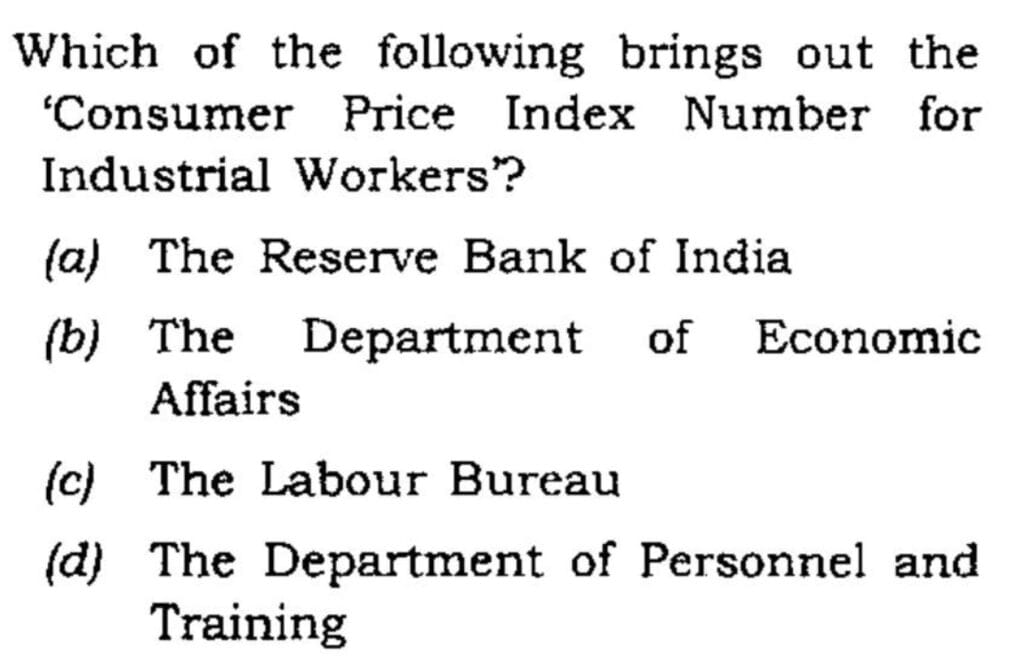
  4. CPI-IW (Industrial Workers) → Used for Dearness Allowance (DA) calculation for Central government employees and pensioners.
  5. CPI-AL → Agricultural Labourers.
  6. CPI-RL → Rural Labourers.
  • CPI-IW, CPI-AL, and CPI-RL are released by the Labour Bureau under the Ministry of Labour & Employment.

CPI Used by RBI

  • RBI uses CPI Combined under the Flexible Inflation Targeting (FIT) framework.
  • Inflation target: 4% ± 2%.
  • Introduced through amendments to the Reserve Bank of India Act, 1934 in 2016.
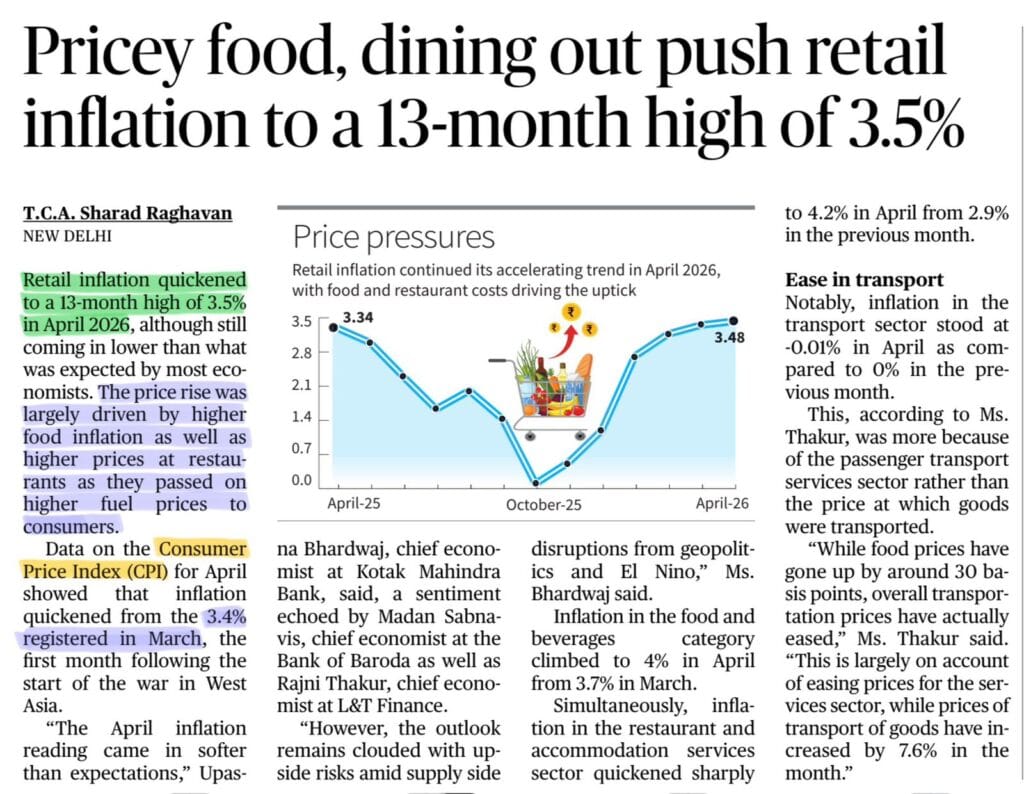
Retail Inflation
Retail Inflation
PYQ – 2015, Ans – C

IMD launches Block-Level Monsoon Forecast system for farmers

Context: Block-Level Monsoon Forecast

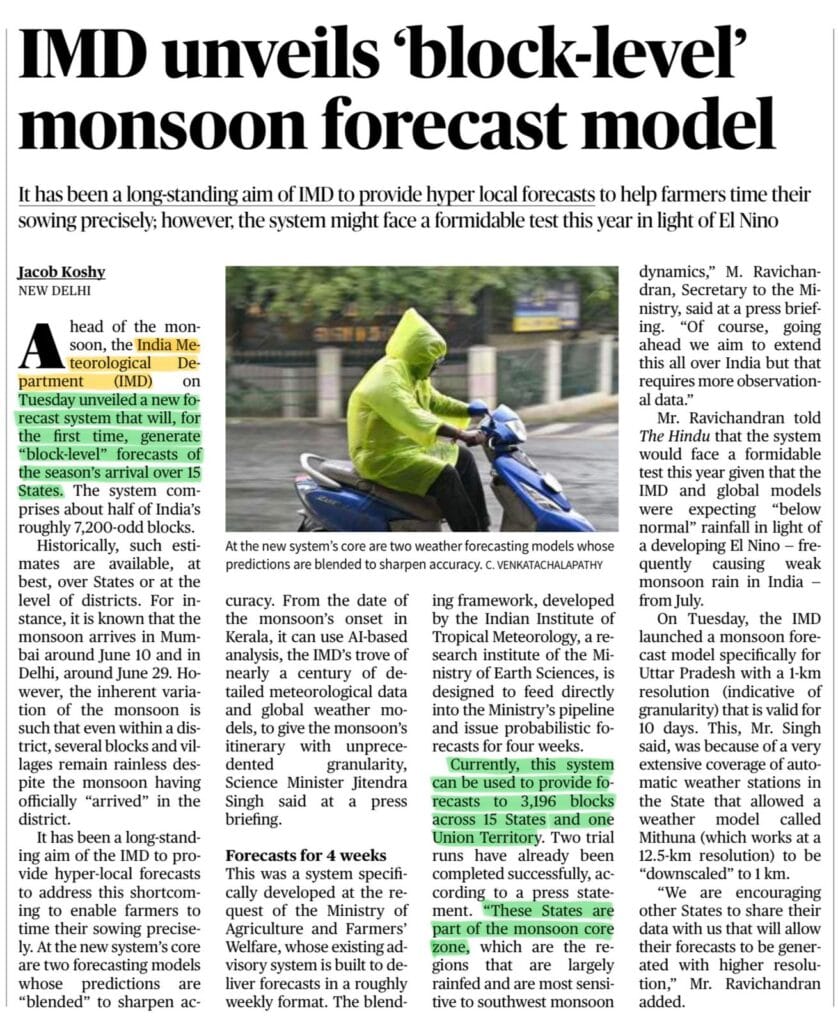
The India Meteorological Department (IMD) launched a new block-level monsoon forecasting system to provide hyper-local rainfall forecasts for farmers. The system currently covers 3,196 blocks across 15 States and 1 UT in the monsoon core zone.

India Meteorological Department (IMD)

  1. Established: 1875
  2. Ministry: Ministry of Earth Sciences (MoES)
  3. Headquarters: New Delhi
  4. Nature: Not a statutory body; attached office of MoES.

Functions

Weather forecasting, monsoon prediction, cyclone warnings, earthquake monitoring, and climate data services.

Earlier Forecasting System

  1. Forecasts were mainly issued at State/district level.
  2. Rainfall variation within districts could not be captured accurately.
  3. Limited usefulness for village-level farm decisions like sowing and irrigation.

New Block-Level Forecast System

  1. Forecasts now issued at block level using AI-based analysis, IMD weather database, and blended forecasting models.
  2. Forecast validity up to 4 weeks.
  3. Designed to support precise farm advisories and improve crop planning.
  4. Developed with support from the Indian Institute of Tropical Meteorology.

Uttar Pradesh 1-km Resolution Initiative

  1. IMD launched a special high-resolution monsoon model for Uttar Pradesh.
  2. Earlier models worked on broader 10–12 km grids; new model predicts weather for every 1 km × 1 km area.
  3. Uses the Mithuna weather model and dense network of Automatic Weather Stations (AWS).
  4. Enables highly localised rainfall prediction, disaster alerts, and agricultural advisories.
Block-Level Monsoon Forecast

Supreme Court launches One Case One Data digital initiative

One Case One Data

Context: One Case One Data

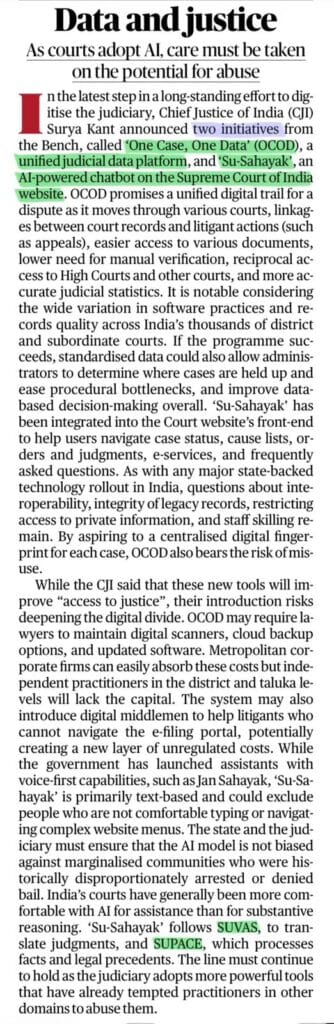
The Supreme Court launched two digital initiatives — One Case, One Data (OCOD) and Su-Sahayak — to improve judicial digitisation and citizen access to courts.

One Case, One Data (OCOD)

  1. Creates a single digital trail of a case across different courts.
  2. Helps track orders, appeals, and documents from Trial Court to High Court to Supreme Court in one place.
  3. Aim: improve judicial efficiency and reduce duplication.

Su-Sahayak

  1. AI-powered chatbot integrated with Supreme Court website.
  2. Helps citizens access:
  • Case status
  • Cause lists
  • Judgments/orders
  • E-services

Related AI Initiatives

  1. SUVAS → AI-based translation of judgments into regional languages.
  2. SUPACE → AI tool assisting judges in processing facts and legal precedents.

Water Governance in India focuses on efficient management and regulation

Context: Water Governance in India

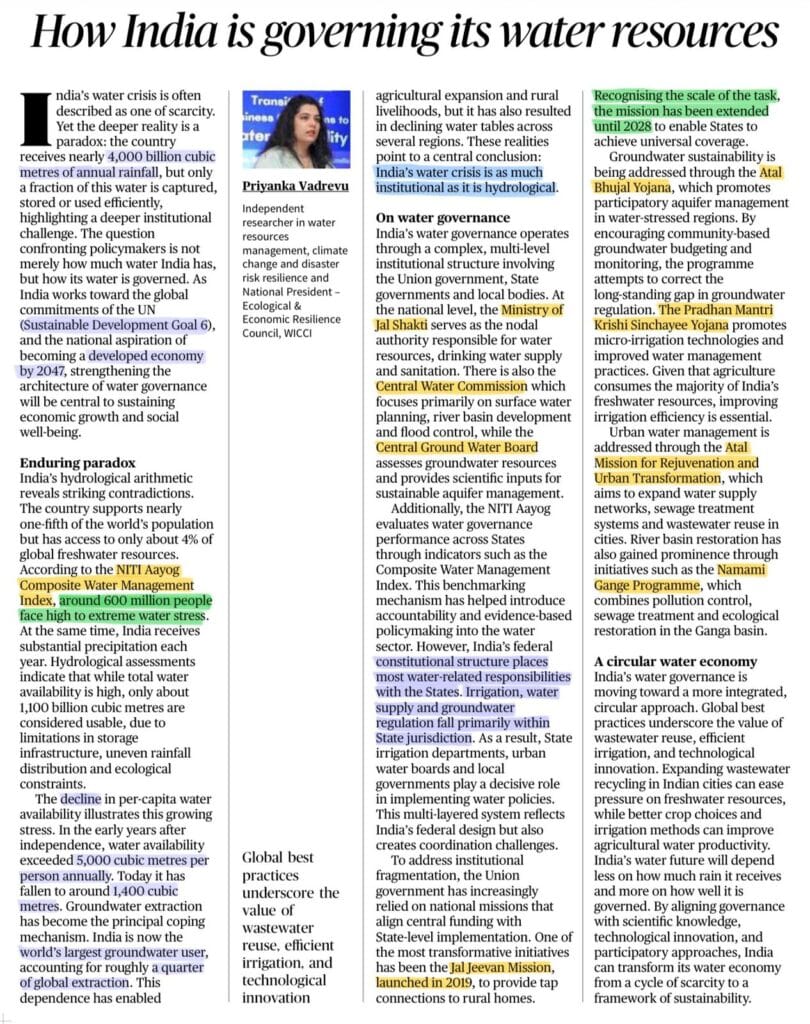
India’s water crisis is increasingly seen as a governance and management challenge rather than only a scarcity issue. The article argues that long-term water security depends on efficient institutions, groundwater regulation, irrigation efficiency, wastewater reuse, and better Centre-State-local coordination.

Key Data

  1. India receives nearly 4,000 BCM of annual rainfall, but only around 1,100 BCM is utilisable due to runoff, evaporation, uneven distribution, and storage limitations.
  2. India has only about 4% of global freshwater resources despite supporting nearly 18% of world population.
  3. Around 600 million people face high to extreme water stress.
  4. Per capita water availability declined from over 5,000 cubic metres/year after Independence to nearly 1,400 cubic metres/year today.
  5. India is the world’s largest groundwater user, accounting for nearly 25% of global groundwater extraction.

Key Water Governance Institutions

  1. Ministry of Jal Shakti (2019) → Nodal ministry for water resources, drinking water, and sanitation.
  2. Central Water Commission (CWC) (1945)
  • Surface water planning, flood control, river basin management.
  • Not a statutory body.
  1. Central Ground Water Board (CGWB) (1970)
  • Groundwater assessment and aquifer management.
  • Not a statutory body.

Major Schemes

  1. Jal Jeevan Mission (JJM) (2019)
  • Ministry: Ministry of Jal Shakti
  • Aim: Functional tap water connection to every rural household.
  1. Atal Bhujal Yojana (ATAL JAL) (2019)
  • Ministry: Ministry of Jal Shakti
  • Aim: Community-led groundwater management in water-stressed areas.
  1. PMKSY — Pradhan Mantri Krishi Sinchayee Yojana (2015)
  • Ministry: Ministry of Agriculture & Farmers Welfare
  • Aim: Irrigation efficiency and “Per Drop More Crop”.
  1. AMRUT — Atal Mission for Rejuvenation and Urban Transformation (2015)
  • Ministry: Ministry of Housing & Urban Affairs
  • Aim: Urban water supply, sewerage, and wastewater treatment.
  1. Namami Gange Programme (2014)
Water Governance in India

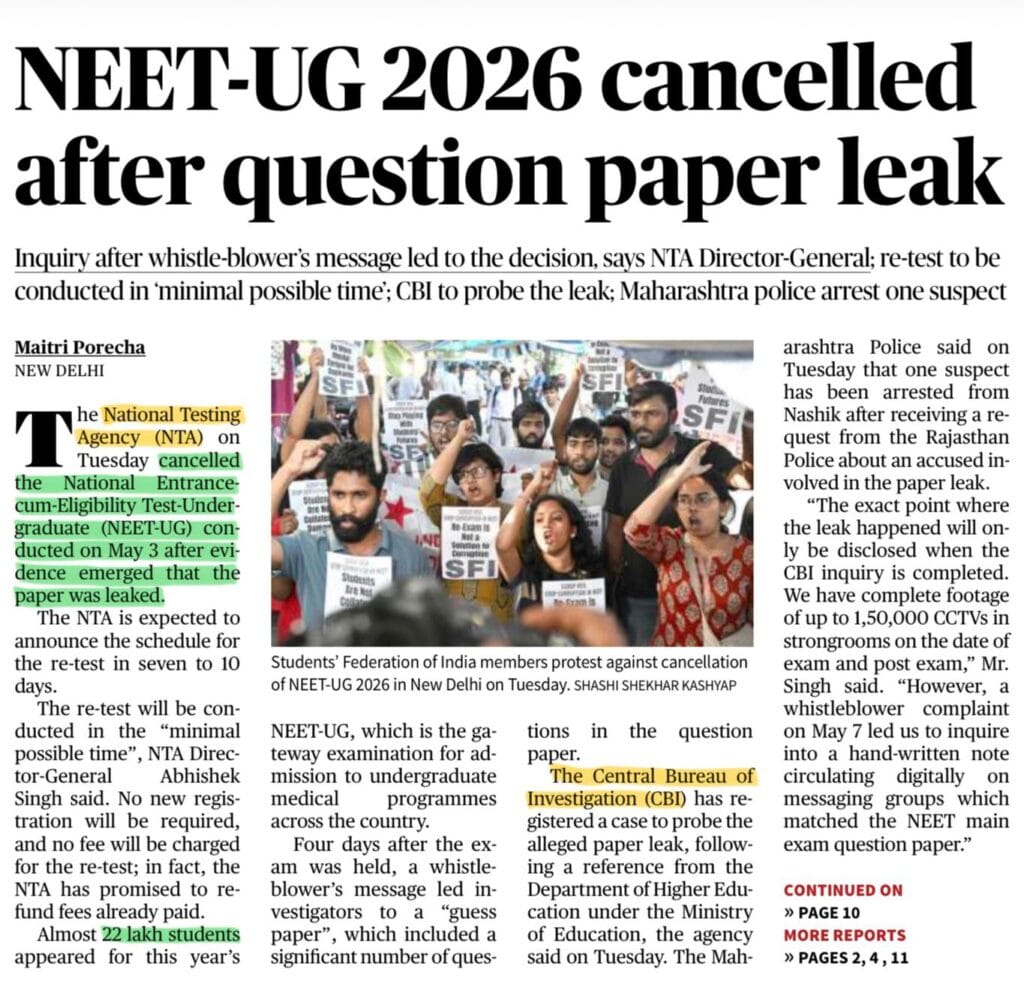
NEET-UG 2026 cancelled after question paper leak concerns

Context: NEET-UG 2026

The National Testing Agency (NTA) cancelled NEET-UG 2026 after evidence of a question paper leak emerged. Around 22 lakh students appeared for the examination. The incident has raised concerns regarding exam security, transparency, cybersecurity, and institutional accountability.

National Testing Agency (NTA)

  1. Established: 2017
  2. Ministry: Ministry of Education
  3. Nature: Autonomous testing agency registered as a society.
  4. Conducts major entrance exams such as NEET, JEE Main, CUET, and UGC-NET.

University Grants Commission (UGC)

  1. Statutory body established under the University Grants Commission Act, 1956.
  2. Functions under the Ministry of Education.
  3. Regulates standards of higher education in India.
  4. Grants recognition and funding to universities and colleges.

Ethics Example (GS-4)

Example of:

  1. Failure of integrity, transparency, and accountability in public institutions.
  2. Ethical issues in examinations:
  • Paper leaks
  • Organised cheating
  • Abuse of public trust
  1. Highlights need for fairness, data security, and responsible governance.
Water Governance in India

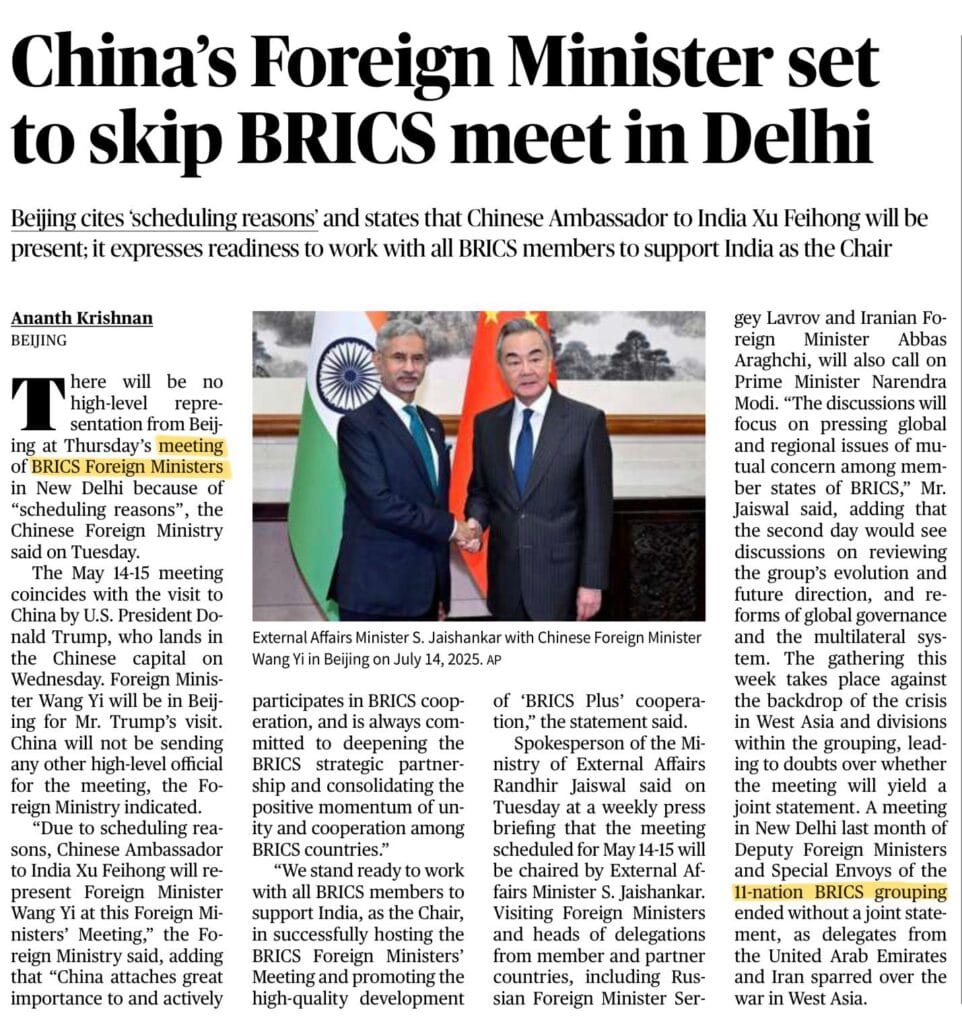
China Foreign Minister likely to skip BRICS Meeting in Delhi

Context: BRICS Meeting

China’s Foreign Minister will skip the BRICS Foreign Ministers’ Meeting in Delhi, as India hosts BRICS meetings under its Chairship.

BRICS Basics

BRICS is a grouping of major emerging economies: Brazil, Russia, India, China, South Africa. It began as BRIC in 2009; South Africa joined in 2010, making it BRICS.

Expansion

  • January 2024: Egypt, Ethiopia, Iran, UAE joined BRICS.
  • January 2025: Indonesia joined as a full member.
  • Saudi Arabia: mentioned in some official BRICS lists as full member, but its final membership status has seen ambiguity in reporting. India’s BRICS 2026 site lists Saudi Arabia as full member from January 2024.

Important Declarations

  • Johannesburg II Declaration (2023): approved BRICS expansion.
  • Kazan Declaration (2024): adopted at the 16th BRICS Summit in Russia.
  • Rio de Janeiro Declaration (2025): adopted at the 17th BRICS Summit in Brazil; theme: “Strengthening Global South Cooperation for More Inclusive and Sustainable Governance.”

India and BRICS 2026

India is hosting BRICS in 2026, including ministerial meetings and the annual summit.

BRICS Meeting
About the UPSC Civil Services Examination (UPSC CSE)

The UPSC Civil Services Examination (CSE) is one of the most competitive and esteemed examinations in India, conducted by the Union Public Service Commission to recruit officers for services such as the Indian Administrative Service (IAS), Indian Police Service (IPS), Indian Foreign Service (IFS), and others. The exam comprises three stages — Prelims, Mains, and the Personality Test (Interview) — designed to test a candidate’s knowledge, aptitude, decision-making, and leadership skills.


How to Prepare Effectively for UPSC CSE

Cracking the UPSC CSE requires a deep understanding of the syllabus, consistent revision, structured answer writing, and smart test-taking strategies. The Prelims test analytical and conceptual clarity, the Mains focuses on critical thinking, articulation, and subject mastery, while the Interview assesses presence of mind, ethical judgment, and personality traits relevant to public service.

At UnderStand UPSC, we empower aspirants with a personalized and focused approach to each stage of the exam.


Why Choose UnderStand UPSC?

UnderStand UPSC is a mentorship-driven platform offering a clear, clutter-free strategy to tackle the Civil Services Examination. Our programs like Transform (for beginners and intermediate learners) and Conquer (for advanced mains preparation) provide structured study plans, syllabus-wise video content, interactive live sessions, and answer writing support.

We emphasize:

  • Concept clarity through topic-wise lectures

  • Test series designed around real UPSC standards

  • Personalized mentorship in small groups

  • Regular performance tracking and peer benchmarking

  • Doubt-clearing sessions, current affairs analysis, and monthly magazines


Join the UnderStand UPSC Learning Community

Our mission is to make UPSC preparation less overwhelming and more strategic. We combine mentorship, discipline, and academic rigor to help you clear CSE with confidence. Whether you’re preparing from Delhi, Mumbai, Bangalore, or a remote village — our online-first model ensures quality guidance reaches every corner of India.

Join the thousands of aspirants who trust UnderStand UPSC to guide their journey toward becoming civil servants.

Stay connected with us through our Telegram, YouTube, and Instagram channels for daily tips, strategies, and updates.

Copyright © 2026 USARAMBHA EDUCATION (UnderStand UPSC). All Rights Reserved.

Join the Success Journey!