4 Dec, 2025

Govt Withdraws Order on Sanchar Saathi App | Sanchar Saathi App UPSC Current Affairs

Sanchar Saathi App

What is it?
A telecom security & citizen-service platform by DoT.

Key Features
• Block/trace lost or stolen phones
• Check SIMs issued in your name
• Identify fraudulent or cloned connections

Why in News?

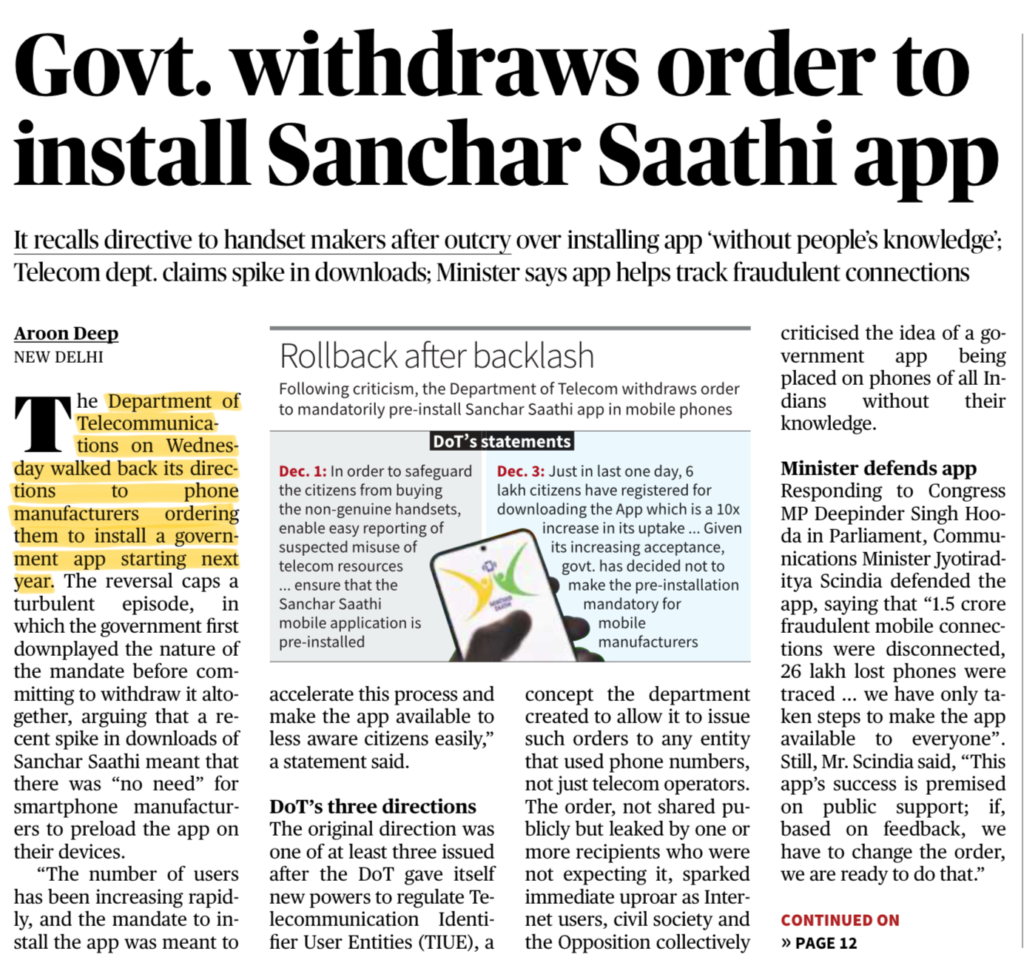
DoT issued an order to mandatorily pre-install the Sanchar Saathi app on all new smartphones from next year.
This led to backlash due to privacy concerns, lack of consent, and fear of surveillance.

Government’s Latest Directive

Order withdrawn.
The app will remain voluntary, not pre-installed.

Why Withdrawn?

• Spike in voluntary downloads (6 lakh in one day; 10× increase)
• Strong public backlash (users, civil society, Opposition)
• DoT said the aim was awareness, now already achieved.
Rupee Depreciation Amid Unclear Trade Deal | Rupee Depreciation UPSC Economy Update

Key Reasons for Rupee Depreciation

  1. Delay in U.S.–India Trade Deal
    • Trade deal pending for 6–7 months.
    • Markets not able to “price in” the deal → uncertainty weakens rupee.
  2. Lack of Clear Communication from Indian Authorities
    • Limited clarity from RBI and government on rupee management.
    • Creates speculation and nervousness among investors.
  3. Foreign Investors Selling Indian Assets
    • FIIs moved money to U.S., Europe, Korea, Japan.
    • Causes capital outflow → rupee weakens.
  4. Strength of U.S. Dollar Globally
    • Higher dollar demand due to U.S. economic conditions.

RBI’s Lower Intervention
• Current governor less interventionist; RBI selling fewer dollars → weaker defence of rupee.

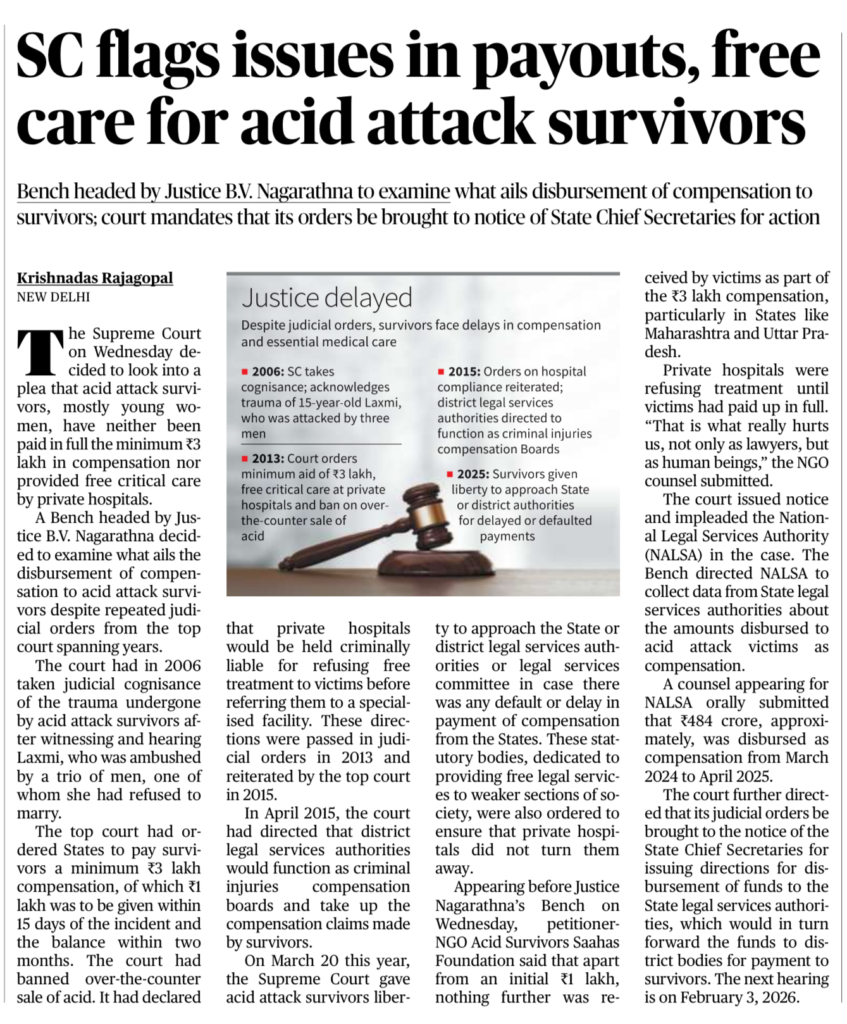
SC Highlights Gaps in Support for Acid Attack Survivors | Acid Attack Survivors UPSC News

Context

The Supreme Court noted that acid attack survivors are still not receiving the mandatory ₹3 lakh compensation or free critical care at private hospitals, despite repeated SC orders (2006, 2013, 2015).
SC asked why delays persist and directed State Chief Secretaries and NALSA to ensure compliance.

UPSC Mains Notes

1. Key Issues Identified by SC
• Delayed/incomplete ₹3 lakh compensation
• Private hospitals refusing free treatment until victims pay first
• Weak enforcement by district legal services authorities
• Slow processing of claims

2. SC Directions (Recent + Past)
• Minimum ₹3 lakh compensation; ₹1 lakh within 15 days, remainder in 2 months
• Free treatment at private hospitals; refusal = criminal liability
• District authorities to act as Criminal Injuries Compensation Boards
• Survivors can approach State/DLSA for delays
• NALSA to collect data and ensure compliance; orders to be sent to Chief Secretaries3. Why This Matters
• Acid attack survivors = vulnerable group needing medical + legal protection
• Shows implementation gap despite strong judicial framework
• Highlights need for accountability, compensation, and victim-centric justice

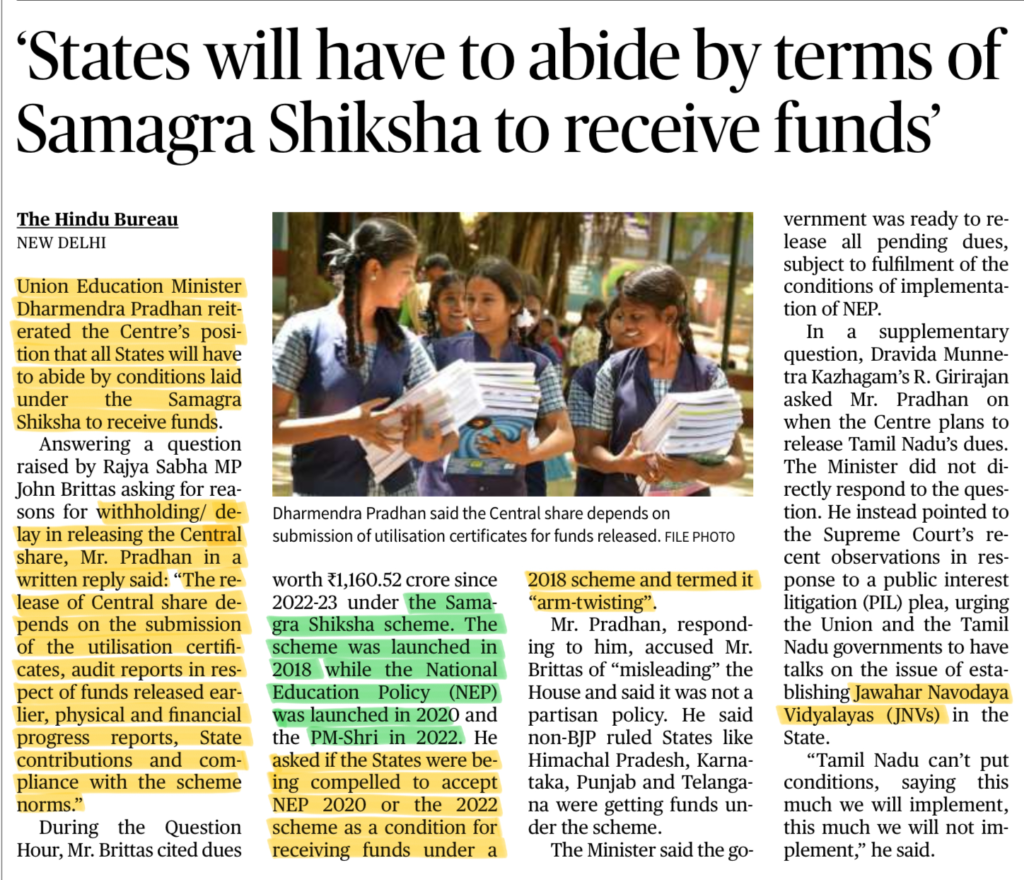
States Must Follow Samagra Shiksha Guidelines for Funding | Samagra Shiksha UPSC Update

Context

• Centre clarified that funds under Samagra Shiksha will be released only when States meet scheme conditions (utilisation certificates, audits, progress reports).
• MPs asked whether States were being forced to accept NEP 2020 or PM-SHRI to receive funds.
• Government said no — fund release is scheme-based, not political.

Samagra Shiksha Abhiyan — Prelims Essentials

A Centrally Sponsored Scheme (launched 2018) integrating:

  1. SSA – Sarva Shiksha Abhiyan
  2. RMSA – Rashtriya Madhyamik Shiksha Abhiyan
  3. Teacher Education

Key Features
• Holistic school education Pre-primary → Class 12
• School infrastructure, teacher training, quality improvement
• Strong focus on FLN (Foundational Literacy & Numeracy)

Funding pattern
• 60:40 → General States
• 90:10 → NE & Himalayan States
• 100% → UTs

PM-SHRI (PM Schools for Rising India) — Prelims Points

• Launched: 2022
• 14,500 schools to be upgraded as model NEP schools
• Emphasis on green schools & sustainability, smart classrooms, experiential learning
• Voluntary — States join via MoU, not compulsory.

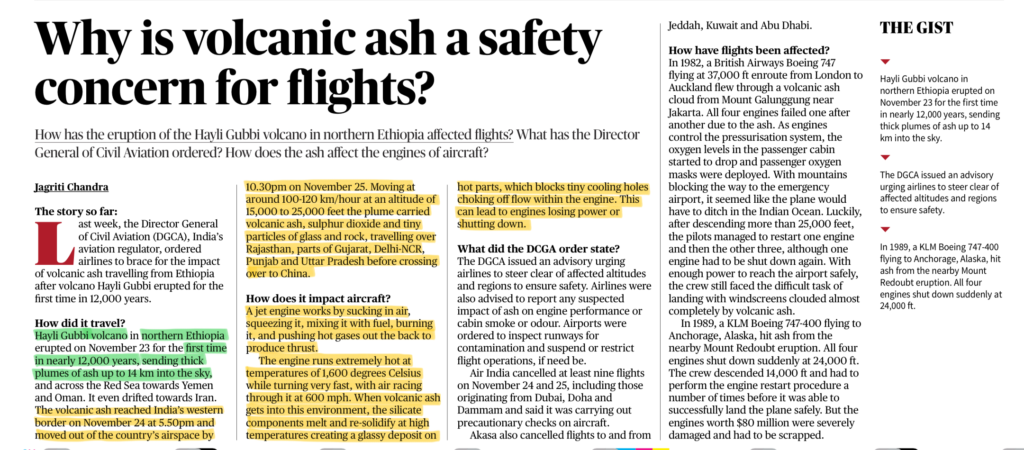
Why Volcanic Ash is a Threat to Aircraft Safety | Volcanic Ash UPSC Prelims Topic

Context

• Hayli Gubbi volcano, northern Ethiopia erupted on 23 November after ~12,000 years.
• Sent ash plumes up to ~14 km into the sky.
• Ash cloud travelled across the Red Sea and Arabian Peninsula and even reached India’s western border.
• DGCA issued an advisory to airlines to steer clear of affected altitudes/areas.

How Volcanic Ash Impacts Aircraft — Step by Step

  1. Ash enters jet engine
    • Engine sucks in air + ash instead of clean air.
  2. Melting inside engine
    • Inside temperature: ~1,400–1,600°C.
    • Ash (fine rock/glass) melts and becomes a glassy liquid.
  3. Deposits on hot parts
    • Melted ash sticks to turbine blades and other hot components.
  4. Blocks cooling & airflow
    • Forms a glassy coating, blocking tiny cooling holes.
    • Chokes airflow inside the engine.
  5. Engine damage/shutdown
    • Causes overheating, loss of power, compressor stall.
    • Engine can lose thrust or completely shut down.

Other effects on aircraft
• Ash abrades windscreens → poor visibility.
• Can clog sensors and contaminate cabin/air filters.

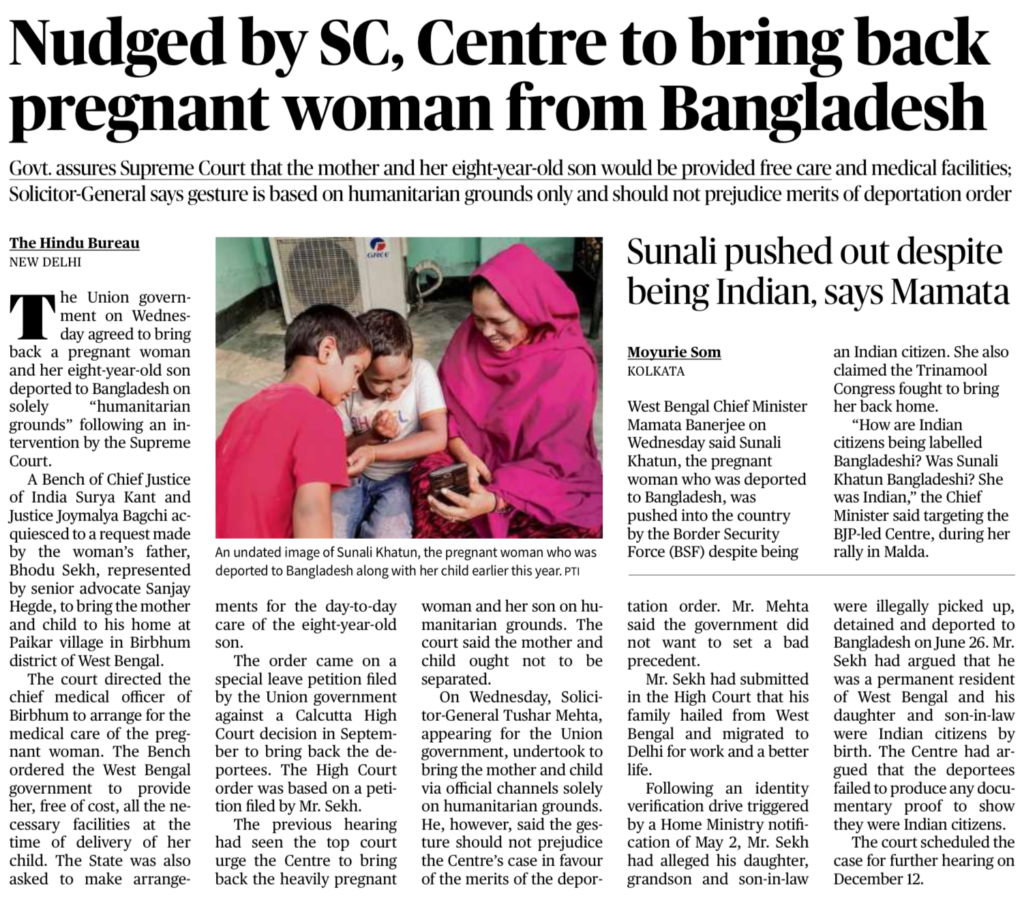
India’s Humanitarian Relief for Pregnant Woman in Bangladesh | Humanitarian Relief UPSC News

What is the Issue?

• A pregnant Indian woman (Sunali Khatun) and her eight-year-old son were deported to Bangladesh by authorities despite her family claiming Indian citizenship.
• Her father approached the courts arguing that the deportation was wrongful and that mother and child should not be separated.
• The Supreme Court intervened, directing the Union government and West Bengal government to arrange medical care, safe return, and humanitarian assistance.
• The Centre agreed to bring them back purely on humanitarian grounds, without affecting the merits of the deportation case.

Mains Enrichment

1. Judicial Humanitarian Intervention
SC ensured return and care of the woman and child purely on humanitarian grounds.

2. Protection Against Administrative Overreach
SC checked arbitrary deportation actions and upheld due process.

TDF

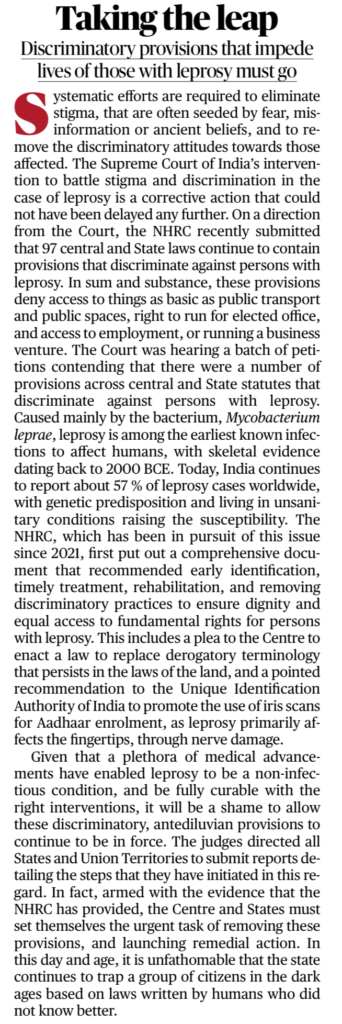
“Despite scientific evidence proving leprosy is curable and non-infectious, discriminatory laws persist in India. Discuss the role of the Supreme Court in correcting such legal inertia.” (150 words)

Discriminatory Leprosy Laws in India Explained | Leprosy Laws UPSC Current Affairs

Mains Enrichment — Leprosy

• India reports ~57% of global leprosy cases.
• Caused by Mycobacterium leprae.
• One of the earliest known human infections — evidence from 2000 BCE.
• Genetic predisposition + unsanitary living conditions raise susceptibility.

Discriminatory Laws Data

• 97 Central & State laws still discriminate against leprosy-affected persons.

Restrictions include:
• Access to public transport
• Employment restrictions
• Discriminatory terminology in statutes

NHRC 2021 Report Recommendations

• Early identification & timely treatment
• Rehabilitation
• Remove discriminatory laws
• Replace derogatory terms
• Use iris scans for Aadhaar (since leprosy affects fingerprints)

What the Supreme Court has Done?

1. SC took suo motu-like corrective action
• Heard petitions claiming Indian laws still discriminate against persons with leprosy.

2. Sought NHRC report
• NHRC submitted that 97 laws still contain discriminatory provisions.

3. Directed Centre, States & UTs
• To submit status reports on steps taken to remove these laws.
• To take urgent remedial measures.

Why This is Good??

• Promotes dignity, equality, and non-discrimination for a vulnerable group.
• Aligns with constitutional rights — Article 14, 15, 21.
• Corrects historical injustice and stigma rooted in fear and misinformation.
• Encourages scientific, evidence-based policymaking.
• Supports rehabilitation and mainstreaming of leprosy-affected individuals.

About the UPSC Civil Services Examination (UPSC CSE)

The UPSC Civil Services Examination (CSE) is one of the most competitive and esteemed examinations in India, conducted by the Union Public Service Commission to recruit officers for services such as the Indian Administrative Service (IAS), Indian Police Service (IPS), Indian Foreign Service (IFS), and others. The exam comprises three stages — Prelims, Mains, and the Personality Test (Interview) — designed to test a candidate’s knowledge, aptitude, decision-making, and leadership skills.


How to Prepare Effectively for UPSC CSE

Cracking the UPSC CSE requires a deep understanding of the syllabus, consistent revision, structured answer writing, and smart test-taking strategies. The Prelims test analytical and conceptual clarity, the Mains focuses on critical thinking, articulation, and subject mastery, while the Interview assesses presence of mind, ethical judgment, and personality traits relevant to public service.

At Understand UPSC, we empower aspirants with a personalized and focused approach to each stage of the exam.


Why Choose Understand UPSC?

Understand UPSC is a mentorship-driven platform offering a clear, clutter-free strategy to tackle the Civil Services Examination. Our programs like Transform (for beginners and intermediate learners) and Conquer (for advanced mains preparation) provide structured study plans, syllabus-wise video content, interactive live sessions, and answer writing support.

We emphasize:

  • Concept clarity through topic-wise lectures

  • Test series designed around real UPSC standards

  • Personalized mentorship in small groups

  • Regular performance tracking and peer benchmarking

  • Doubt-clearing sessions, current affairs analysis, and monthly magazines


Join the Understand UPSC Learning Community

Our mission is to make UPSC preparation less overwhelming and more strategic. We combine mentorship, discipline, and academic rigor to help you clear CSE with confidence. Whether you’re preparing from Delhi, Mumbai, Bangalore, or a remote village — our online-first model ensures quality guidance reaches every corner of India.

Join the thousands of aspirants who trust Understand UPSC to guide their journey toward becoming civil servants.

Stay connected with us through our Telegram, YouTube, and Instagram channels for daily tips, strategies, and updates.

Copyright © 2025 USARAMBHA EDUCATION (UnderStand UPSC). All Rights Reserved.

Join the Success Journey!