Context
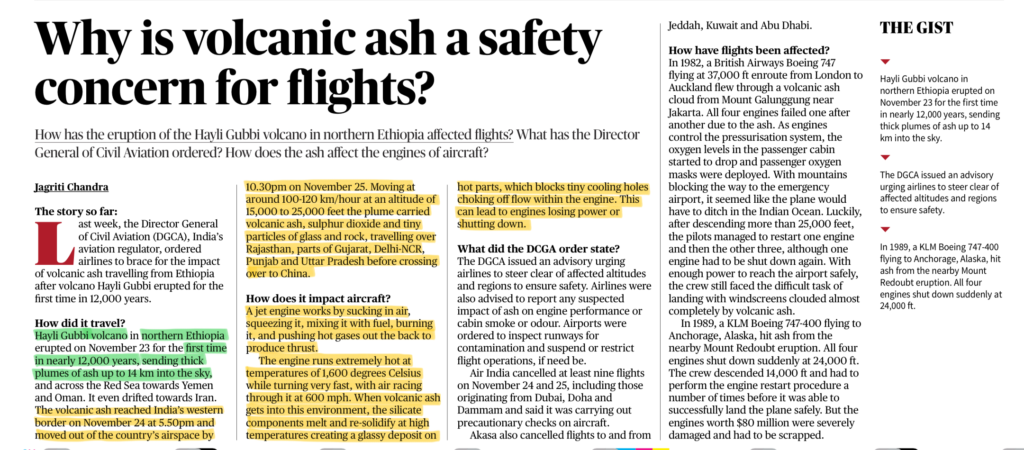
• Hayli Gubbi volcano, northern Ethiopia erupted on 23 November after ~12,000 years.
• Sent ash plumes up to ~14 km into the sky.
• Ash cloud travelled across the Red Sea and Arabian Peninsula and even reached India’s western border.
• DGCA issued an advisory to airlines to steer clear of affected altitudes/areas.
How Volcanic Ash Impacts Aircraft — Step by Step
- Ash enters jet engine
• Engine sucks in air + ash instead of clean air. - Melting inside engine
• Inside temperature: ~1,400–1,600°C.
• Ash (fine rock/glass) melts and becomes a glassy liquid. - Deposits on hot parts
• Melted ash sticks to turbine blades and other hot components. - Blocks cooling & airflow
• Forms a glassy coating, blocking tiny cooling holes.
• Chokes airflow inside the engine. - Engine damage/shutdown
• Causes overheating, loss of power, compressor stall.
• Engine can lose thrust or completely shut down.
Other effects on aircraft
• Ash abrades windscreens → poor visibility.
• Can clog sensors and contaminate cabin/air filters.