Every year, lakhs of candidates prepare for the UPSC Civil Services Examination with one goal: to enter India’s civil services. But in 2026, the conversation around this examination is going beyond the usual questions about vacancies, cut-offs and difficulty levels.
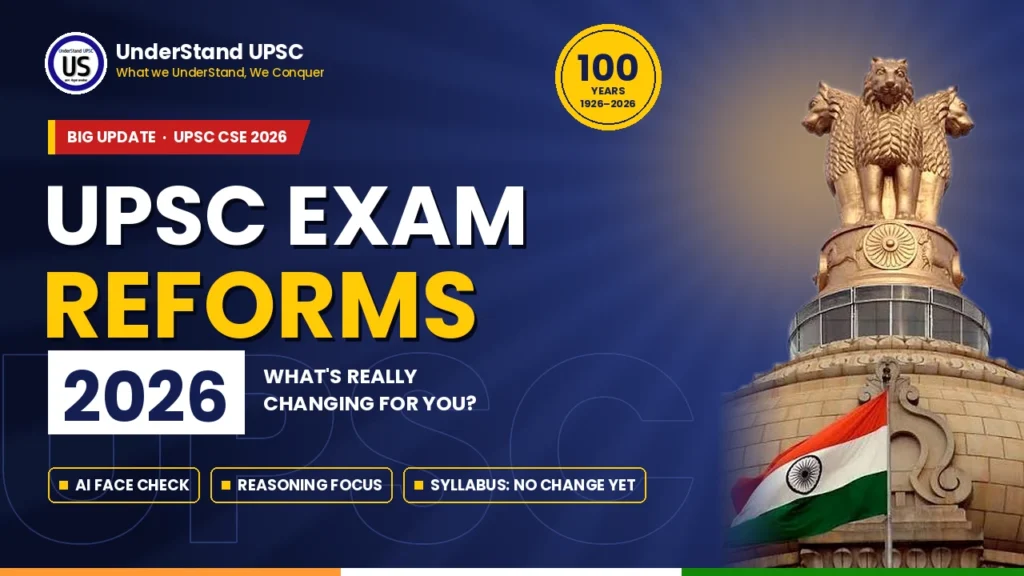
As the Union Public Service Commission marks 100 years since the establishment of India’s first Public Service Commission, attention has turned towards the future of civil services recruitment. The UPSC exam reforms 2026 discussions have raised important questions about how candidates should be evaluated and whether existing recruitment practices adequately reflect the demands of modern administration.
From reasoning and decision-making to artificial intelligence and examination transparency, several developments deserve the attention of UPSC aspirants.
UPSC at 100: Why Is Reform Being Discussed?
India’s first Public Service Commission was established on October 1, 1926. A century later, the responsibilities of civil servants have expanded considerably.
An IAS officer today may have to deal with climate-related disasters, digital governance, cybersecurity concerns, economic challenges and rapidly changing public expectations. Handling these responsibilities requires more than remembering facts or reproducing prepared answers.
During UPSC’s centenary celebrations in 2026, Chairman Dr Ajay Kumar highlighted the importance of reasoning, spontaneous thinking and the ability to make decisions under uncertainty.
The UPSC 100 years milestone has therefore brought renewed attention to an important question: how can recruitment identify candidates who possess the judgement required for public administration?
This does not mean the existing examination is being replaced. Rather, it reflects a broader discussion about improving the way administrative potential is assessed.
Reasoning and Decision-Making Take Centre Stage
One of the most significant aspects of the UPSC exam reforms discussion is the emphasis on analytical ability.
Traditionally, UPSC preparation has involved extensive reading, revision and practice. While these remain essential, the Commission’s leadership has highlighted the importance of assessing how candidates approach unfamiliar problems.
Consider a question about urban flooding. Remembering the causes is useful, but a future administrator must also understand how poor planning, infrastructure gaps and institutional coordination affect the response.
This is where analytical thinking becomes important.
For aspirants, the implication is straightforward. Understanding a topic thoroughly and connecting it with real administrative challenges is more useful than relying entirely on memorised material.
However, no new CSE question-paper pattern has been officially announced as a result of these discussions.
AI-Based Facial Authentication: A Major Change in 2026
Technology is one area where UPSC has already introduced a concrete change.
During the Civil Services Preliminary Examination held on May 24, 2026, the Commission implemented AI-enabled facial authentication at examination centres.
The system was deployed across 2,072 venues in 83 cities, covering an examination attended by approximately 5.49 lakh candidates. Facial verification generally took around six to eight seconds.
The initiative was designed to strengthen identity verification and reduce the risk of impersonation.
This development is particularly important because examination security directly affects the credibility of the recruitment process.
Among the UPSC new changes 2026, facial authentication stands out as an implemented measure rather than a proposed reform.
Transparency and Recruitment Efficiency
UPSC’s centenary discussions also highlighted three priorities: Trust, Transparency and Technology.
These principles reflect the need to maintain confidence in a recruitment system that determines entry into some of India’s most important public institutions.
Another issue receiving attention is the duration of recruitment.
Prime Minister Narendra Modi emphasised the importance of reducing recruitment timelines during the centenary programme.
For candidates, prolonged selection processes can create uncertainty about employment, finances and future attempts. More predictable timelines could make the recruitment experience easier to manage.
At the same time, aspirants should understand that a general call for faster recruitment does not amount to an officially revised CSE examination calendar.
Are UPSC CSE Exam Reforms Changing the Syllabus?
This is perhaps the most pressing question for candidates preparing for upcoming attempts.
Despite discussions surrounding UPSC CSE exam reforms, the centenary announcements did not introduce a new Civil Services Examination syllabus or replace its established selection stages.
The examination continues to consist of Prelims, Mains and the Personality Test.
The Preliminary Examination tests General Studies and aptitude, while Mains assesses a candidate’s understanding, analytical ability and written expression. The Personality Test evaluates suitability for a career in public service.
Any formal changes to examination rules, eligibility conditions, marking schemes or the syllabus must be announced through official UPSC notifications.
Candidates should be particularly cautious about online claims concerning the removal of optional subjects or major changes to the examination structure.
What Should Aspirants Change in Their Preparation?
The most useful response to these developments is not to overhaul an existing study plan but to improve its quality.
Aspirants should continue studying standard books and following current affairs. However, they should also develop the habit of questioning information rather than simply collecting it.
For example, while studying a government scheme, examine why it was introduced, how it is implemented, what challenges it faces and whether its outcomes can be improved.
For Mains, practise answers that present balanced arguments supported by relevant examples. For Prelims, strengthen conceptual understanding alongside factual revision and CSAT practice.
Most importantly, rely on the official UPSC website for examination-related announcements.
Conclusion
The UPSC exam reforms 2026 discussions reflect a wider effort to ensure that India’s civil services recruitment system remains relevant after a century of institutional development.
AI-enabled facial authentication has already strengthened examination security, while reasoning, transparency and recruitment efficiency have emerged as important reform priorities.
Although these discussions have not established a new CSE examination pattern, they offer a valuable lesson for aspirants.
Preparing for UPSC is not only about knowing the right answer. It is also about understanding a problem, weighing different perspectives and arriving at a well-reasoned decision.
That approach will remain valuable regardless of how the examination evolves.