Context:
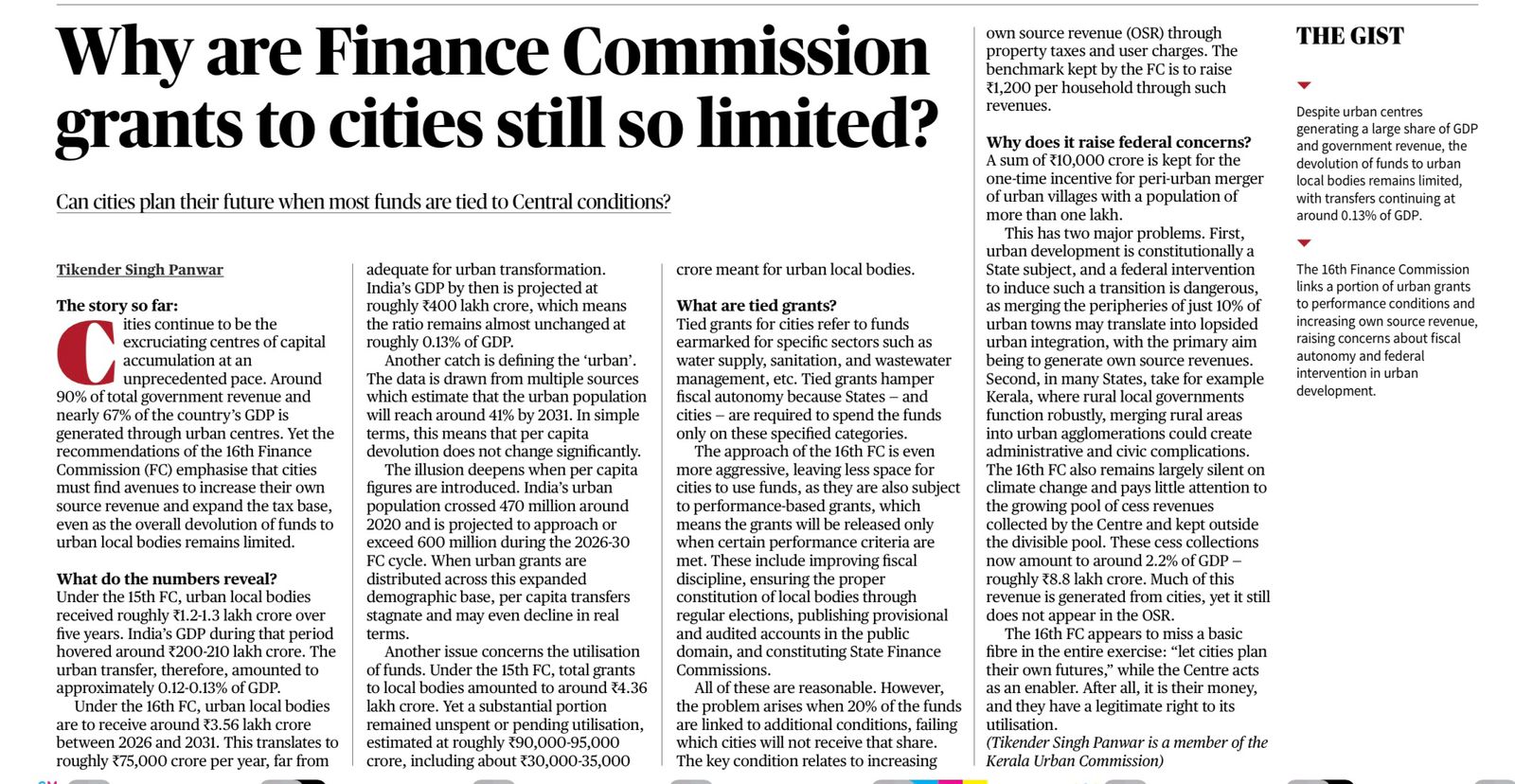
Cities generate ~67% of GDP and ~90% of government revenue, yet Finance Commission transfers to urban local bodies remain only ~0.12–0.13% of GDP.
1. Finance Commission — Basis & Role
• Constituted under Article 280 by the President (every 5 years).
• Composition: 1 Chairman + 4 Members.
Recommends:
– Tax devolution (Union–States; among States).
– Grants-in-aid under Article 275.
– Measures to augment funds of Panchayats & Municipalities (urban local bodies).
2. Transfers to Urban Local Bodies
• 15th Finance Commission: ~₹1.2–1.3 lakh crore (5 years).
• 16th Finance Commission: ₹3.56 lakh crore (2026–31) (₹75,000 crore/year).
• Urban population:
– ~470 million (2020)
– May exceed 600 million by 2030
→ Per-capita support limited.
3. Why Grants Stay Limited
• Mostly tied grants (water, sanitation, waste), limiting flexibility.
• Performance-linked conditions: audits, elections, fiscal discipline, State Finance Commissions.
• Urban development is a State subject (State List), raising federal concerns.
4. Structural Constraints
• Rising cess collections (~2.2% of GDP) outside divisible pool reduce devolution space.
• Weak own-source revenue (property tax, user charges) constrains cities.