
Context: Voting Rights and Electoral Rolls
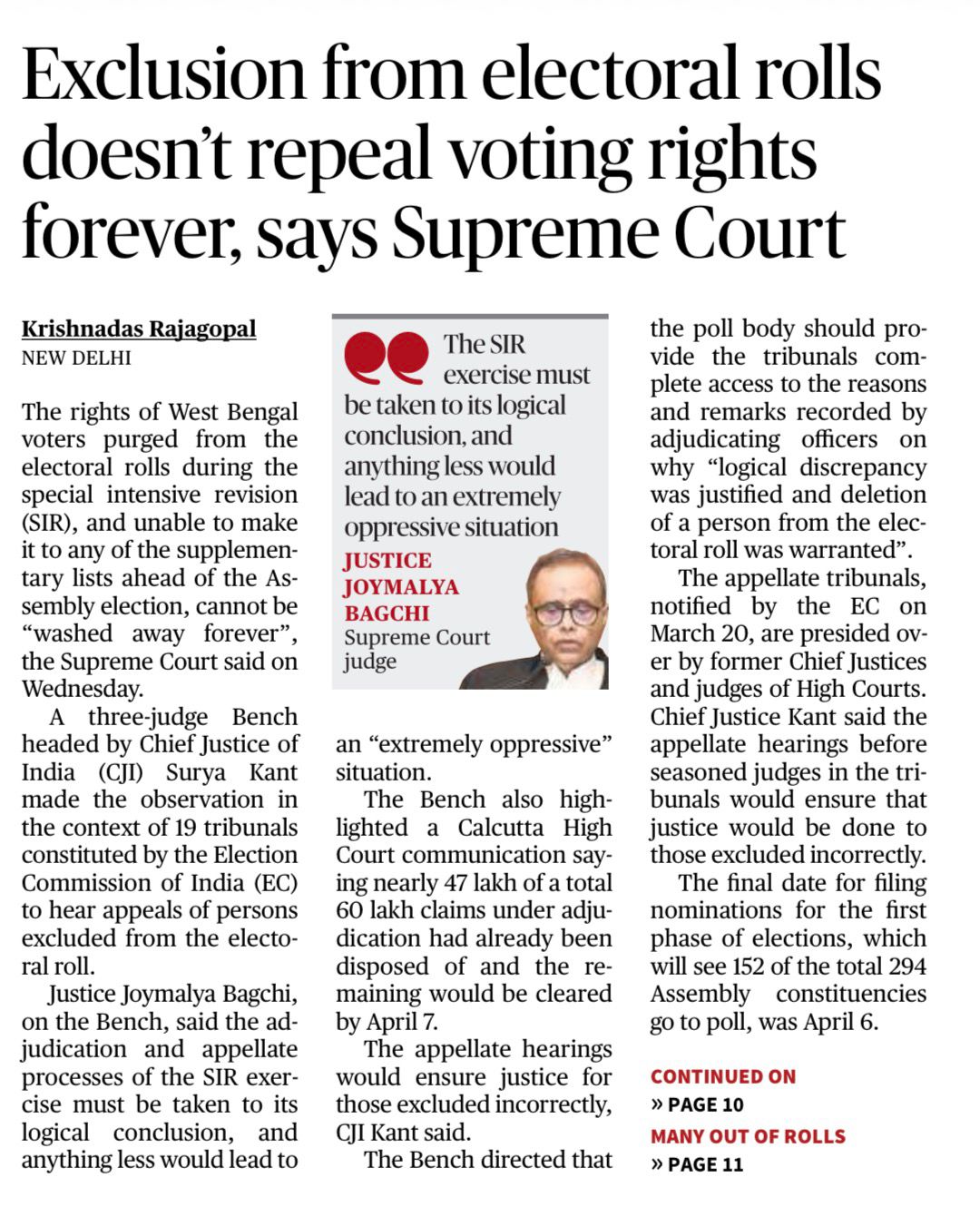
The Supreme Court held that deletion of names during the Special Intensive Revision (SIR) is only procedural and cannot permanently deprive citizens of voting rights, which must be protected through a legally backed, fair and reviewable process.
Core Principle
• Voting rights are not permanently extinguished due to deletion
• SIR must be carried to its logical conclusion with safeguards
• Arbitrary exclusion → “extremely oppressive situation”
Statutory & Constitutional Basis of SIR
• Article 324(1) → ECI’s plenary powers: superintendence, direction & control of electoral rolls
• Representation of the People Act, 1950
Section 21(3) → Allows special revision at any time in any manner deemed fit
Section 22 → Correction (deletion/modification) of entries
Section 23 → Inclusion of eligible voters
• Registration of Electors Rules, 1960
Rule 25 → “Intensive revision” → preparation of rolls afresh (door-to-door verification)
Due Process Safeguards
• Deletion must be based on objective grounds (death, migration, duplication)
• Notice + opportunity to be heard is essential
• EC must record reasons for exclusion
Appellate Mechanism
• 19 tribunals set up by ECI
• Headed by former Chief Justices / High Court judges
• Ensure judicial scrutiny of wrongful exclusions
Scale of Exercise
• Large-scale exclusions (West Bengal context)
• ~47 lakh of 60 lakh claims disposed
• Remaining cases to be cleared within timeline
Constitutional Significance
• Voting → Statutory right (RPA) but core to:
• Free & fair elections (Basic Structure)
• Article 326 (adult suffrage framework)
• Balance required between electoral purity vs voter inclusion







