2 Jan 2026 | Daily Current Affairs

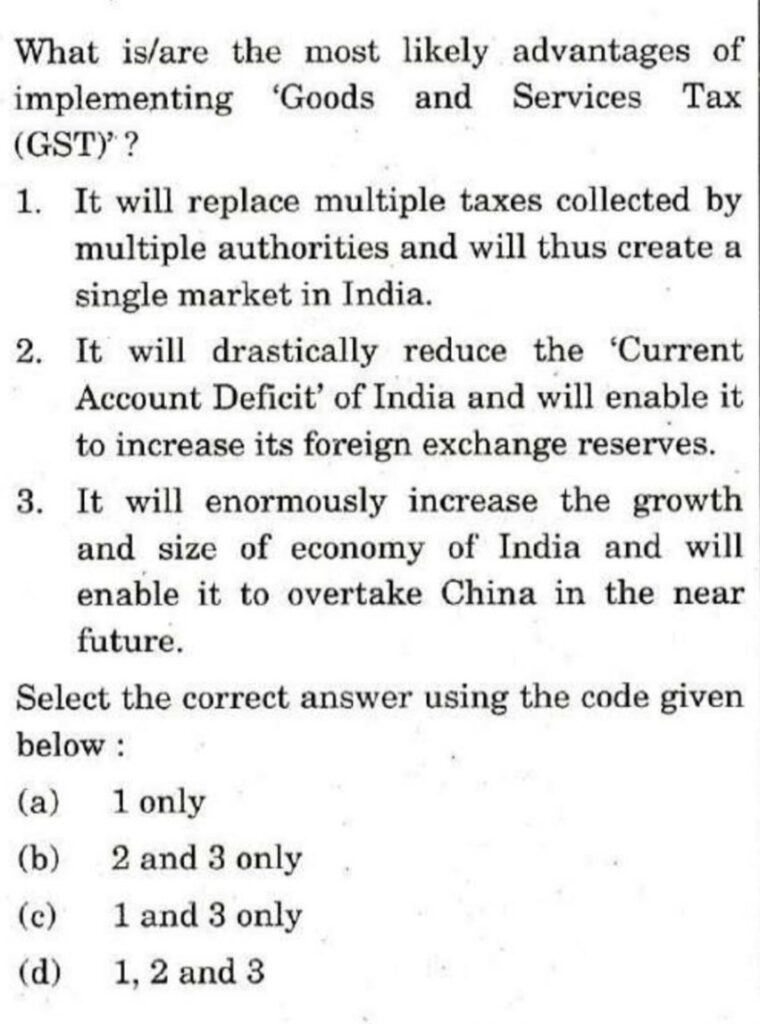
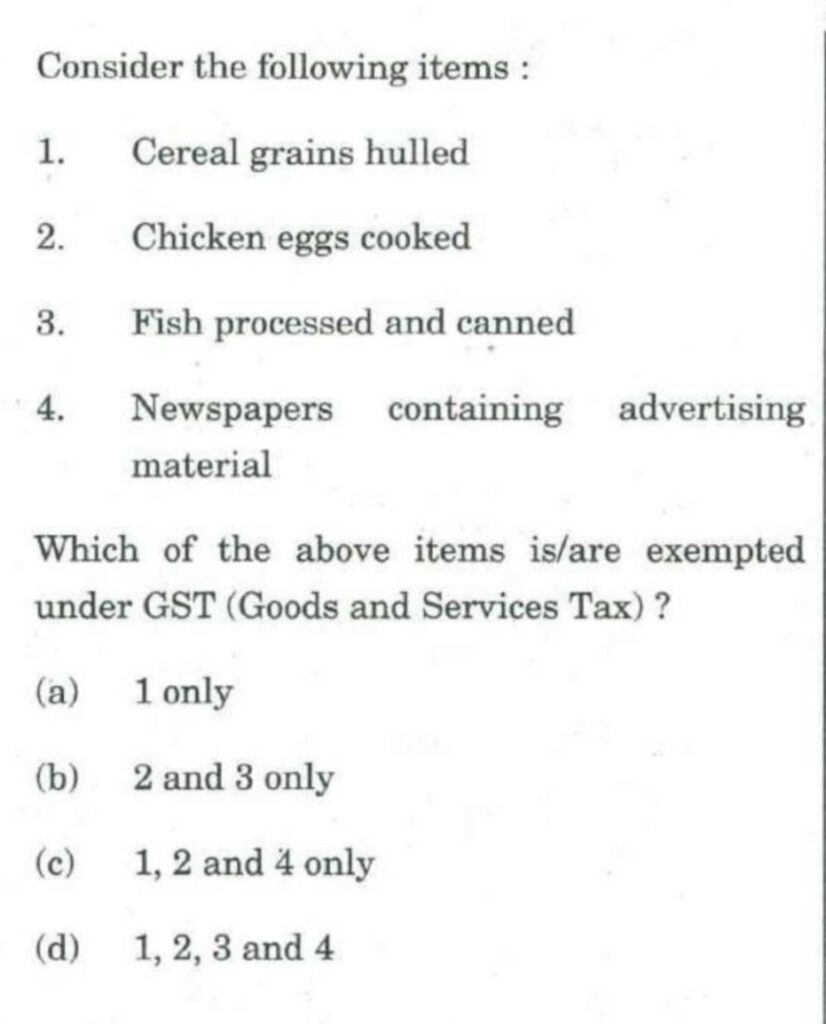
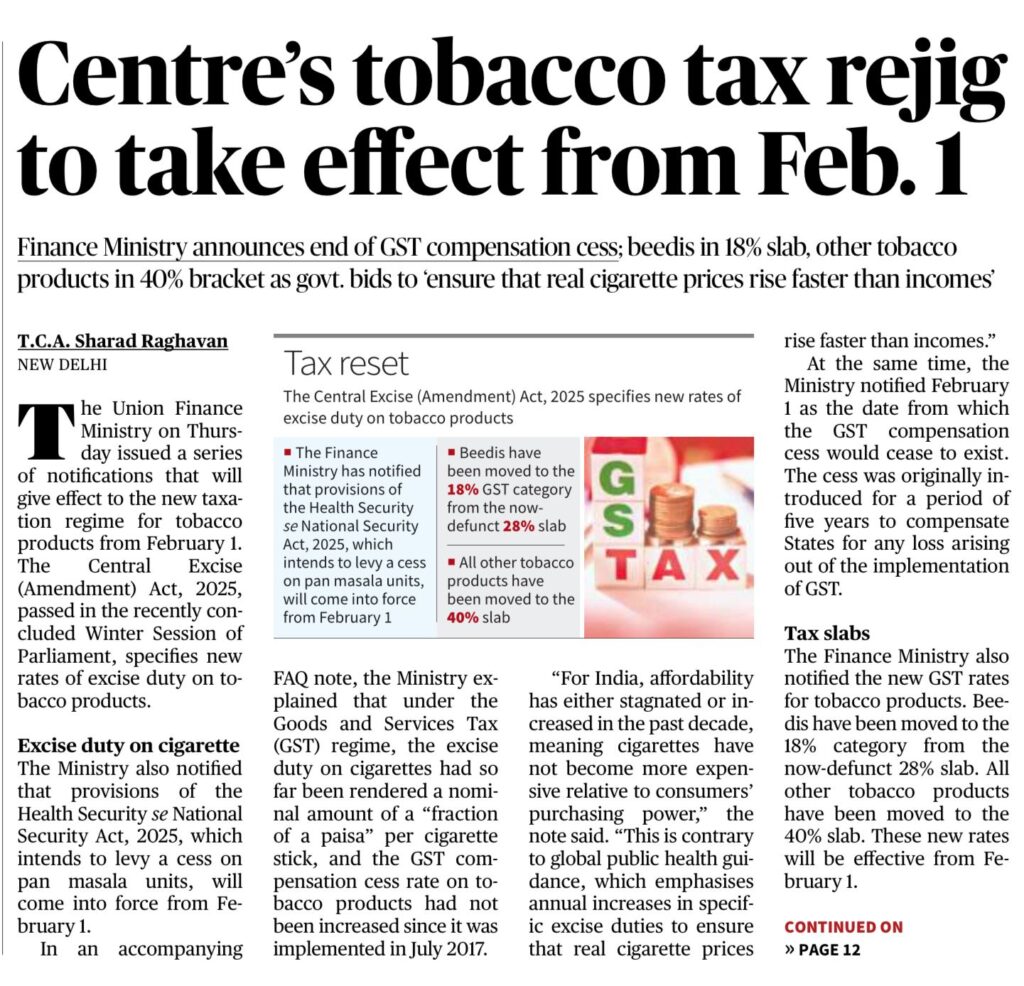
Tobacco Tax Reform in India: Centre’s New Excise Changes Explained

The Tobacco Tax “Reset”

Context

  • The Union has passed the Central Excise (Amendment) Act, 2025 and the Health & National Security Cess Act, 2025.
  • These laws restructure tobacco taxation to replace the temporary GST Compensation Cess which expires on February 1, 2026.

UPSC Prelims Cheat Sheet

Constitutional Source

  • Article 246A: Grants concurrent power to both Centre and States for GST
  • Entry 84 (Union List): Gives the Centre exclusive power to levy Excise Duty on tobacco (tobacco is among the few items under both GST and Excise)
  • Article 270: Proceeds of GST and Excise are shared with States (Divisible Pool)
  • Article 271: Proceeds of the National Security Cess go solely to the Consolidated Fund of India and are not shared with States

Key Structural Changes

  • Cigarettes & smokeless tobacco
    • Permanent 40% GST slab
    • High specific excise duty (tax per 1,000 sticks)
  • Beedis
    • Moved to lower 18% GST slab (from 28%) to protect workers
    • Still subject to excise
  • GST Compensation Cess
    • Officially ceased (abolished) from February 1, 2026

Administrative Reform

  • Capacity-based levy for unorganised sectors (pan masala)
  • Tax calculated on machine speed (pouches per minute) instead of self-declared sales
  • Objective: curb tax evasion

Policy Goal

  • Align with WHO guidelines
  • Ensure tobacco prices rise faster than income growth (negative affordability)
Tobacco Tax Reform in India

Climate-Resilient Agriculture in India: Need and Significance

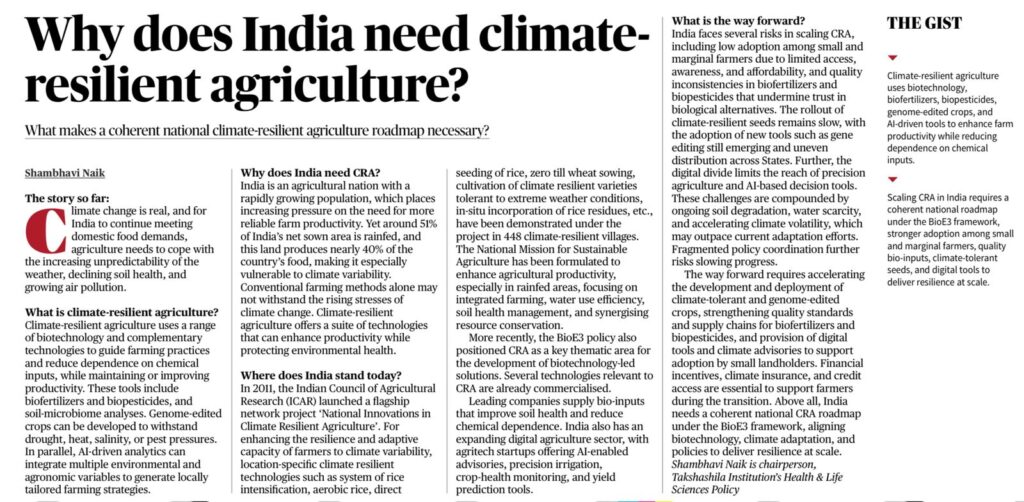
Climate-Resilient Agriculture (CRA)

Context

  • 51% of India’s sown area is rainfed
  • Contributes ~40% of food production
  • Without adaptation, rice yields may drop 3–22% by end of century

Definition

  • Integrated approach to managing cropland, livestock, forests and fisheries
  • Addresses food security and climate change simultaneously

Core Objective

  • Enable agriculture to “bounce back” from climate shocks
  • Maintain productivity while reducing chemical dependence

Key Pillar

  • Biotechnology (genome-edited seeds)
  • Complementary technologies (biofertilisers, AI-based weather alerts)

UPSC Fact Sheet

Institutional Framework

  • NICRA (National Innovations in Climate Resilient Agriculture)
    • Launched by ICAR in 2011
    • Focus on research, technology demonstration and Climate Resilient Villages
  • BioE3 Policy (2024)
    • Identifies CRA as a thematic sector
    • Targets $300 billion bio-economy by 2030

Strategic Interventions & Technologies

  • Crop science
    • Stress-tolerant varieties (HDCSW-18, DBW-187 wheat)
    • 2,600+ varieties released by ICAR in last decade
  • Water-smart technologies
    • SRI, aerobic rice, rainwater harvesting, precision drip irrigation
  • Carbon-smart practices
    • Zero tillage, cover cropping, agroforestry
  • Biotech solutions
    • Microbial consortia and soil microbiome restoration

Critical Challenges

  • Adoption gap
    • 85% farmers are small/marginal
    • High cost and low awareness
  • Digital divide
    • Limited reach of precision farming and AI advisories
  • Resource fatigue
    • Declining soil organic carbon
    • Overexploited groundwater (notably Haryana)
Climate-Resilient Agriculture in India

Technical Textile Exports: Reasons Behind 1.2% Decline

Technical Textiles

Context

Definition

  • Materials manufactured primarily for technical performance and functional properties rather than aesthetics

Materials

  • Natural and man-made
  • Examples: Kevlar, Nomex, Spandex, Carbon fibre

Policy & Trade Snapshot (2026 Update)

  • National Technical Textiles Mission (NTTM)
    • Launched in 2020
    • Final year: FY 2025–26
    • Domestic market target: $40–50 billion
  • PLI Scheme
    • Technical textiles included to boost scale
  • Trade challenge
    • U.S. is India’s largest market (~26% share)
    • Recent tariffs caused ~15% drop in exports to the U.S.
Technical Textile Exports

National Pension System Reform: Banks Allowed to Sponsor Pension Funds

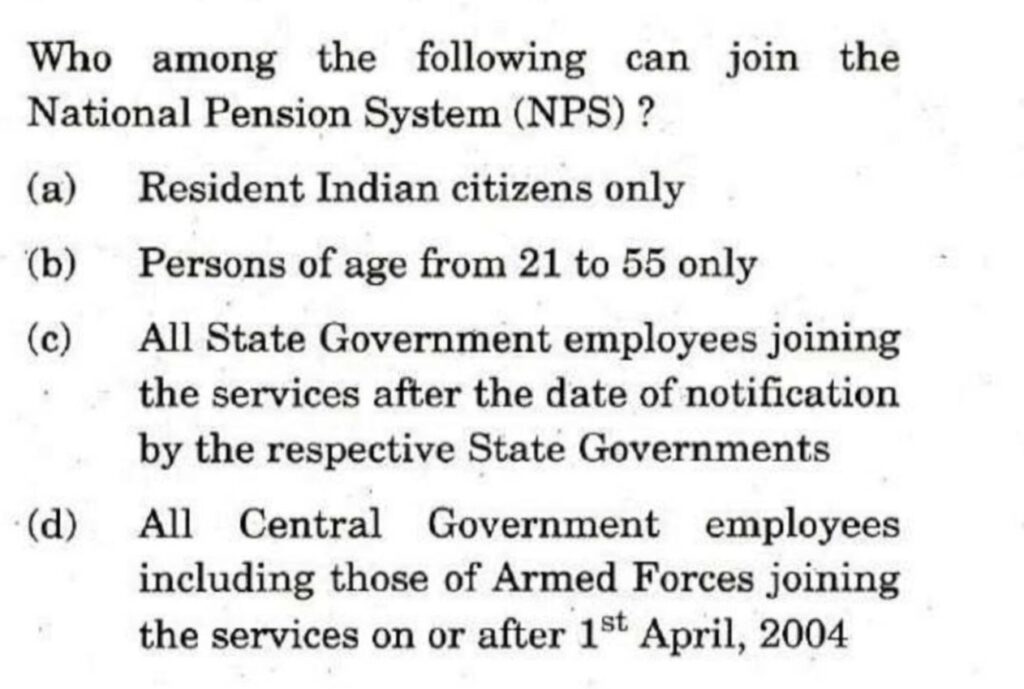
National Pension System (NPS) – Structural Reforms (2026)

Context

  • PFRDA approved major reforms to deepen pension ecosystem
  • Aims to increase competition and align with global benchmarks

PFRDA

  • Statutory body under PFRDA Act, 2013
  • Jurisdiction
  • Composition
    • 1 Chairperson
    • 3 Whole-time Members
    • 3 Part-time Members
  • Goal
    • Ensure old-age income security
    • Protect subscriber interests

Major Indian Pension Schemes

  • National Pension System (NPS)
    • Mandatory for Central Government employees since 2004 (except armed forces)
    • Open to all citizens including NRIs (18–70 years)

Institutional Participation – Entry of Banks

  • New power
  • Earlier constraint
    • Regulatory barriers limited direct bank participation
  • Eligibility criteria
    • Net worth
    • Market capitalisation
    • Prudential soundness aligned with RBI norms
National Pension System Reform

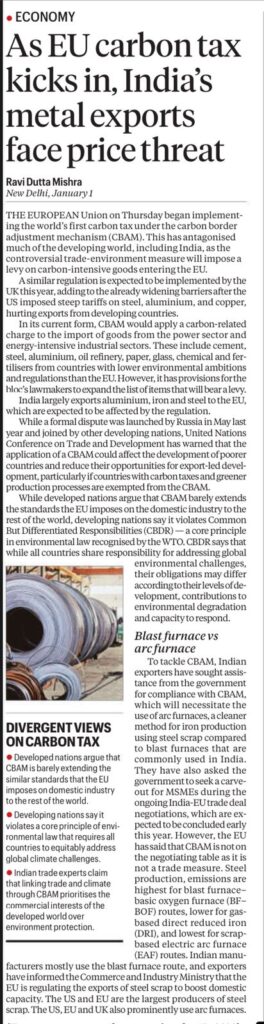
EU Carbon Border Tax: Impact on India’s Metal Exports

EU Carbon Border Adjustment Mechanism (CBAM)

Context

  • From January 1, 2026, CBAM enters the payment phase
  • EU importers must pay for embedded carbon emissions in select imports

What is CBAM?

  • EU’s carbon border tax on carbon-intensive imports
  • Objective
    • Prevent carbon leakage
    • Ensure level playing field with EU producers under EU ETS

How it works

  • Importers buy CBAM certificates
  • One certificate equals one tonne of CO₂

Covered Sectors

  • Iron & steel
  • Aluminium
  • Cement
  • Fertilisers
  • Electricity
  • Hydrogen

India’s Concerns

  • Violates CBDR principle
  • Acts as non-tariff barrier / green protectionism
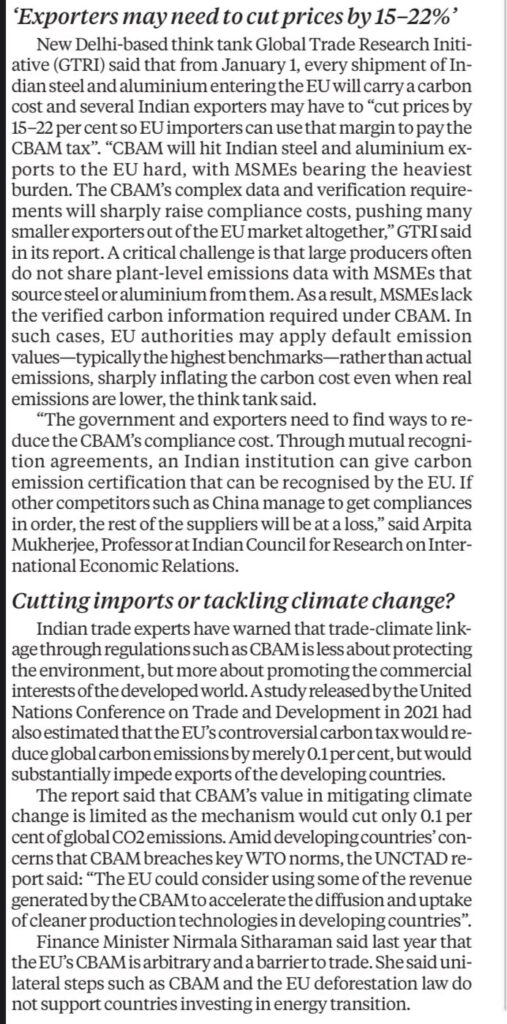
  • Indian steel and aluminium may face 20–35% price disadvantage in EU market

India’s Response

  • Carbon Credit Trading Scheme (CCTS): domestic carbon pricing
  • Carbon price paid in India can be deducted from CBAM liability
  • Prevents double taxation
EU Carbon Border Tax
About the UPSC Civil Services Examination (UPSC CSE)

The UPSC Civil Services Examination (CSE) is one of the most competitive and esteemed examinations in India, conducted by the Union Public Service Commission to recruit officers for services such as the Indian Administrative Service (IAS), Indian Police Service (IPS), Indian Foreign Service (IFS), and others. The exam comprises three stages — Prelims, Mains, and the Personality Test (Interview) — designed to test a candidate’s knowledge, aptitude, decision-making, and leadership skills.


How to Prepare Effectively for UPSC CSE

Cracking the UPSC CSE requires a deep understanding of the syllabus, consistent revision, structured answer writing, and smart test-taking strategies. The Prelims test analytical and conceptual clarity, the Mains focuses on critical thinking, articulation, and subject mastery, while the Interview assesses presence of mind, ethical judgment, and personality traits relevant to public service.

At Understand UPSC, we empower aspirants with a personalized and focused approach to each stage of the exam.


Why Choose Understand UPSC?

Understand UPSC is a mentorship-driven platform offering a clear, clutter-free strategy to tackle the Civil Services Examination. Our programs like Transform (for beginners and intermediate learners) and Conquer (for advanced mains preparation) provide structured study plans, syllabus-wise video content, interactive live sessions, and answer writing support.

We emphasize:

  • Concept clarity through topic-wise lectures

  • Test series designed around real UPSC standards

  • Personalized mentorship in small groups

  • Regular performance tracking and peer benchmarking

  • Doubt-clearing sessions, current affairs analysis, and monthly magazines


Join the Understand UPSC Learning Community

Our mission is to make UPSC preparation less overwhelming and more strategic. We combine mentorship, discipline, and academic rigor to help you clear CSE with confidence. Whether you’re preparing from Delhi, Mumbai, Bangalore, or a remote village — our online-first model ensures quality guidance reaches every corner of India.

Join the thousands of aspirants who trust Understand UPSC to guide their journey toward becoming civil servants.

Stay connected with us through our Telegram, YouTube, and Instagram channels for daily tips, strategies, and updates.

Copyright © 2025 USARAMBHA EDUCATION (UnderStand UPSC). All Rights Reserved.

Join the Success Journey!