1 May 2026 | Daily Current Affairs

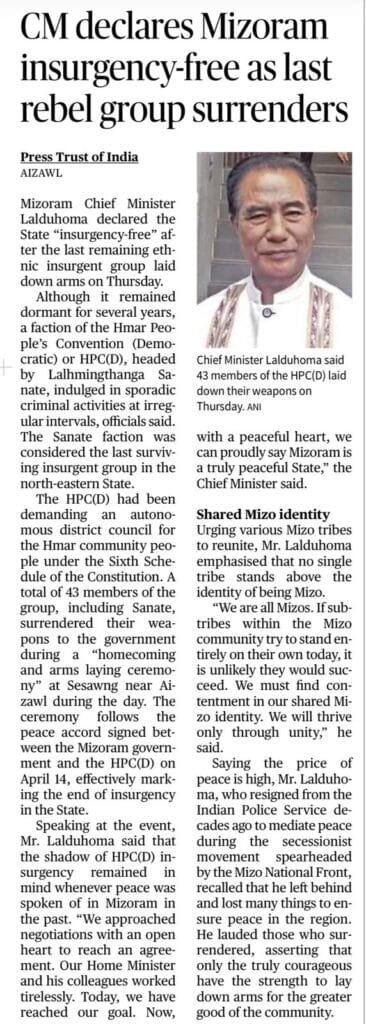
Mizoram insurgency ends after HPC(D) peace agreement

Context: Mizoram insurgency

Mizoram has become one of the first States in Northeast India to be insurgency-free after the final peace settlement with Hmar People’s Convention (Democratic) and surrender of its cadres.

From Insurgency to Peace

  • Trigger: 1959 Mautam famine + central neglect
  • Phase I: Mizo National Front insurgency (1966–1986) → demand for independence
  • Resolution: 1986 Peace Accord (GoI + Mizo National Front)
    → secession dropped | statehood (1987) | full political integration

Residual Conflict and Demand

  • Post-1986: conflict continued through Hmar People’s Convention (Democratic)
  • Shift from secession → sub-tribal autonomy (Hmar areas)
  • Core demand: Autonomous District Council under Sixth Schedule

Final Settlement

  • Cadres surrendered and joined mainstream
  • Focus on development and governance of Hmar areas
  • Sixth Schedule demand not accepted → resolved through negotiated accommodation

Why It Matters

  • Marks end of insurgency cycle in Mizoram
  • Validates dialogue-based conflict resolution
  • Strengthens border security and governance
  • Provides a template for Northeast peace processes

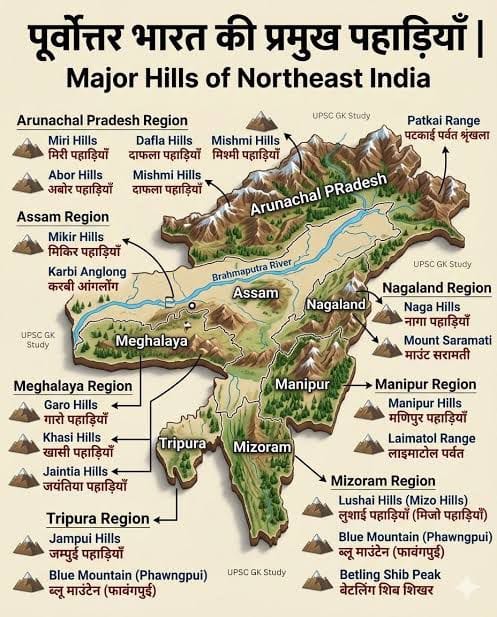
Mizoram – Geography

  • Borders: Myanmar, Bangladesh
  • Relief: North–south aligned folded hills (Purvanchal ranges)
  • Basin: Surma–Mizoram (Molasse) Basin → hydrocarbon potential
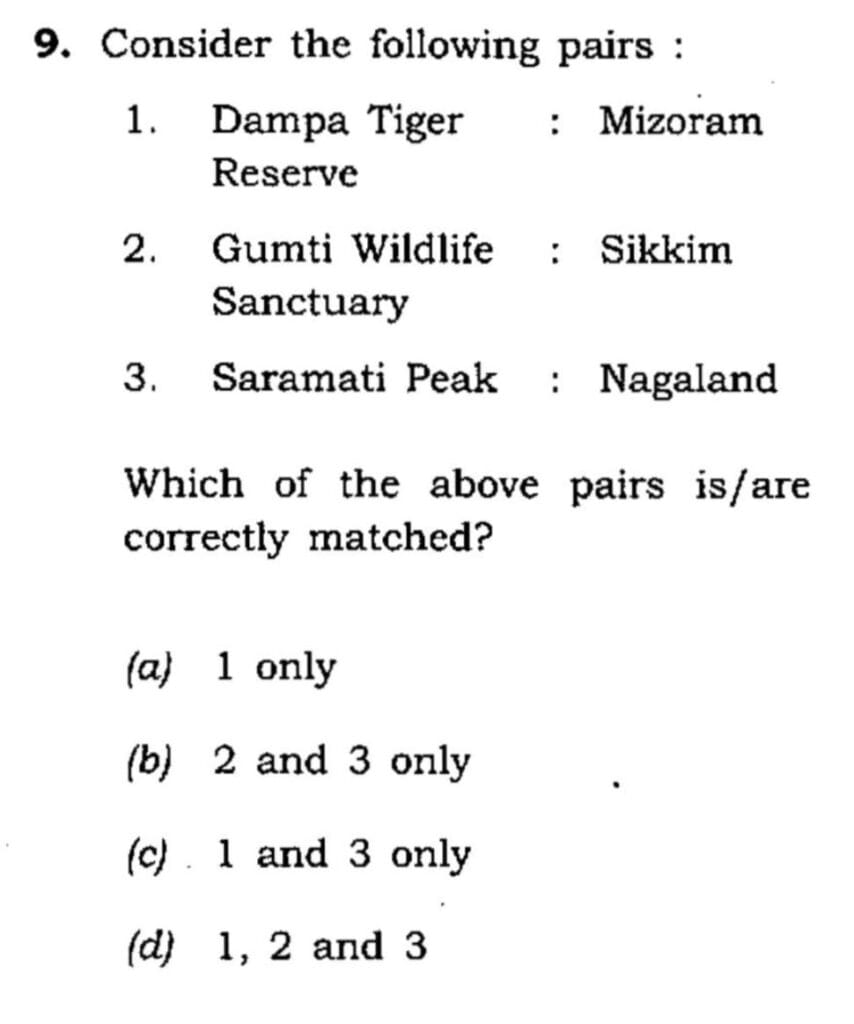
  • Protected Areas: Dampa Tiger Reserve, Murlen National Park, Phawngpui National Park
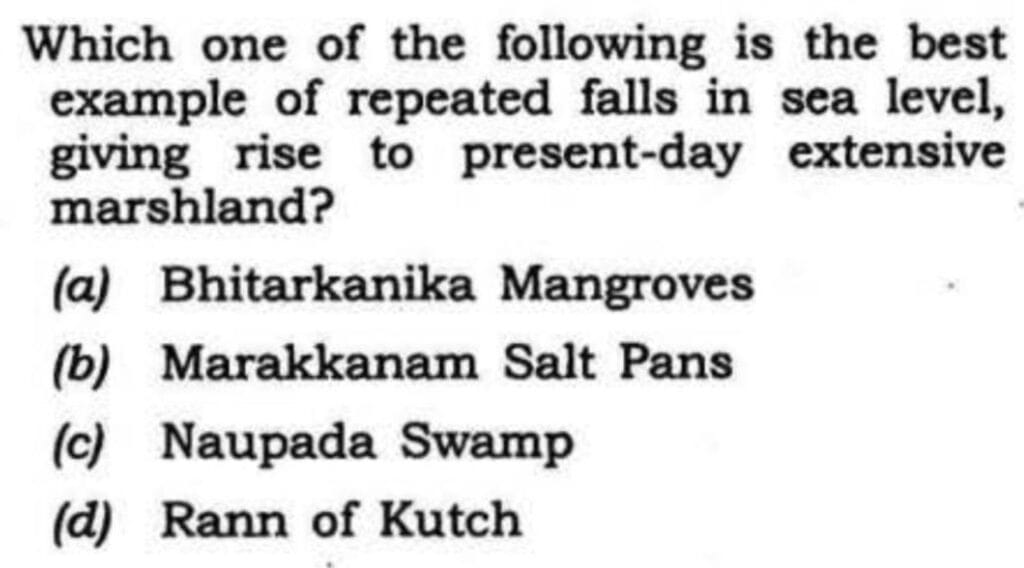
PYQ – 2014, Ans – C

Revenue deficit States rise as fiscal stress increases in India

Context: Revenue deficit States

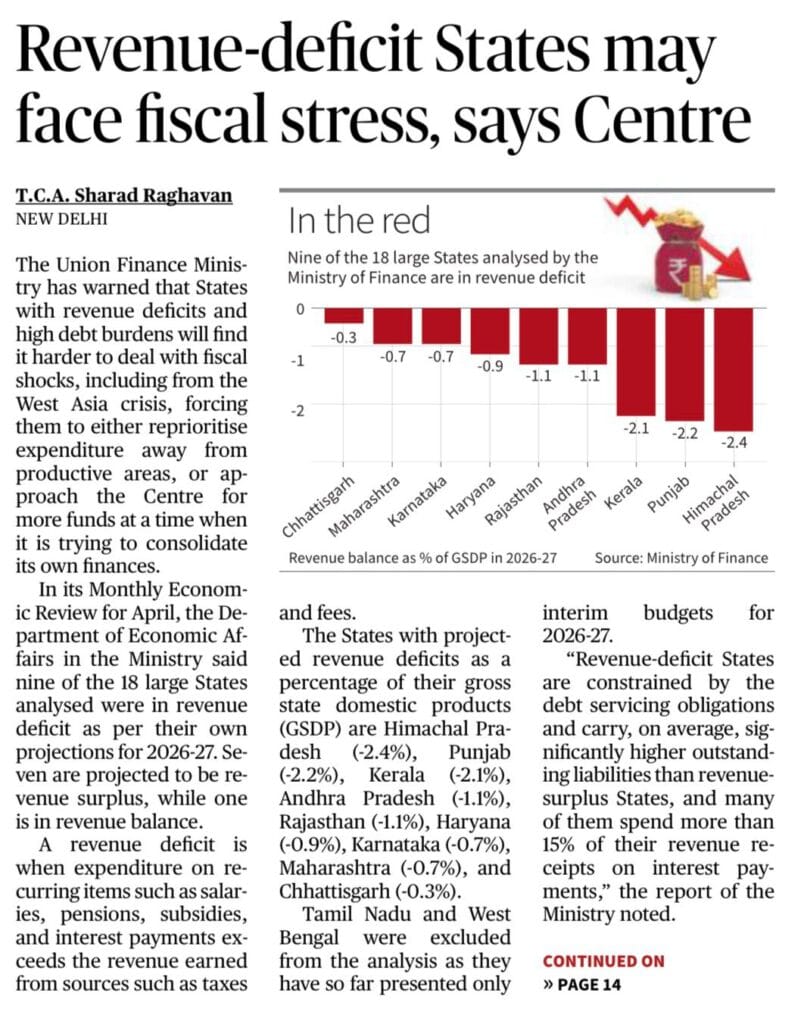
Finance Ministry’s Monthly Economic Review (Department of Economic Affairs) flags 9 of 18 large States in revenue deficit, indicating fiscal stress due to high debt and weak revenues.

Deficit Concepts

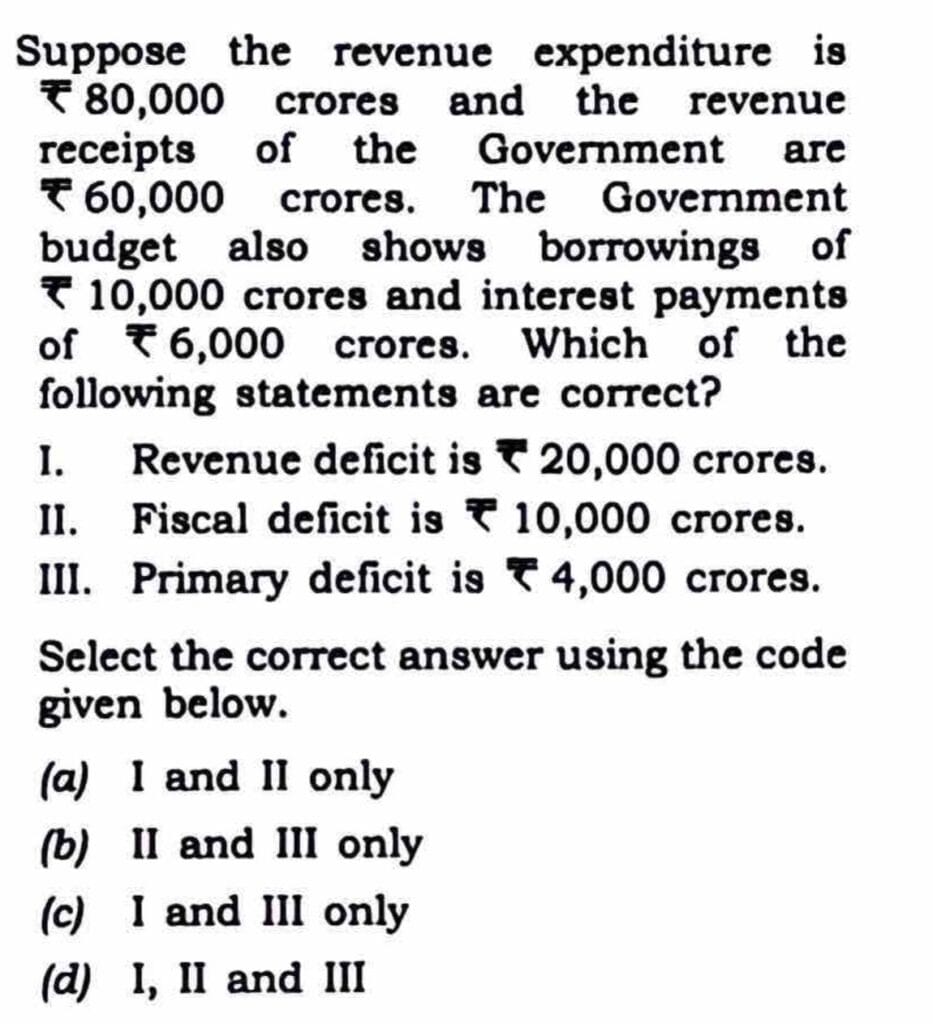
  • Revenue Deficit
    Revenue expenditure exceeds revenue receipts → inability to meet routine expenses → weak fiscal health
  • Fiscal Deficit
    Total expenditure minus revenue receipts and non-debt capital receipts → total borrowing requirement → overall fiscal gap
  • Primary Deficit
    Fiscal deficit minus interest payments → current year fiscal stance → excludes past debt burden

States and Data

  • Total analysed: 18
  • Revenue deficit: 9 | Surplus: 7 | Balance: 1
  • Excluded: Tamil Nadu, West Bengal

Revenue deficit States % of GSDP 2026–27

Himachal Pradesh –2.4 | Punjab –2.2 | Kerala –2.1 | Andhra Pradesh –1.1 | Rajasthan –1.1 | Haryana –0.9 | Karnataka –0.7 | Maharashtra –0.7 | Chhattisgarh –0.3

Stress indicators

  • Interest payments >15% of revenue receipts in many States
  • Higher outstanding liabilities than surplus States

Reasons

  • High committed expenditure: salaries, pensions, subsidies, interest
  • Weak revenue mobilisation
  • Rising debt and interest burden
  • Exposure to external shocks

Implications

  • Higher fiscal vulnerability
  • Limited shock absorption capacity
  • Reduced capital and productive expenditure
  • Greater dependence on Centre
  • Persistent structural fiscal imbalance
PYQ – 2025, Ans – D

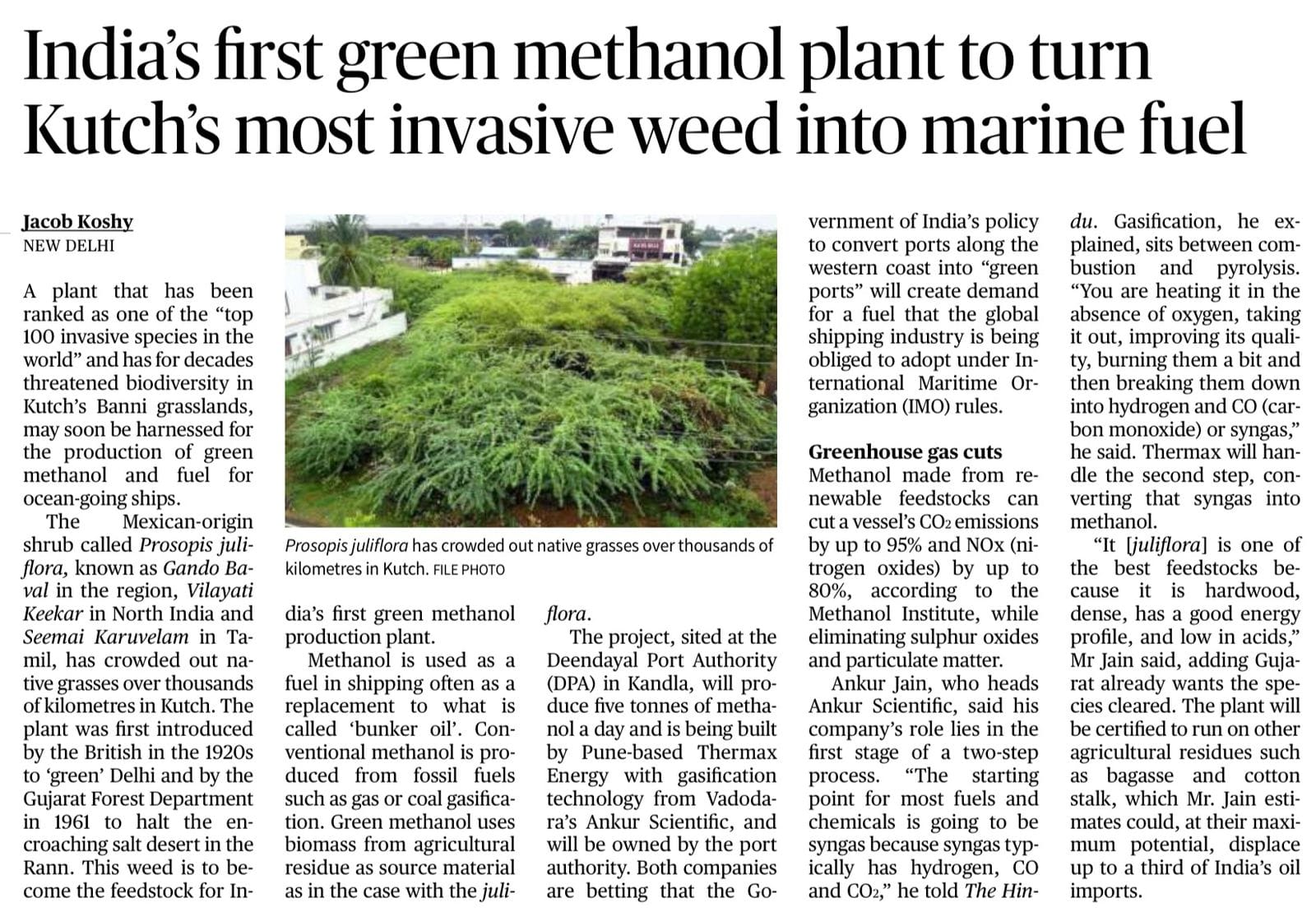
Green methanol project using Prosopis juliflora for clean fuel

Context: Green methanol

India plans to convert Prosopis juliflora, among the world’s top 100 invasive species, into green methanol for marine fuel, linking ecological control with clean energy.

Species in News – Prosopis juliflora

  • Origin: Mexico
  • Local names: Gando Baval, Vilayati Keekar, Seemai Karuvelam
  • Status: Among top 100 invasive species globally
  • Introduced: Colonial period for afforestation

Issues

  • Highly invasive and fast spreading
  • Replaces native grasses in Banni grassland
  • Threat to biodiversity in Kutch

Utility

Dense hardwood, high calorific value → suitable biomass feedstock

Green Methanol and Environmental Significance

  • Green methanol: Produced from biomass/renewable sources
  • Use: Alternative to bunker fuel in shipping

Environmental benefits

CO₂ ↓ up to 95% | NOx ↓ up to 80% | eliminates SOx and particulate matter | supports IMO norms

Process

Gasification → biomass to syngas (H₂ + CO)
Conversion → syngas to methanol

Banni Grassland

  • Location: Rann of Kachchh, Gujarat
  • Asia’s largest tropical grassland
  • Threat: invasion by Prosopis juliflora

Community

Maldharis pastoralists depend on it

Implications

  • Converts invasive species into economic resource
  • Supports clean shipping and energy transition
  • Reduces oil import dependence
  • Helps restore native grassland ecosystem
PYQ – 2023, Ans – D

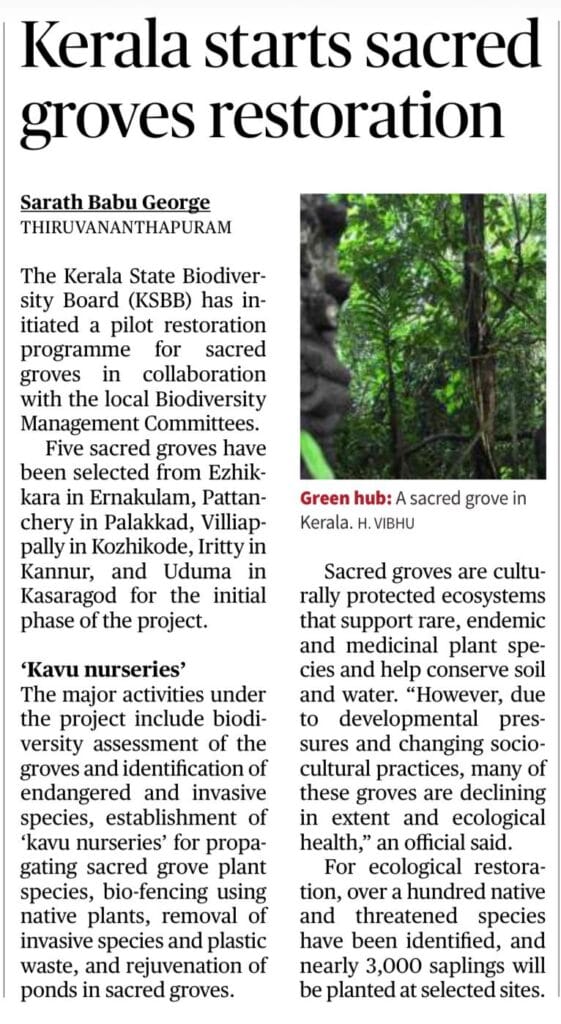
Sacred groves restoration launched in Kerala for biodiversity conservation

Context: Sacred groves

Kerala has initiated a pilot restoration of sacred groves (kavus) to revive degraded ecosystems, conserve biodiversity, and remove invasive species through community participation.

Sacred Groves and Their Significance

  • Sacred groves are community-protected forest patches preserved due to religious and cultural beliefs

Significance

  • Act as biodiversity hotspots with rare, endemic and medicinal species
  • Provide ecosystem services: soil conservation, groundwater recharge, micro-climate regulation
  • Serve as in-situ conservation sites with minimal human interference
  • Reflect traditional ecological knowledge and community conservation ethics

Threats

  • Urbanisation and land-use change
  • Decline in traditional belief systems
  • Invasive species encroachment
  • Pollution and neglect

Sacred Groves in India – State-wise Names

  • Kerala – Kavus
  • Karnataka – Devarakadu
  • Tamil Nadu – Kovil Kadu
  • Maharashtra & Goa – Devrai
  • Rajasthan & Gujarat – Orans
  • Madhya Pradesh & Chhattisgarh – Sarna
  • Jharkhand – Sarna / Jaher Than
  • Odisha & West Bengal – Jaher Than
  • Himachal Pradesh & Uttarakhand – Dev Van
  • Meghalaya – Law Kyntang / Law Lyngdoh
  • Manipur – Umang Lai
  • Assam – Than

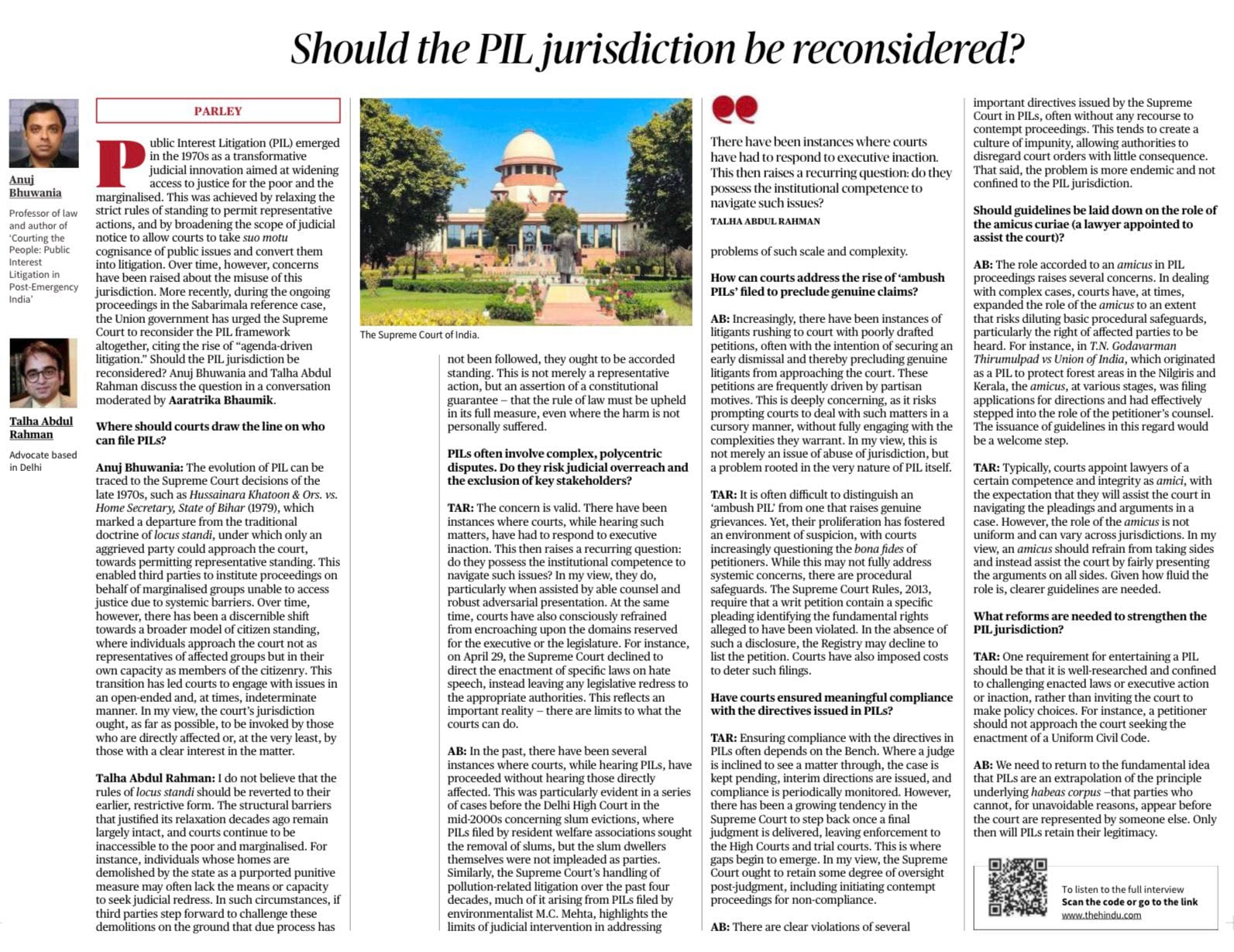
Public Interest Litigation reform debate over misuse and scope

Context: Public Interest Litigation

A growing concern that Public Interest Litigation (PIL)—once a tool for social justice—is increasingly misused, raising the need to redefine its scope and safeguards.

Public Interest Litigation (PIL) – Basics

  • Definition: Litigation filed in public interest to protect rights of groups unable to approach courts themselves
  • Core feature: Relaxation of locus standi → any public-spirited person can file

Constitutional basis

Origin

Late 1970s–80s (post-Emergency judicial activism)

Key Cases

  • Hussainara Khatoon (1979) → access to justice, undertrial rights
  • S.P. Gupta (1981) → liberal locus standi
  • M.C. Mehta cases → environmental PIL
  • T.N. Godavarman → continuing mandamus in forest governance

Problems with PIL

  • Frivolous / “Ambush PILs” → publicity, political motives
  • Judicial overreach → courts entering policy domain
  • Complex governance issues → beyond judicial expertise
  • Stakeholder exclusion → affected parties not heard
  • Procedural dilution → excessive reliance on amicus curiae
  • Weak enforcement → poor compliance with court orders

Suggested Reforms

  • Strict screening of PILs at admission stage
  • Limit scope to rights violations, not policy-making
  • Guidelines for amicus curiae and petition standards
  • Ensure stakeholder participation
  • Impose costs on frivolous PILs
  • Strengthen compliance mechanisms without replacing executive

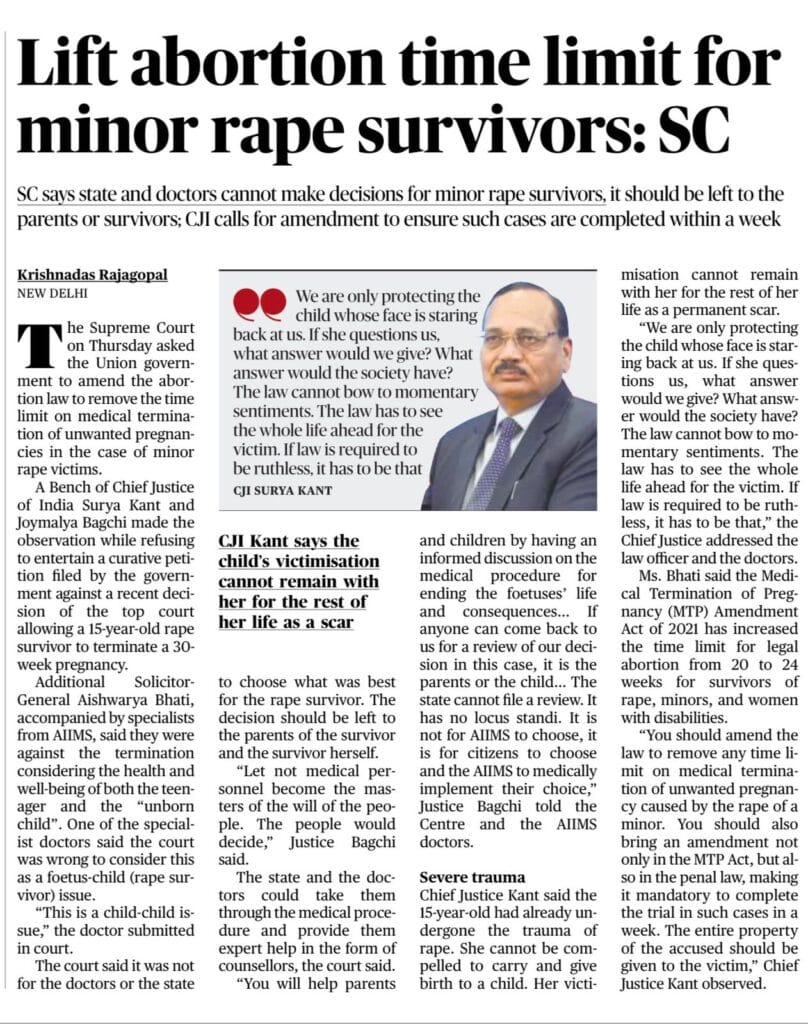
MTP Act time limits under review by Supreme Court in minor cases

Context: MTP Act time limits

In a recent Supreme Court proceeding (minor rape survivor case), the Court flagged that strict gestational limits under abortion law may violate the survivor’s rights.

MTP Act – Core Basics

  • Full form: Medical Termination of Pregnancy Act, 1971 (amended 2021)
  • Governs legal abortion in India

Time limits

  • Up to 20 weeks → 1 doctor
  • 20–24 weeks → special categories (including minors, rape survivors) → 2 doctors
  • Beyond 24 weeks → only for foetal abnormalities (Medical Board)

Issue

  • Minor rape survivor sought termination beyond legal limit
  • Authorities reluctant due to statutory restriction
  • Conflict: legal time limit vs survivor’s autonomy and trauma

Constitutional Basis

  • Article 21 → Right to life includes dignity, bodily autonomy, reproductive choice

Supreme Court’s Observations and Advice

  • Pregnancy due to rape causes severe and continuing trauma, especially for minors
  • Forcing continuation violates Article 21 (dignity and autonomy)
  • State and doctors cannot override survivor/guardian decision

Suggested

  • Relax/remove time limits in such cases
  • Time-bound decisions
  • Need to amend MTP framework to make it more victim-centric
About the UPSC Civil Services Examination (UPSC CSE)

The UPSC Civil Services Examination (CSE) is one of the most competitive and esteemed examinations in India, conducted by the Union Public Service Commission to recruit officers for services such as the Indian Administrative Service (IAS), Indian Police Service (IPS), Indian Foreign Service (IFS), and others. The exam comprises three stages — Prelims, Mains, and the Personality Test (Interview) — designed to test a candidate’s knowledge, aptitude, decision-making, and leadership skills.


How to Prepare Effectively for UPSC CSE

Cracking the UPSC CSE requires a deep understanding of the syllabus, consistent revision, structured answer writing, and smart test-taking strategies. The Prelims test analytical and conceptual clarity, the Mains focuses on critical thinking, articulation, and subject mastery, while the Interview assesses presence of mind, ethical judgment, and personality traits relevant to public service.

At UnderStand UPSC, we empower aspirants with a personalized and focused approach to each stage of the exam.


Why Choose UnderStand UPSC?

UnderStand UPSC is a mentorship-driven platform offering a clear, clutter-free strategy to tackle the Civil Services Examination. Our programs like Transform (for beginners and intermediate learners) and Conquer (for advanced mains preparation) provide structured study plans, syllabus-wise video content, interactive live sessions, and answer writing support.

We emphasize:

  • Concept clarity through topic-wise lectures

  • Test series designed around real UPSC standards

  • Personalized mentorship in small groups

  • Regular performance tracking and peer benchmarking

  • Doubt-clearing sessions, current affairs analysis, and monthly magazines


Join the UnderStand UPSC Learning Community

Our mission is to make UPSC preparation less overwhelming and more strategic. We combine mentorship, discipline, and academic rigor to help you clear CSE with confidence. Whether you’re preparing from Delhi, Mumbai, Bangalore, or a remote village — our online-first model ensures quality guidance reaches every corner of India.

Join the thousands of aspirants who trust UnderStand UPSC to guide their journey toward becoming civil servants.

Stay connected with us through our Telegram, YouTube, and Instagram channels for daily tips, strategies, and updates.

Copyright © 2026 USARAMBHA EDUCATION (UnderStand UPSC). All Rights Reserved.

Join the Success Journey!


Fill the form and our Team will reach out to you soon


Fill the form and our Team will reach out to you soon