
Section 44(3) of DPDP Act: Supreme Court to Review Impact on RTI
Context
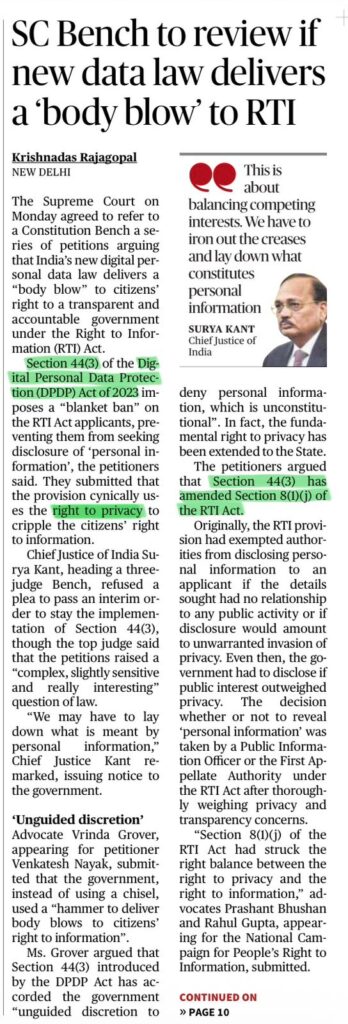
Supreme Court has referred petitions to a Constitution Bench to examine whether Section 44(3) of the Digital Personal Data Protection (DPDP) Act, 2023 undermines citizens’ Right to Information (RTI) by overriding Section 8(1)(j) of the RTI Act, thereby limiting access to “personal information”.
Key Sections & the Conflict
- Section 44(3) — DPDP Act, 2023
• Imposes a blanket prohibition on disclosing any “personal information”.
• Gives the government wide discretion to deny information.
• Applies broadly, without the earlier balancing test of “public interest vs privacy”. - Section 8(1)(j) — RTI Act, 2005
• Allowed disclosure of personal information if:
• There was no relation to public activity, OR
• Public interest outweighed privacy concerns.
• Maintained a balance between transparency and privacy.
How they conflict
• DPDP Section 44(3) → Treats all personal information as protected, no public-interest exception.
• RTI Section 8(1)(j) → Allowed disclosure when public interest justified it.
• Petitioners argue the DPDP has amended/overridden this RTI safeguard, delivering a “body blow” to transparency.