27 June 2026 | Daily Current Affairs

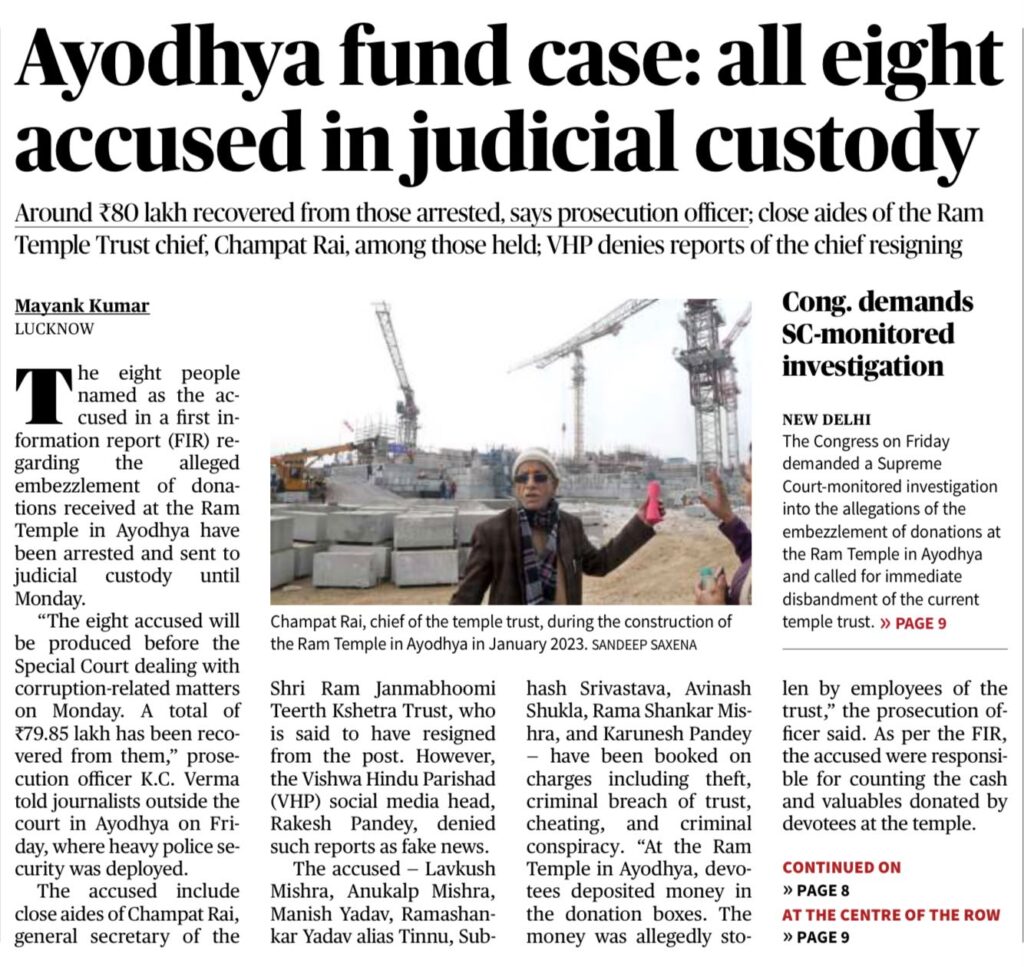
Ayodhya Temple Donation Fund Case: GS4 Ethics Notes

Context: Ayodhya Temple Donation Fund Case
Eight accused have been remanded to judicial custody in the alleged embezzlement of donations received at the Shri Ram Janmabhoomi Teerth Kshetra Trust.

Around ₹80 lakh has reportedly been recovered, and the matter has raised concerns over accountability in the management of public religious funds.

GS4 Ethics Value Addition

This is a useful case study example for ethics, probity and accountability.

1. Probity in Public Life

Public institutions and trusts handling donations must uphold:

  • Honesty
  • Integrity
  • Fiduciary responsibility
  • Public trust

2. Accountability and Transparency

Proper systems are essential, including:

  • Accounting
  • Audits
  • Internal controls
  • Public disclosure
  • Transparent donation management

3. Conflict of Interest and Abuse of Trust

Individuals entrusted with public or charitable funds must not misuse their position for personal gain.

4. Rule of Law

Allegations of financial misconduct should be investigated:

  • Fairly
  • Impartially
  • Without influence
  • Through due process

5. Institutional Ethics

Religious and charitable institutions often receive donations based on faith and public confidence.

Therefore, they require:

  • Strong governance mechanisms
  • Independent audit systems
  • Traceable financial transactions
  • Whistleblower protection
  • Clear accountability of office-bearers

Mains Usage

This example can be used in GS4 answers on:

  • Probity in public life
  • Fiduciary responsibility
  • Public trust
  • Accountability
  • Misuse of office
  • Ethical governance
  • Transparency in charitable institutions
  • Rule of law and impartial investigation
National Food Security Act Reforms: AAY Changes

Context: National Food Security Act Reforms
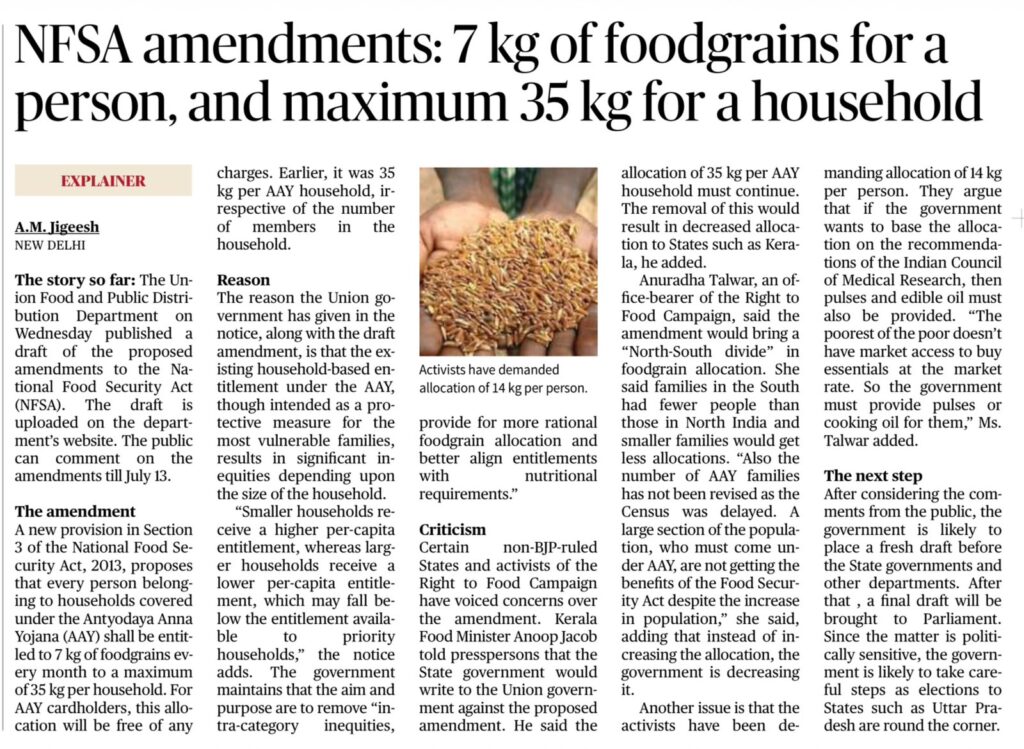
The Union Government has released a draft amendment to the National Food Security Act, 2013, proposing to replace the household-based foodgrain entitlement under the Antyodaya Anna Yojana with a per-person entitlement.

National Food Security Act, 2013

The NFSA provides legal entitlement to subsidised foodgrains through the Targeted Public Distribution System.

Beneficiary Categories

1. Priority Households

  • Entitlement: 5 kg per person per month

2. Antyodaya Anna Yojana

  • Covers the poorest and most vulnerable households.
  • Provides higher entitlement than Priority Households.

Current AAY System

Every AAY household receives 35 kg of foodgrains per month, irrespective of whether the family has 2 members or 8 members.

Proposed Change

Current System

  • 35 kg per household per month

Proposed System

  • 7 kg per person per month
  • Subject to a maximum of 35 kg per household

Why Is the Change Proposed?

The aim is to remove intra-household inequity.

Larger families currently receive the same 35 kg as smaller families, which reduces per-person availability for larger households.

The proposed system gives a fairer per-person allocation while retaining the 35 kg ceiling.

Concerns

  • Smaller AAY households may receive lower allocations.
  • Experts have demanded inclusion of pulses and edible oil.
  • Nutritional security may require more than cereals.
  • Implementation must ensure no vulnerable household is worse off.

Targeted Public Distribution System

Foodgrains under NFSA are supplied through the Targeted Public Distribution System.

UPSC Value Addition

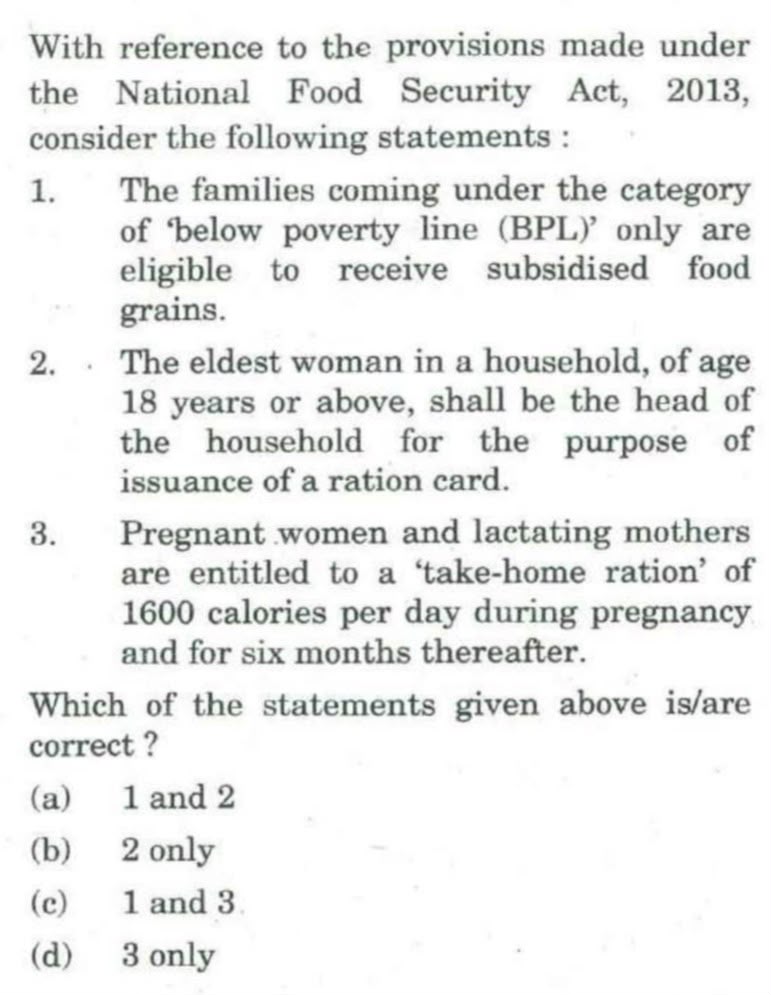
  • Eldest woman of the household, aged 18 years or above, is recognised as the head of household for ration-card purposes.
  • NFSA covers Priority Households and Antyodaya Anna Yojana households.
  • NFSA is not limited only to Below Poverty Line families.

PYQ Link

Under NFSA:

  • It is incorrect to say only BPL families are eligible.
  • The eldest woman aged 18 years or above is treated as head of household for ration-card purposes.
  • Pregnant women and lactating mothers are entitled to nutritional support, but not exactly in the form stated as “take-home ration of 1600 calories per day” in the PYQ framing.

India Drug Trafficking Challenge: NDPS & Golden Triangle

Context: India Drug Trafficking Challenge
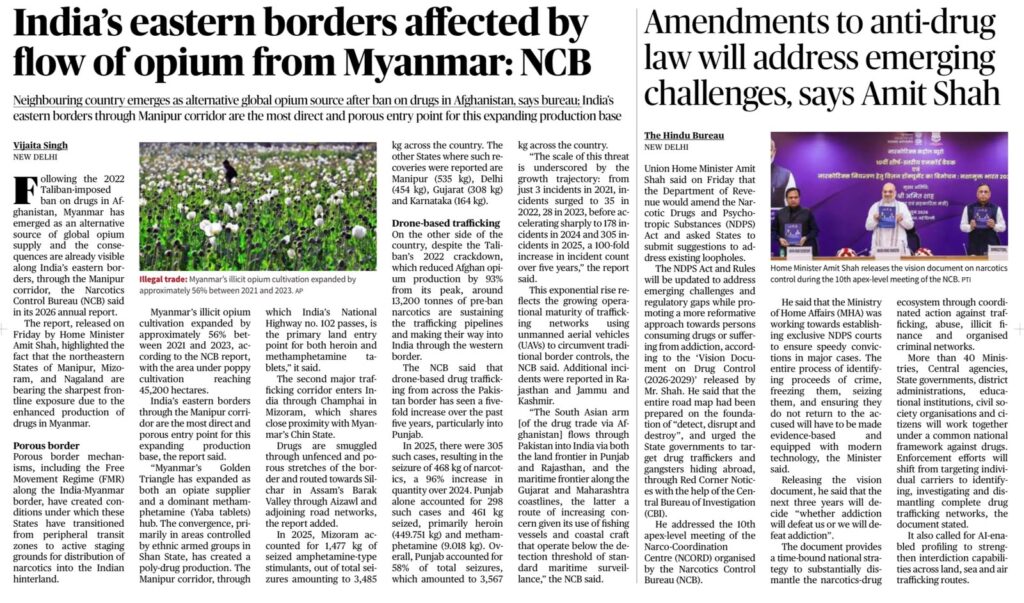
The Narcotics Control Bureau Annual Report 2026 highlights the growing drug trafficking threat through India’s eastern border and recommends strengthening the Narcotic Drugs and Psychotropic Substances Act, 1985 to address evolving narcotics networks.

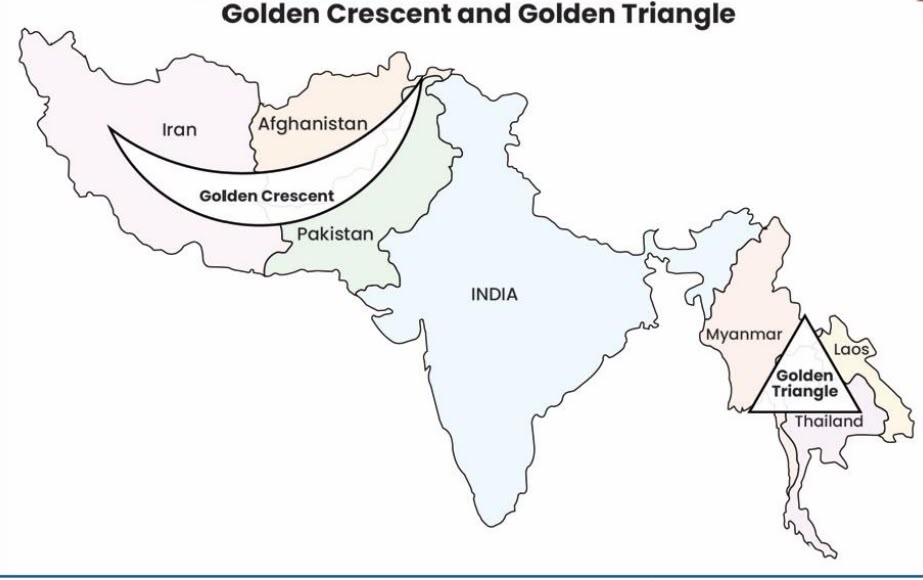
Golden Triangle

The Golden Triangle includes:

  • Myanmar
  • Laos
  • Thailand

It is a major global hub for:

  • Opium
  • Heroin
  • Synthetic drugs
  • Methamphetamine / Yaba

Golden Crescent

The Golden Crescent includes:

  • Afghanistan
  • Iran
  • Pakistan

It has traditionally been one of the world’s largest opium-producing regions.

Changing Drug Geography

After Afghanistan’s 2022 opium ban, Myanmar has emerged as an alternative production hub.

This has shifted trafficking routes towards India’s eastern border.

Emerging Challenges

1. Changing Drug Profile

There is rising trafficking of synthetic drugs such as:

  • Methamphetamine
  • Yaba

alongside heroin.

2. Technology-enabled Trafficking

Traffickers increasingly use:

  • Unmanned Aerial Vehicles
  • Encrypted communication
  • Dark web
  • Maritime routes

3. India’s Vulnerable Corridors

Eastern Corridor

  • Manipur
  • Mizoram
  • Nagaland

Linked to the Golden Triangle.

Western Corridor

  • Punjab
  • Rajasthan
  • Gujarat

Linked to the Golden Crescent.

4. Key Enablers

NDPS Act, 1985

The Narcotic Drugs and Psychotropic Substances Act is India’s principal law regulating and penalising:

  • Production
  • Manufacture
  • Possession
  • Transport
  • Sale
  • Purchase
  • Consumption
  • Trafficking of narcotic drugs and psychotropic substances

Proposed Reforms

The NCB recommends changes to address:

  • Synthetic drugs
  • Drone-enabled trafficking
  • Financial networks
  • Regulatory loopholes
  • Cross-border organised crime

Government Strategy

The suggested approach is:

Detect
→ Disrupt
→ Destroy

Tools Required

  • AI-enabled profiling
  • Intelligence-led policing
  • Inter-agency coordination
  • Asset freezing
  • Financial investigation
  • Dismantling entire trafficking networks

Key Data

  • Myanmar’s illicit opium cultivation increased by around 56% between 2021 and 2023.
  • Poppy cultivation reached around 45,200 hectares.
  • NCB reported a 100-fold increase in drug trafficking incidents between 2021 and 2025.

Mains Significance

This topic can be used in answers on:

  • Internal security
  • Border management
  • Narco-terrorism
  • Organised crime
  • India–Myanmar border
  • Northeast security
  • Drug trafficking and youth vulnerability

Wimbledon Grand Slam Tennis: Traditions & UPSC Facts

Context: Wimbledon Grand Slam Tennis
Wimbledon 2026 introduces Video Review Technology while preserving its traditional identity of grass courts and all-white dress code.

The editorial argues that modern sport must balance:

  • Tradition
  • Technology
  • Player welfare
  • Equitable revenue sharing

Grand Slam Basics

There are four Grand Slam tennis tournaments.

1. Australian Open

  • Country: Australia
  • Surface: Hard Court
  • Month: January

2. French Open / Roland Garros

  • Country: France
  • Surface: Clay Court
  • Month: May–June

3. Wimbledon

  • Country: United Kingdom
  • Surface: Grass Court
  • Month: June–July

4. US Open

  • Country: United States
  • Surface: Hard Court
  • Month: August–September

Wimbledon

Wimbledon is the oldest Grand Slam tournament.

It is known for:

  • Grass courts
  • All-white dress code
  • Strong traditional identity
  • Centre Court culture
  • Royal Box tradition

Video Review Technology

Video Review Technology helps review line calls and disputed decisions.

Significance of Technology in Sports

  • Improves fairness.
  • Reduces human error.
  • Strengthens player confidence.
  • Supports transparent officiating.
  • Modernises traditional sports.

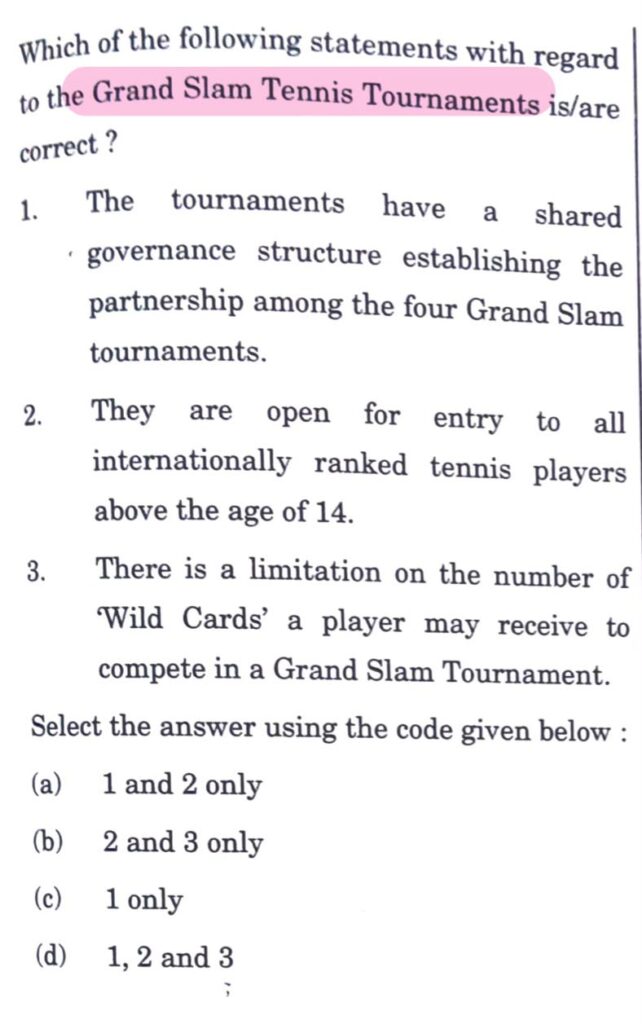
Key Governance Points

Grand Slam Governance

The four Grand Slams are independently organised by their respective national associations or clubs.

There is no single common governing authority for all four Grand Slam tournaments.

Entry Rule

A player aged 14 years or above may enter a Grand Slam only if he or she satisfies:

  • ATP / WTA ranking requirements
  • Qualifying draw rules
  • Wild Card eligibility

Age alone does not guarantee entry.

Wild Card

A Wild Card is a special invitation given by tournament organisers to players who do not qualify through rankings or qualifiers.

There is no fixed annual or lifetime limit on the number of Wild Cards a player may receive.

Each Grand Slam decides its Wild Cards independently every year.

PYQ Value Addition

For Grand Slam Tennis:

  • There is no shared governance structure among all four Grand Slams.
  • Entry is not open to all internationally ranked players above the age of 14.
  • Wild Card allocation is decided independently by each tournament.

India New Zealand Free Trade Agreement: Key UPSC Notes

Context: India New Zealand Free Trade Agreement
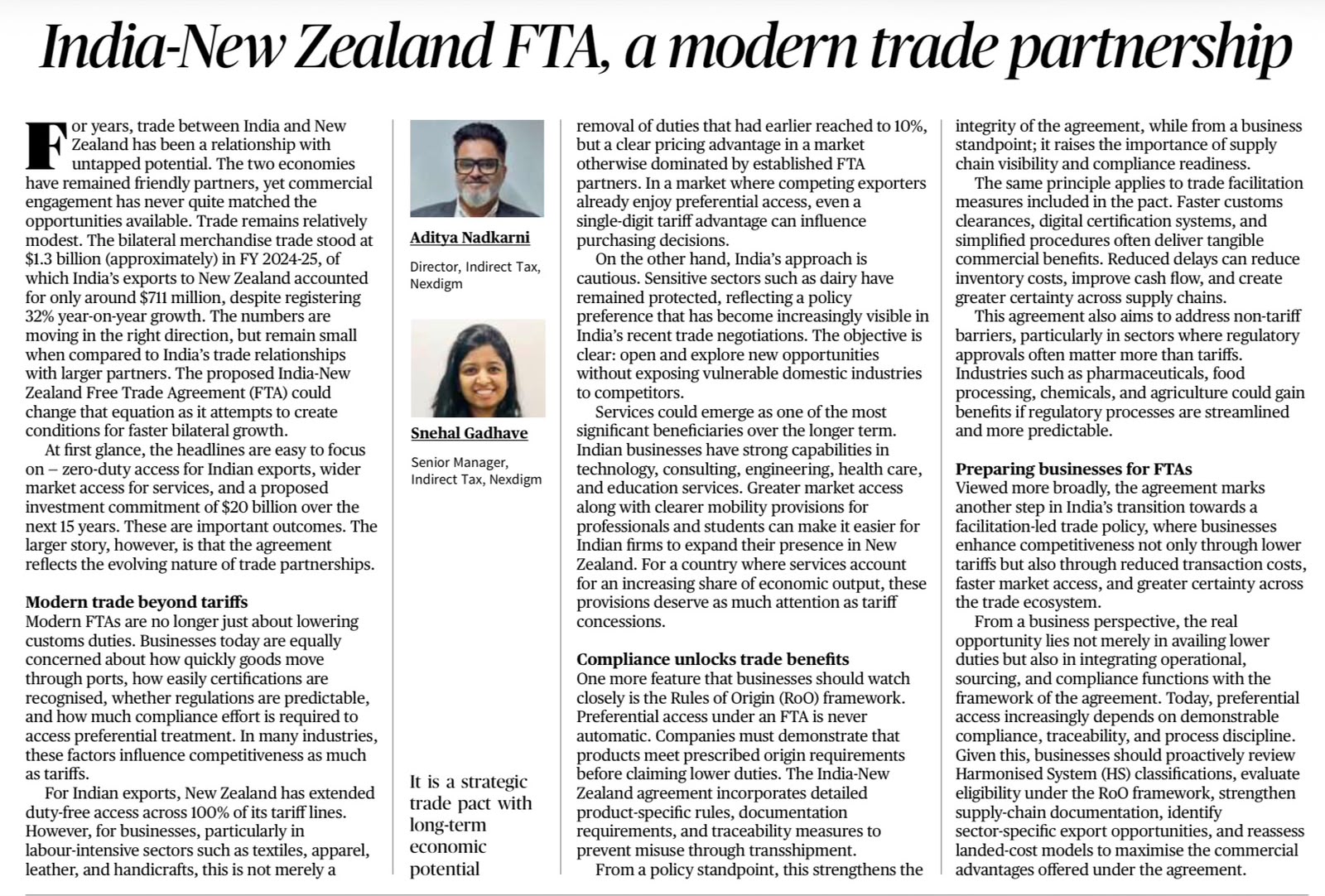
India and New Zealand signed the Free Trade Agreement on 27 April 2026 after concluding negotiations in December 2025. However, it is not yet operational. It will enter into force only after both countries complete their domestic ratification procedures.

The editorial uses this agreement to explain how modern FTAs are evolving beyond simple tariff liberalisation.

How Modern FTAs Are Evolving

1. Beyond Tariffs

Competitiveness now depends not only on lower import duties, but also on:

  • Trade facilitation
  • Logistics
  • Digital customs
  • Regulatory certainty
  • Faster approvals

2. Services-Centric FTAs

Modern FTAs increasingly focus on:

  • Professional mobility
  • Student mobility
  • Knowledge industries
  • Services market access

3. Compliance-Based Market Access

FTA benefits are not automatic.

They depend on:

  • Rules of Origin
  • Traceability
  • Documentation
  • Harmonised System classification
  • Compliance capacity of exporters

4. Addressing Non-Tariff Barriers

Real market access is often shaped by:

  • Sanitary and Phytosanitary Measures
  • Technical Barriers to Trade
  • Certifications
  • Quality standards
  • Regulatory approvals

5. Supply Chain Integration

FTAs are becoming tools for:

  • Resilient global value chains
  • Trusted sourcing
  • Lower transaction costs
  • Supply-chain diversification

6. Calibrated Liberalisation

Countries open competitive sectors while protecting sensitive ones.

For India, dairy remains a sensitive sector.

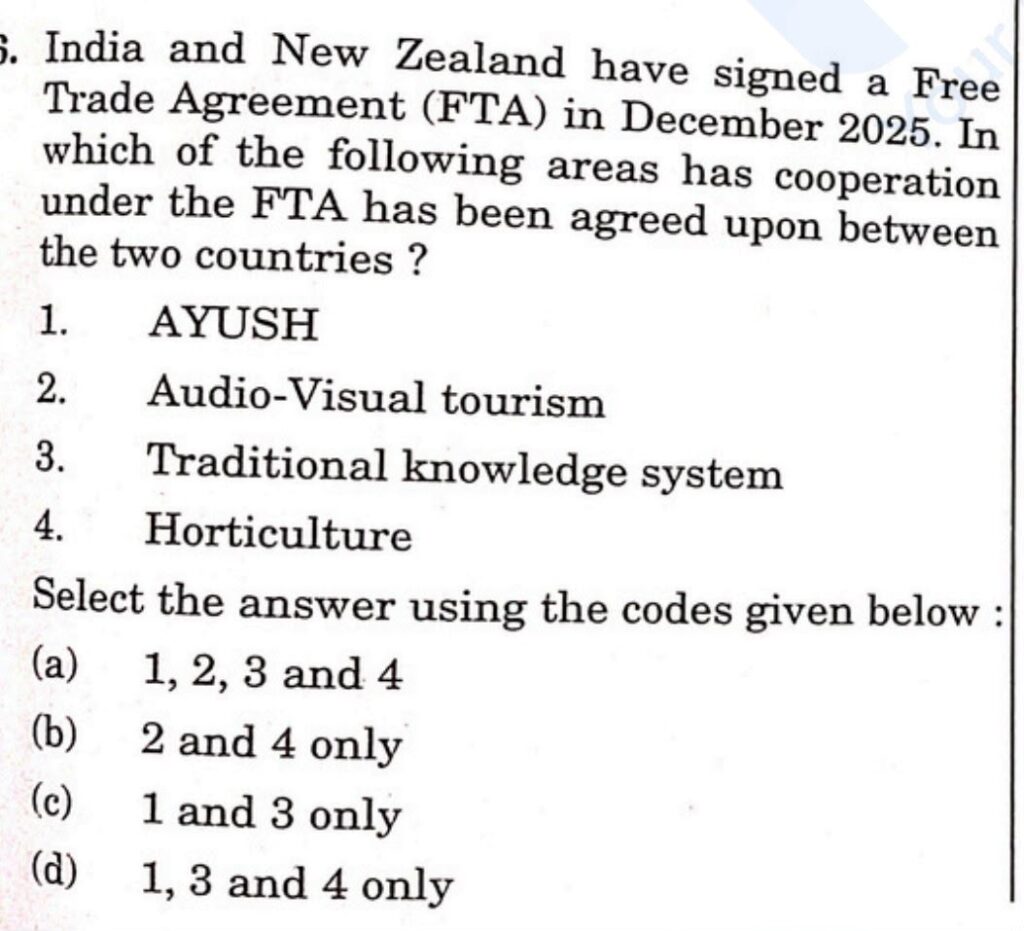
India–New Zealand FTA: Key Highlights

  • 100% duty-free access for Indian exports to New Zealand.
  • India liberalises around 70% of tariff lines.
  • Sensitive sectors remain protected.
  • Strong emphasis on services, trade facilitation, digital certification, customs cooperation and Rules of Origin.
  • Dedicated cooperation in:
    • AYUSH
    • Traditional Knowledge Systems
    • Student Mobility
    • Horticulture

Significance

  • Strengthens India’s engagement with Oceania.
  • Supports services exports.
  • Improves professional and student mobility.
  • Helps diversify trade partnerships.
  • Builds modern trade architecture beyond tariffs.
  • Improves export competitiveness through compliance and regulatory cooperation.
About the UPSC Civil Services Examination (UPSC CSE)

The UPSC Civil Services Examination (CSE) is one of the most competitive and esteemed examinations in India, conducted by the Union Public Service Commission to recruit officers for services such as the Indian Administrative Service (IAS), Indian Police Service (IPS), Indian Foreign Service (IFS), and others. The exam comprises three stages — Prelims, Mains, and the Personality Test (Interview) — designed to test a candidate’s knowledge, aptitude, decision-making, and leadership skills.


How to Prepare Effectively for UPSC CSE

Cracking the UPSC CSE requires a deep understanding of the syllabus, consistent revision, structured answer writing, and smart test-taking strategies. The Prelims test analytical and conceptual clarity, the Mains focuses on critical thinking, articulation, and subject mastery, while the Interview assesses presence of mind, ethical judgment, and personality traits relevant to public service.

At UnderStand UPSC, we empower aspirants with a personalized and focused approach to each stage of the exam.


Why Choose UnderStand UPSC?

UnderStand UPSC is a mentorship-driven platform offering a clear, clutter-free strategy to tackle the Civil Services Examination. Our programs like Transform (for beginners and intermediate learners) and Conquer (for advanced mains preparation) provide structured study plans, syllabus-wise video content, interactive live sessions, and answer writing support.

We emphasize:

  • Concept clarity through topic-wise lectures

  • Test series designed around real UPSC standards

  • Personalized mentorship in small groups

  • Regular performance tracking and peer benchmarking

  • Doubt-clearing sessions, current affairs analysis, and monthly magazines


Join the UnderStand UPSC Learning Community

Our mission is to make UPSC preparation less overwhelming and more strategic. We combine mentorship, discipline, and academic rigor to help you clear CSE with confidence. Whether you’re preparing from Delhi, Mumbai, Bangalore, or a remote village — our online-first model ensures quality guidance reaches every corner of India.

Join the thousands of aspirants who trust UnderStand UPSC to guide their journey toward becoming civil servants.

Stay connected with us through our Telegram, YouTube, and Instagram channels for daily tips, strategies, and updates.

Copyright © 2026 USARAMBHA EDUCATION (UnderStand UPSC). All Rights Reserved.

Fill out the form for

Downloading the free Agriculture Short Notes


Fill out the form

If you have any queries related to
GS Foundation 2027/28