Context
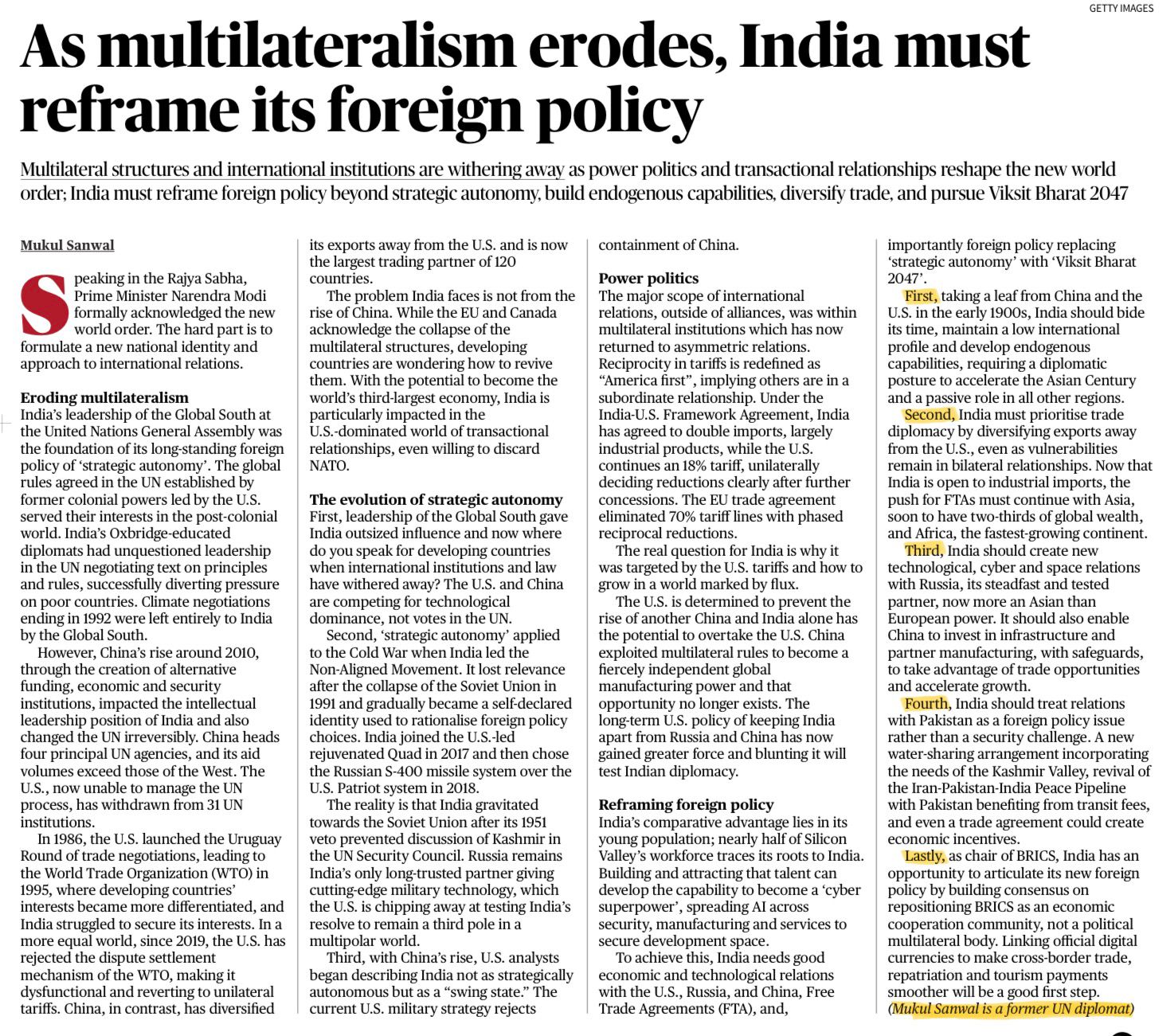
As multilateralism weakens and global power politics return, the author argues that India must recalibrate its foreign policy to enhance strategic autonomy and secure long-term national interests.
Five Key Solutions Suggested for India
- Reclaim strategic autonomy
- Reduce over-dependence on any single major power (U.S./China).
- Build indigenous capabilities and maintain balanced global engagement.
- Prioritise trade diversification
- Expand exports beyond the U.S.
- Strengthen India-U.S. trade ties while mitigating tariff vulnerabilities.
- Build new technological & geopolitical partnerships
• Deepen cooperation with Europe, East Asia, and emerging tech powers.
• Invest in cyber security, digital economy, defence tech, and space. - Reset relations with Pakistan calmly
- Approach Pakistan as a foreign policy issue, not an emotional one.
- Explore structured engagement (e.g., pipelines, trade) if conditions permit.
- Re-energise BRICS & Global South leadership
- Use BRICS as a vehicle to push multipolarity and financial alternatives.
- Promote de-dollarisation tools (digital currencies, settlement systems) and fairer global governance.