Passive Euthanasia in India: Supreme Court Upholds Right to Die with Dignity under Article 21

Context
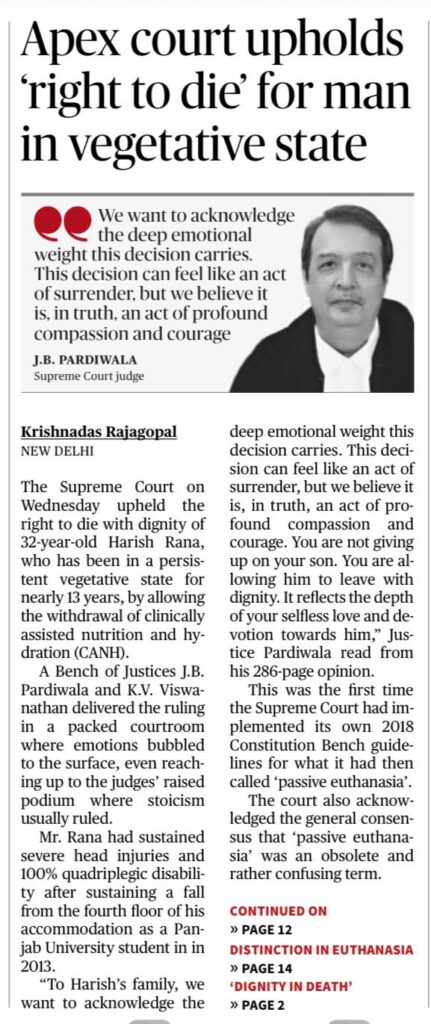
The Supreme Court allowed the withdrawal of clinically assisted nutrition and hydration (CANH) for a man in a persistent vegetative state, reaffirming that the right to die with dignity flows from Article 21 of the Constitution.

Passive Euthanasia

• Passive euthanasia refers to withdrawal or withholding of life-sustaining treatment, such as ventilators, feeding tubes or critical medicines.
• It allows natural death to occur when recovery is medically impossible.
• Importantly, there is no direct act to cause death, unlike active euthanasia.
• In India, passive euthanasia is permitted with strict safeguards under Article 21.

Historical Evolution

Aruna Shanbaug Case (2011)

  • The Supreme Court first recognised passive euthanasia.
  • However, strict approval from courts was required.

Common Cause vs Union of India (2018)

  • The Court ruled that Article 21 includes the right to die with dignity.
  • It also legally recognised the concept of a Living Will, allowing individuals to specify medical decisions in advance.

Present Case

• The recent ruling is not the first recognition of passive euthanasia.
• However, it is one of the first major instances where the Supreme Court itself applied the 2018 safeguards to permit withdrawal of CANH.

Key Observations of the Court

• Artificially prolonging life without the possibility of recovery violates the dignity guaranteed under Article 21.
• Withdrawal of CANH was permitted after medical confirmation of an irreversible and long-term vegetative condition.

Safeguards

The Court mandated safeguards before withdrawal of life-support:
• Approval from a medical board of doctors.
Consent of the family.
• Judicial oversight to ensure the decision is ethical and voluntary.
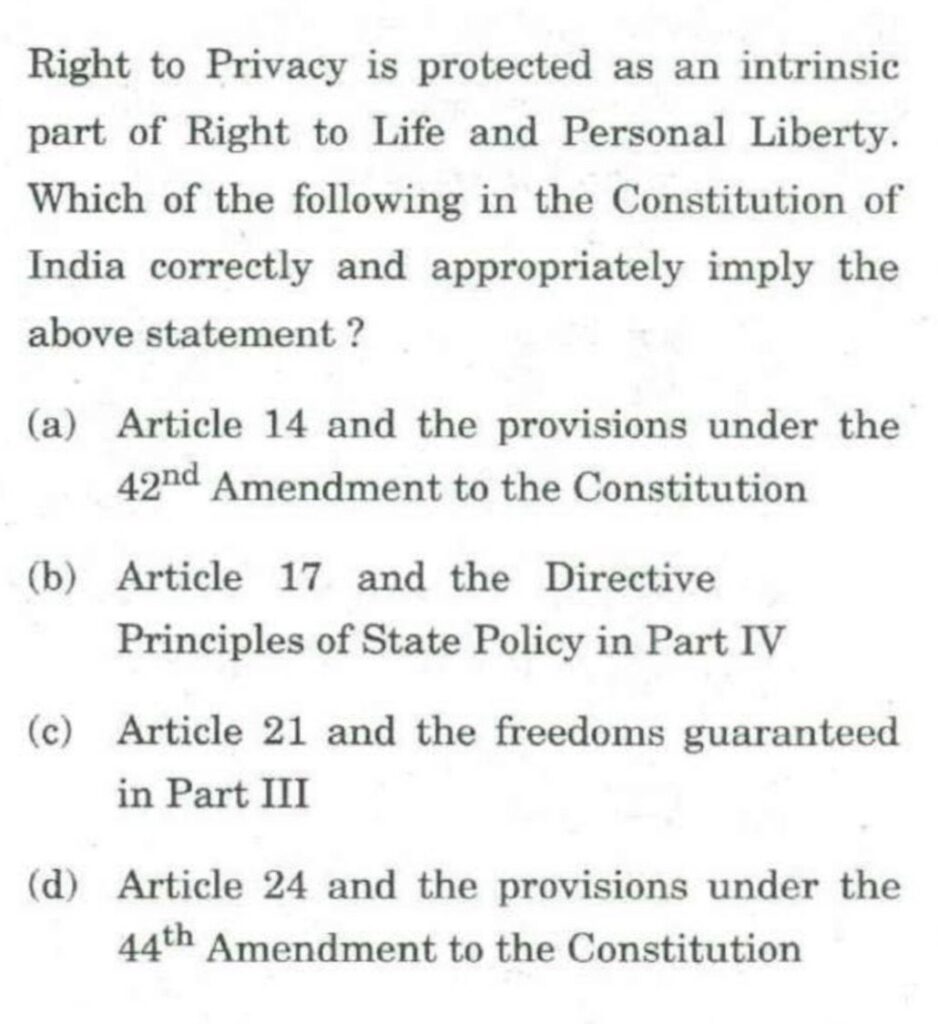
PYQ – 2018, Ans – C
About the UPSC Civil Services Examination (UPSC CSE)

The UPSC Civil Services Examination (CSE) is one of the most competitive and esteemed examinations in India, conducted by the Union Public Service Commission to recruit officers for services such as the Indian Administrative Service (IAS), Indian Police Service (IPS), Indian Foreign Service (IFS), and others. The exam comprises three stages — Prelims, Mains, and the Personality Test (Interview) — designed to test a candidate’s knowledge, aptitude, decision-making, and leadership skills.


How to Prepare Effectively for UPSC CSE

Cracking the UPSC CSE requires a deep understanding of the syllabus, consistent revision, structured answer writing, and smart test-taking strategies. The Prelims test analytical and conceptual clarity, the Mains focuses on critical thinking, articulation, and subject mastery, while the Interview assesses presence of mind, ethical judgment, and personality traits relevant to public service.

At UnderStand UPSC, we empower aspirants with a personalized and focused approach to each stage of the exam.


Why Choose UnderStand UPSC?

UnderStand UPSC is a mentorship-driven platform offering a clear, clutter-free strategy to tackle the Civil Services Examination. Our programs like Transform (for beginners and intermediate learners) and Conquer (for advanced mains preparation) provide structured study plans, syllabus-wise video content, interactive live sessions, and answer writing support.

We emphasize:

  • Concept clarity through topic-wise lectures

  • Test series designed around real UPSC standards

  • Personalized mentorship in small groups

  • Regular performance tracking and peer benchmarking

  • Doubt-clearing sessions, current affairs analysis, and monthly magazines


Join the UnderStand UPSC Learning Community

Our mission is to make UPSC preparation less overwhelming and more strategic. We combine mentorship, discipline, and academic rigor to help you clear CSE with confidence. Whether you’re preparing from Delhi, Mumbai, Bangalore, or a remote village — our online-first model ensures quality guidance reaches every corner of India.

Join the thousands of aspirants who trust UnderStand UPSC to guide their journey toward becoming civil servants.

Stay connected with us through our Telegram, YouTube, and Instagram channels for daily tips, strategies, and updates.

Copyright © 2026 USARAMBHA EDUCATION (UnderStand UPSC). All Rights Reserved.

Join the Success Journey!