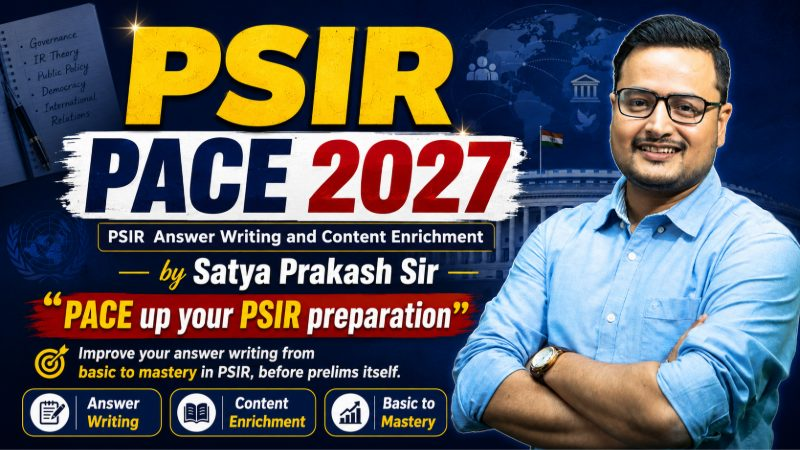
“PACE up your PSIR preparation”
Course Features
Course Pillars:
TEST SCHEDULE
| PSIR Answer Writing and Content Enrichment (PACE) – 2027 | ||
| Test Number | Date | Test Topics |
| PSIR Test 1 | 28-Jun-26 | Western Political Thought : Plato, Aristotle, Machiavelli, Hobbes, Locke, John S. Mill, Marx,
Gramsci, Hannah Arendt. Political Theory: meaning and approaches. |
| PSIR Test 2 | 12-Jul-26 | Theories of state : Liberal, Neo-liberal, Marxist, Pluralist, post-colonial and Feminist.
Justice : Conceptions of justice with special reference to Rawl’s theory of justice and its communitarian critiques. |
| PSIR Test 3 | 26-Jul-26 | Equality : Social, political and economic; relationship between equality and freedom;
Affirmative action.
Rights : Meaning and theories; different kinds of rights; Concept of Human Rights. Democracy : Classical and contemporary theories; different models of democracy— representative, participatory and deliberative. |
| PSIR Test 4 | 09-Aug-26 | Concept of power : hegemony, ideology and legitimacy.
Political Ideologies : Liberalism, Socialism, Marxism, Fascism, Gandhism and Feminism. Indian Political Thought: Dharamshastra, Arthashastra and Buddhist Traditions; Sir Syed Ahmed Khan, Sri Aurobindo, M. K. Gandhi, B. R. Ambedkar, M. N. Roy. |
| PSIR Test 5 | 23-Aug-26 | Indian Nationalism : * Political Strategies of India’s Freedom Struggle : Constitutionalism to mass Satyagraha, Non-cooperation, Civil Disobedience; Militant and Revolutionary Movements, Peasant and Workers Movements. * Perspectives on Indian National Movement; Liberal, Socialist and Marxist; Radical Humanist and Dalit. Making of the Indian Constitution : Legacies of the British rule; different social and political perspectives. Salient Features of the Indian Constitution : The Preamble, Fundamental Rights and Duties, Directive Principles; Parliamentary System and Amendment Procedures; Judicial Review and Basic Structure doctrine. |
| PSIR Test 6 | 06-Sep-26 | Principal Organs of the Union Government : Envisaged role and actual working of the Executive, Legislature and Supreme Court Principal Organs of the State Government : Envisaged role and actual working of the Executive, Legislature and High Courts. Grassroots Democracy : Panchayati Raj and Municipal Government; Significance of 73rd and 74th Amendments; Grassroot movements. Statutory Institutions/Commissions : Election Commission, Comptroller and Auditor General, Finance Commission, Union Public Service Commission, National Commission for Scheduled Castes, National Commission for Scheduled Tribes, National Commission for Women; National Human Rights Commission, National Commission for Minorities, National Backward Classes Commission. |
| PSIR Test 7 | 20-Sep-26 | Federalism : Constitutional provisions; changing nature of centre-state relations; integrationist tendencies and regional aspirations; inter-state disputes. Planning and Economic development : Nehruvian and Gandhian perspectives; Role of planning and public sector; Green Revolution, land reforms and agrarian relations; liberalization and economic reforms. |
| PSIR Test 8 | 04-Oct-26 | Caste, Religion and Ethnicity in Indian Politics. Party System : National and regional political parties, ideological and social bases of parties; Patterns of coalition politics; Pressure groups, trends in electoral behaviour; changing socio-economic profile of Legislators. Social Movement : Civil liberties and human rights movements; women’s movements; environmentalist movements. |
| PSIR Test 9 | 18-Oct-26 | Paper 1 |
| PSIR Test 10 | 01-Nov-26 | Comparative Politics : Nature and major approaches; Political economy and political sociology perspectives; Limitations of the comparative method State in Comparative Perspective : Characteristics and changing nature of the State in capitalist and socialist economies, and advanced industrial and developing societies. Politics of Representation and Participation : Political parties, pressure groups and social movements in advanced industrial and developing societies |
| PSIR Test 11 | 15-Nov-26 | Globalisation : Responses from developed and developing societies
Approaches to the Study of International Relations : Idealist, Realist, Marxist, Functionalist and Systems theory. Key Concepts in International Relations : National interest, security and power; Balance of power and deterrence; Transational actors and collective security; World capitalist economy and globalisation. |
| PSIR Test 12 | 29-Nov-26 | Changing International Political Order : * Rise of super powers; Strategic and ideological Bipolarity, arms race and cold war; Nuclear threat * Non-aligned Movement : Aims and achievements. * Collapse of the Soviet Union; Unipolarity and American hegemony; Relevance of non- alignment in the contemporary world. Evolution of the International Economic System : From Brettonwoods to WTO; Socialist economies and the CMEA (Council for Mutual Economic Assistance); Third World demand for new international economic order; Globalisation of the world economy. United Nations : Envisaged role and actual record; Specialized UN agencies—aims and functioning; need for UN reforms. |
| PSIR Test 13 | 13-Dec-26 | Regionalisation of World Politics : EU, ASEAN, APEC, SAARC, NAFTA Contemporary Global Concerns : Democracy, human rights, environment, gender justice terrorism, nuclear proliferation. |
| PSIR Test 14 | 27-Dec-26 | Indian Foreign Policy : Determinants of foreign policy; the institutions of policy-making; Continuity and change. India’s Contribution to the Non-Alignment Movement Different phases; Current role. |
| PSIR Test 15 | 03-Jan-27 | India and South Asia : * Regional Co-operation : SAARC-past performance and future prospects. * South Asia as a Free Trade Area. * India’s “Look East” policy. * Impediments to regional co-operation : River water disputes; illegal cross border migration; Ethnic conflicts and insurgencies; Border disputes. India and the Global South : Relations with Africa and Latin America; Leadership role in the demand for NIEO and WTO negotiations. |
| PSIR Test 16 | 10-Jan-27 | India and the Global Centres of Power : USA, EU, Japan, China and Russia India and the UN System: Role in UN Peace-keeping; Demand for Permanent Seat in the Security Council. |
| PSIR Test 17 | 17-Jan-27 | India and the Nuclear Question : Changing perceptions and policy. Recent developments in Indian Foreign Policy : India’s position on the recent crises in Afghanistan, Iraq and West Asia, growing relations with US and Isreal; Vision of a new world order. |
| PSIR Test 18 | 31-Jan-27 | Paper 2 |
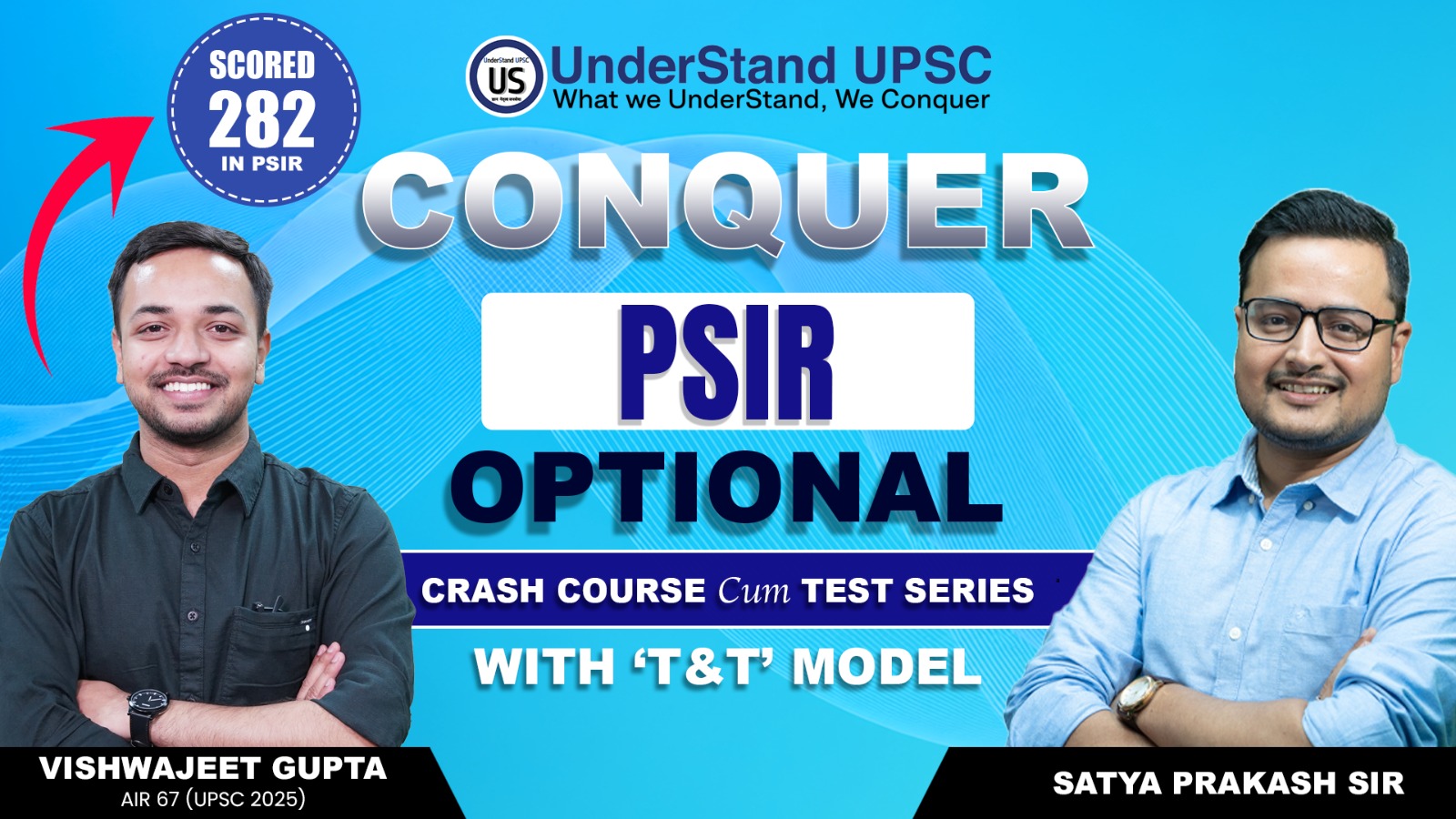
PSIR Crash Course & Test Series – Target 2026
Teacher – Satya Prakash Sir
Course Feature
Course Pillars:
PSIR Crash Course Lectures – Approx 32 lectures, whose focus shall be on a quick revision of the syllabus through value addition and the Previous Year Questions (PYQs).
PSIR Tests (FLTs)
Each Test includes
TEST SCHEDULE
| PSIR Test 1 | 21-Jun-26 | Sectional | Paper 1 Section A |
| PSIR Test 2 | 5-Jul-26 | Sectional | Paper 1 Section B |
| PSIR Test 3 | 19-Jul-26 | Sectional | Paper 2 Section A |
| PSIR Test 4 | 2-Aug-26 | Sectional | Paper 2 Section B |
| PSIR Test 5 | 9-Aug-26 | Full Length | Paper 1 |
| PSIR Test 6 | 9-Aug-26 | Full Length | Paper 2 |
Lecture Schedule
| Lecture/Test Number | Date | Topics | Sectional Syllabus |
| Lecture 1 | 7-Jun-26 | Orientation & Political Theory: meaning and approaches. | Paper 1 Section A |
| Lecture 2 | 8-Jun-26 | Western Political Thought | Paper 1 Section A |
| Lecture 3 | 9-Jun-26 | Indian Political Thought | Paper 1 Section A |
| Lecture 4 | 11-Jun-26 | Theories of state, Justice | Paper 1 Section A |
| Lecture 5 | 12-Jun-26 | Equality, Rights | Paper 1 Section A |
| Lecture 6 | 15-Jun-26 | Democracy, Concept of Power | Paper 1 Section A |
| Lecture 7 | 16-Jun-26 | Political Ideologies, Democracy | Paper 1 Section A |
| PSIR Test 1 | 21-Jun-26 | Paper 1 Section A | |
| Lecture 8 | 18-Jun-26 | Indian Nationalism, Making of the Indian Constitution | Paper 1 Section B |
| Lecture 9 | 19-Jun-26 | Salient Features of the Indian Constitution | Paper 1 Section B |
| Lecture 10 | 22-Jun-26 | Principal Organs of Government, Federalism | Paper 1 Section B |
| Lecture 11 | 23-Jun-26 | Grassroots Democracy, Statutory Institutions/Commissions | Paper 1 Section B |
| Lecture 12 | 25-Jun-26 | Planning and Economic development, Social Movement | Paper 1 Section B |
| Lecture 13 | 26-Jun-26 | Caste, Religion and Ethnicity in Indian Politics | Paper 1 Section B |
| Lecture 14 | 29-Jun-26 | Party System | Paper 1 Section B |
| PSIR Test 2 | 5-Jul-26 | Paper 1 Section B | |
| Lecture 15 | 30-Jun-26 | Comparative Politics, | Paper 2 Section A |
| Lecture 16 | 2-Jul-26 | Politics of Representation and Participation, State in Comparative Perspective | Paper 2 Section A |
| Lecture 17 | 3-Jul-26 | Globalisation, United Nations | Paper 2 Section A |
| Lecture 18 | 6-Jul-26 | Approaches to the Study of International Relations | Paper 2 Section A |
| Lecture 19 | 7-Jul-26 | Key Concepts in International Relations | Paper 2 Section A |
| Lecture 20 | 9-Jul-26 | Changing International Political Order, Regionalisation of World Politics | Paper 2 Section A |
| Lecture 21 | 10-Jul-26 | Evolution of the International Economic System | Paper 2 Section A |
| Lecture 22 | 13-Jul-26 | Contemporary Global Concerns | Paper 2 Section A |
| PSIR Test 3 | 19-Jul-26 | Paper 2 Section A | |
| Lecture 23 | 14-Jul-26 | Indian Foreign Policy | Paper 2 Section B |
| Lecture 24 | 16-Jul-26 | India’s Contribution to the Non-Alignment Movement | Paper 2 Section B |
| Lecture 25 | 17-Jul-26 | India and South Asia | Paper 2 Section B |
| Lecture 26 | 20-Jul-26 | India and the Global South | Paper 2 Section B |
| Lecture 27 | 21-Jul-26 | India and the Global Centres of Power | Paper 2 Section B |
| Lecture 28 | 23-Jul-26 | India and the UN System | Paper 2 Section B |
| Lecture 29 | 24-Jul-26 | India and the Nuclear Question | Paper 2 Section B |
| Lecture 30 | 27-Jul-26 | Recent developments in Indian Foreign Policy | Paper 2 Section B |
| PSIR Test 4 | 2-Aug-26 | Paper 2 Section B | |
| PSIR Test 5 | 9-Aug-26 | Full Length | Paper 1 |
| PSIR Test 6 | 9-Aug-26 | Full Length | Paper 2 |

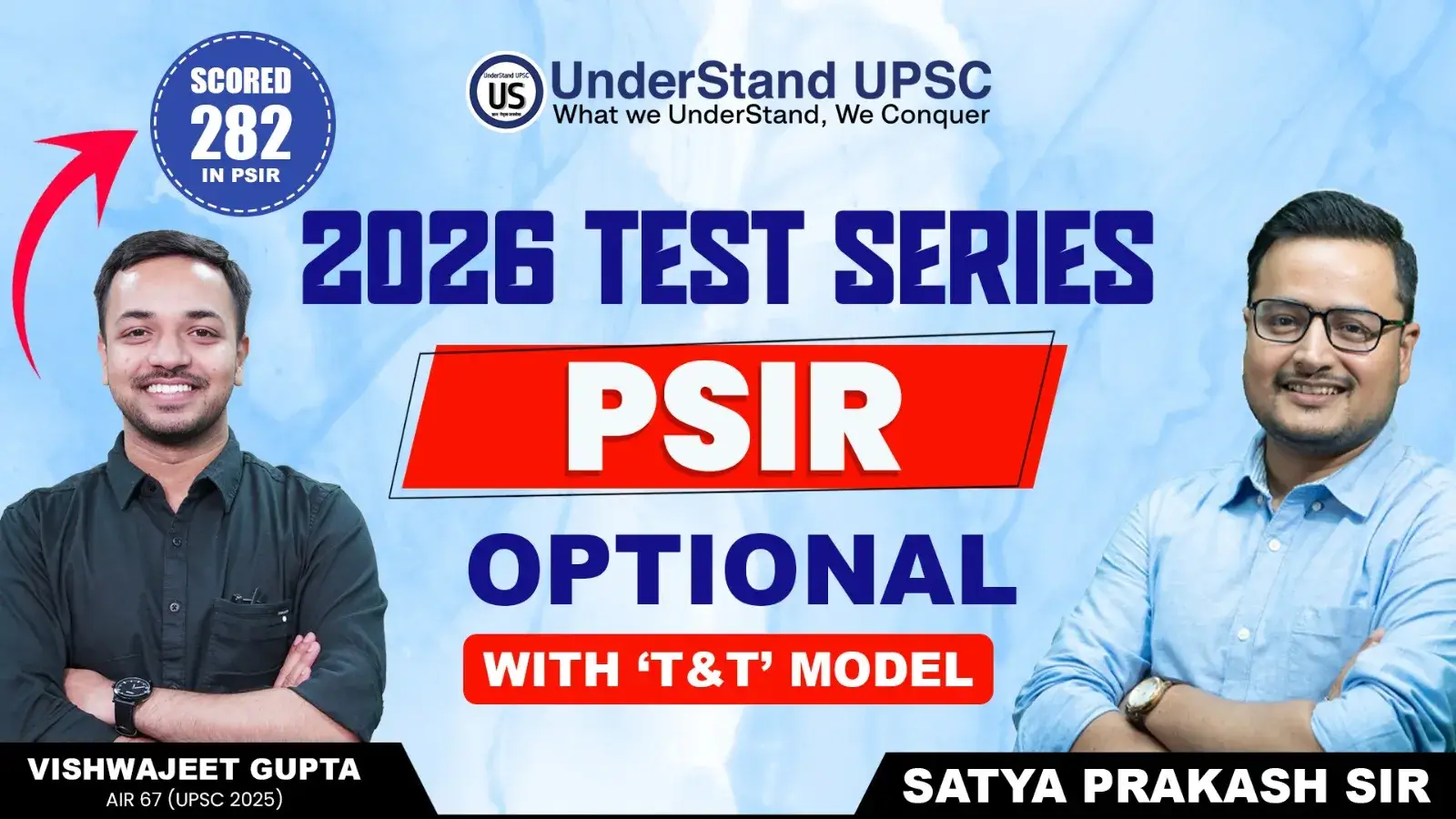
PSIR Full Length Tests (FLTs)
Number of Tests = 6 Tests .
Test 1 Syllabus – Paper 1 Section A
Test 2 Syllabus – Paper 1 Section B
Test 3 Syllabus – Paper 2 Section A
Test 4 Syllabus – Paper 2 Section B
Test 5 Syllabus – Paper 1
Test 6 Syllabus – Paper 2
Each Test includes
TEST SCHEDULE
| PSIR Test 1 | 21-Jun-26 | Sectional | Paper 1 Section A |
| PSIR Test 2 | 5-Jul-26 | Sectional | Paper 1 Section B |
| PSIR Test 3 | 19-Jul-26 | Sectional | Paper 2 Section A |
| PSIR Test 4 | 2-Aug-26 | Sectional | Paper 2 Section B |
| PSIR Test 5 | 9-Aug-26 | Full Length | Paper 1 |
| PSIR Test 6 | 9-Aug-26 | Full Length | Paper 2 |

A Platform OF The Students
For The Students
By The Students




Copyright © 2026 USARAMBHA EDUCATION (UnderStand UPSC). All Rights Reserved.