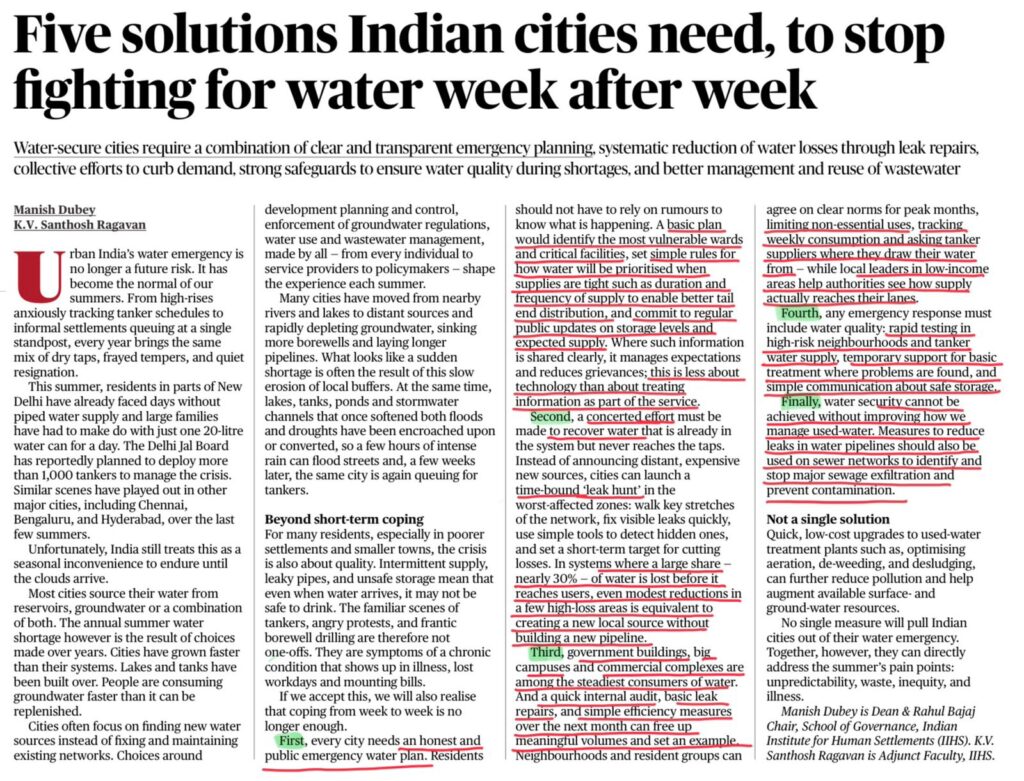
Context: Urban Water Stress in India
The article argues that recurring water crises in Indian cities are not caused only by rainfall deficits. They are also caused by poor water governance, groundwater depletion, leakages, shrinking urban water bodies and inadequate wastewater reuse.
Water Stress in India
Water Stress — Falkenmark Indicator
A region is considered water-stressed when annual per capita freshwater availability falls below 1,700 cubic metres.
Water Scarcity
- Below 1,000 cubic metres.
Absolute Water Scarcity
- Below 500 cubic metres.
Key Facts
NITI Aayog’s Composite Water Management Index
- Nearly 600 million Indians face high-to-extreme water stress.
- Water demand may become twice the available supply by 2030.
United Nations World Water Development Report
- Uses the Falkenmark framework for assessing water stress and scarcity.
India’s per capita water availability declined from:
- 5,177 cubic metres in 1951
- To about 1,486 cubic metres in 2021
This places India in the water-stressed category.
Drivers of Water Stress
- Uneven monsoon distribution
- Groundwater over-extraction
- Rapid urbanisation
- Rising urban water demand
- Encroachment of lakes
- Encroachment of wetlands
- Encroachment of drainage channels
- Pollution reducing usable freshwater
Five Solutions Suggested
1. Urban Water Security Planning
Cities should prepare:
- City-specific water budgets
- Drought contingency plans
- Reservoir monitoring systems
- Transparent water-allocation frameworks
2. Improve Water-Use Efficiency
Reduce Non-Revenue Water through:
- Leak detection
- Smart metering
- Pipeline modernisation
- Efficient distribution networks
3. Demand-Side Water Management
Promote:
- Water audits
- Rational pricing
- Greywater reuse
- Behavioural change to curb excessive urban water consumption
4. Restore and Protect Urban Water Ecosystems
Rejuvenate:
- Lakes
- Wetlands
- Storm-water drains
- Groundwater recharge zones
This strengthens local water resilience.
5. Circular Water Economy
Expand:
- Wastewater treatment
- Recycling
- Reuse for industrial purposes
- Reuse for construction
- Reuse for landscaping
This reduces dependence on freshwater sources.