Context: Dancing Girl of Mohenjo-daro
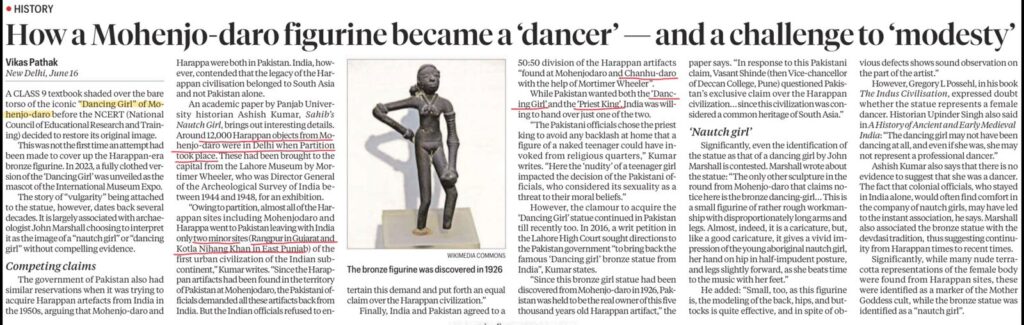
The Dancing Girl of Mohenjo-daro has reignited debate on the interpretation of archaeological artefacts, their representation in educational material, and the question of shared India–Pakistan ownership of Indus Valley Civilization heritage.
The debate shows how modern nations engage with a civilisation that existed long before present-day political boundaries.
Dancing Girl
Discovered
- 1926
Site
- Mohenjo-daro, present-day Pakistan
Material
- Bronze
Height
- Around 10.5 cm
Technique
- Lost-Wax Casting Technique
Significance
The Dancing Girl is considered one of the finest examples of:
- Harappan metallurgy
- Artistic excellence
- Bronze casting
- Urban cultural sophistication
Lost-Wax Casting Technique
Lost-Wax Casting is a metal-casting technique in which a wax model is first made, covered with clay, heated so the wax melts out, and then molten metal is poured into the cavity.
It shows that Harappans had advanced knowledge of:
- Metallurgy
- Craft specialisation
- Artistic design
- Technical precision
India–Pakistan Heritage Dimension
- Most major Harappan sites, including Mohenjo-daro and Harappa, lie in present-day Pakistan.
- The Dancing Girl is housed in India.
- The Priest-King sculpture is housed in Pakistan.
- This raises the question of whether the Indus Valley Civilization should be seen as the heritage of one country or as a shared civilisational heritage of South Asia.
Important Indus Valley Sites
Pakistan
Mohenjo-daro
- Great Bath
- Dancing Girl
Harappa
- Granary
- Cemetery R-37
Chanhu-daro
- Bead-making centre
Kot Diji
- Pre-Harappan fortification
India
Dholavira, Gujarat
- Water management system
- Signboard
Lothal, Gujarat
- Dockyard
Kalibangan, Rajasthan
- Ploughed field
Rakhigarhi, Haryana
- Largest Harappan site in India
Banawali, Haryana
- Fortified town planning
Surkotada, Gujarat
- Horse remains
Ropar, Punjab
- Sutlej settlement
Alamgirpur, Uttar Pradesh
- Easternmost Harappan site
PYQ Fact
The famous female figurine known as the Dancing Girl, found at Mohenjo-daro, is made of bronze.