Context: Western Ghats Ecologically Sensitive Area
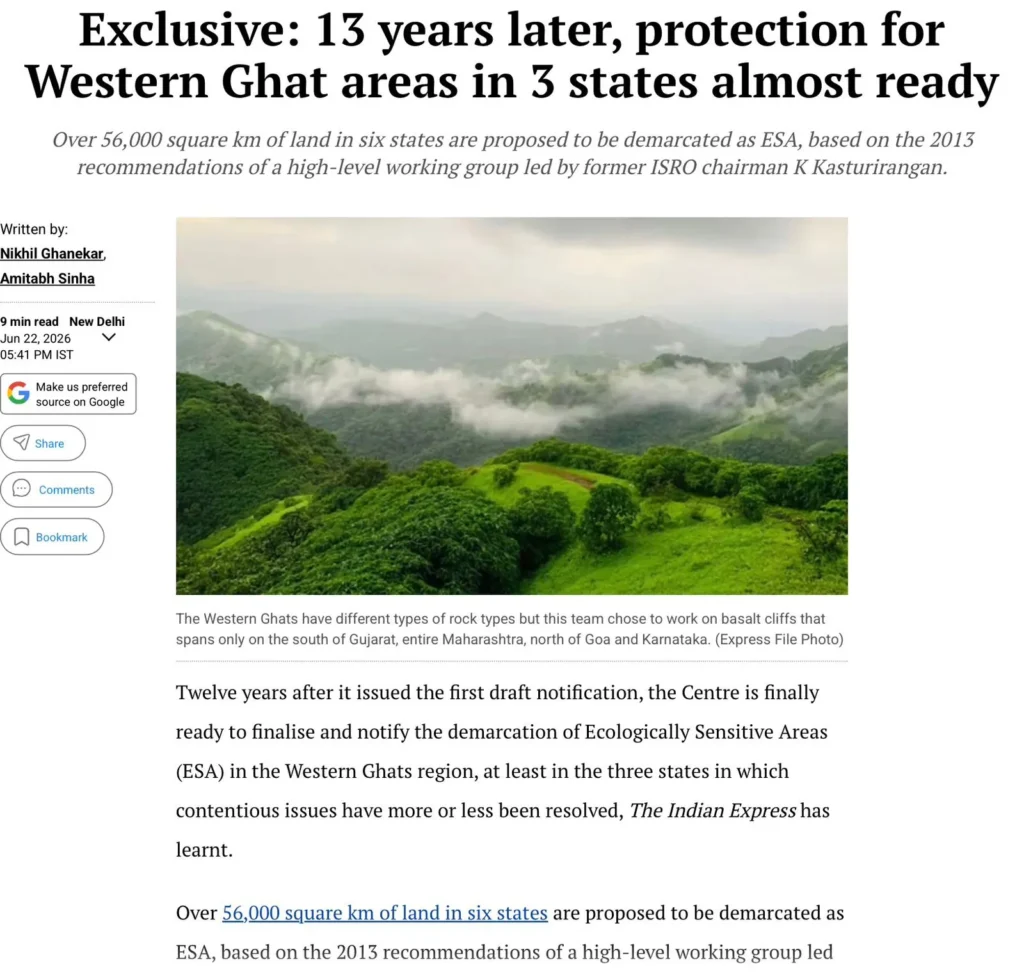
The Centre is close to finalising the Ecologically Sensitive Area notification in the Western Ghats, covering about 56,000 sq km, based largely on the K. Kasturirangan Committee recommendations.
Ecologically Sensitive Area
Ecologically Sensitive Areas are notified under the Environment Protection Act, 1986.
Restrictions in ESA
Activities restricted include:
- Mining
- Quarrying
- Thermal power plants
- Highly polluting industries
Purpose
To protect:
- Biodiversity
- Fragile ecosystems
- Forest landscapes
- Water security
- Ecological balance
Eco-Sensitive Zone
Eco-Sensitive Zones are buffers around:
- National Parks
- Wildlife Sanctuaries
Generally, a minimum 1 km protection zone is applied where applicable.
Earlier, 10 km was only a guideline, not a uniform rule.
Western Ghats
Status
- UNESCO World Heritage Site
Importance
- One of the world’s 8 hottest biodiversity hotspots.
Length
- Around 1,600 km
States Covered: North to South
- Gujarat
- Maharashtra
- Goa
- Karnataka
- Kerala
- Tamil Nadu
Western Ghats Committees
Kasturirangan Committee, 2013
- Recommended ESA for around 37% of Western Ghats.
- Around 60,000 sq km.
- Used Natural Landscape vs Cultural Landscape approach.
- Tried to balance conservation and development.
Gadgil Committee, 2011
- Recommended protection for most of the Western Ghats.
- Suggested stricter environmental safeguards.
- Favoured community-led conservation.
PYQ Link
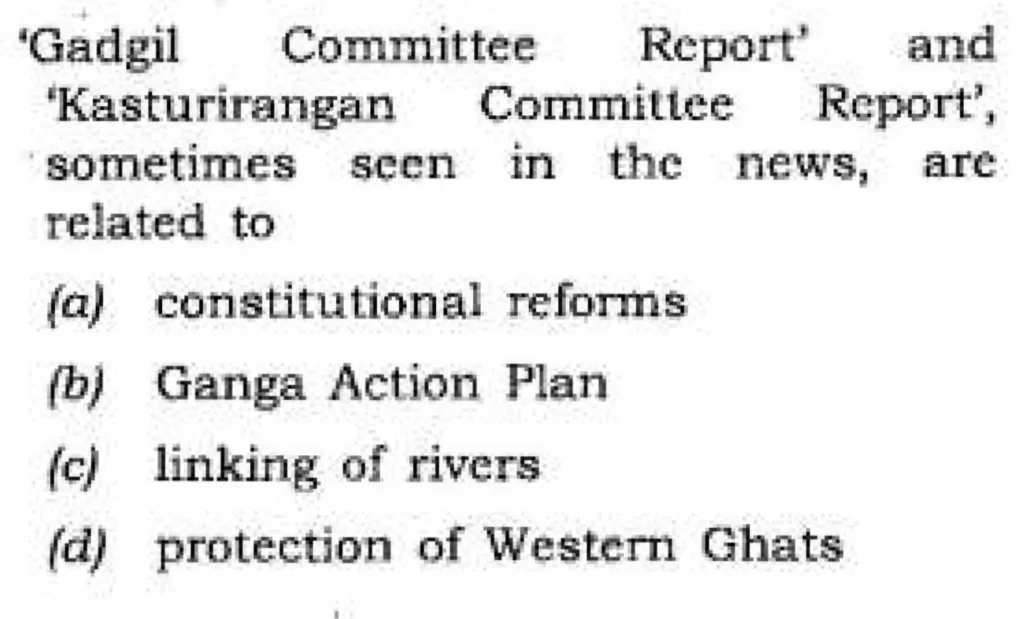
Gadgil Committee Report and Kasturirangan Committee Report are related to protection of Western Ghats.
Significance
- Protects biodiversity-rich Western Ghats.
- Reduces ecological damage from mining and polluting industries.
- Supports climate resilience.
- Protects rivers and water sources.
- Balances development and ecological security.
- Important for disaster risk reduction in fragile hill ecosystems.