Source: The Hindu (Editorial) | Page: 6 | Tags: 27 June 2026, Economy, Free Trade Agreements (FTAs), GS3, International Trade
Context: India New Zealand Free Trade Agreement
India and New Zealand signed the Free Trade Agreement on 27 April 2026 after concluding negotiations in December 2025. However, it is not yet operational. It will enter into force only after both countries complete their domestic ratification procedures.
The editorial uses this agreement to explain how modern FTAs are evolving beyond simple tariff liberalisation.
How Modern FTAs Are Evolving
1. Beyond Tariffs
Competitiveness now depends not only on lower import duties, but also on:
- Trade facilitation
- Logistics
- Digital customs
- Regulatory certainty
- Faster approvals
2. Services-Centric FTAs
Modern FTAs increasingly focus on:
- Professional mobility
- Student mobility
- Knowledge industries
- Services market access
3. Compliance-Based Market Access
FTA benefits are not automatic.
They depend on:
- Rules of Origin
- Traceability
- Documentation
- Harmonised System classification
- Compliance capacity of exporters
4. Addressing Non-Tariff Barriers
Real market access is often shaped by:
- Sanitary and Phytosanitary Measures
- Technical Barriers to Trade
- Certifications
- Quality standards
- Regulatory approvals
5. Supply Chain Integration
FTAs are becoming tools for:
- Resilient global value chains
- Trusted sourcing
- Lower transaction costs
- Supply-chain diversification
6. Calibrated Liberalisation
Countries open competitive sectors while protecting sensitive ones.
For India, dairy remains a sensitive sector.
India–New Zealand FTA: Key Highlights
- 100% duty-free access for Indian exports to New Zealand.
- India liberalises around 70% of tariff lines.
- Sensitive sectors remain protected.
- Strong emphasis on services, trade facilitation, digital certification, customs cooperation and Rules of Origin.
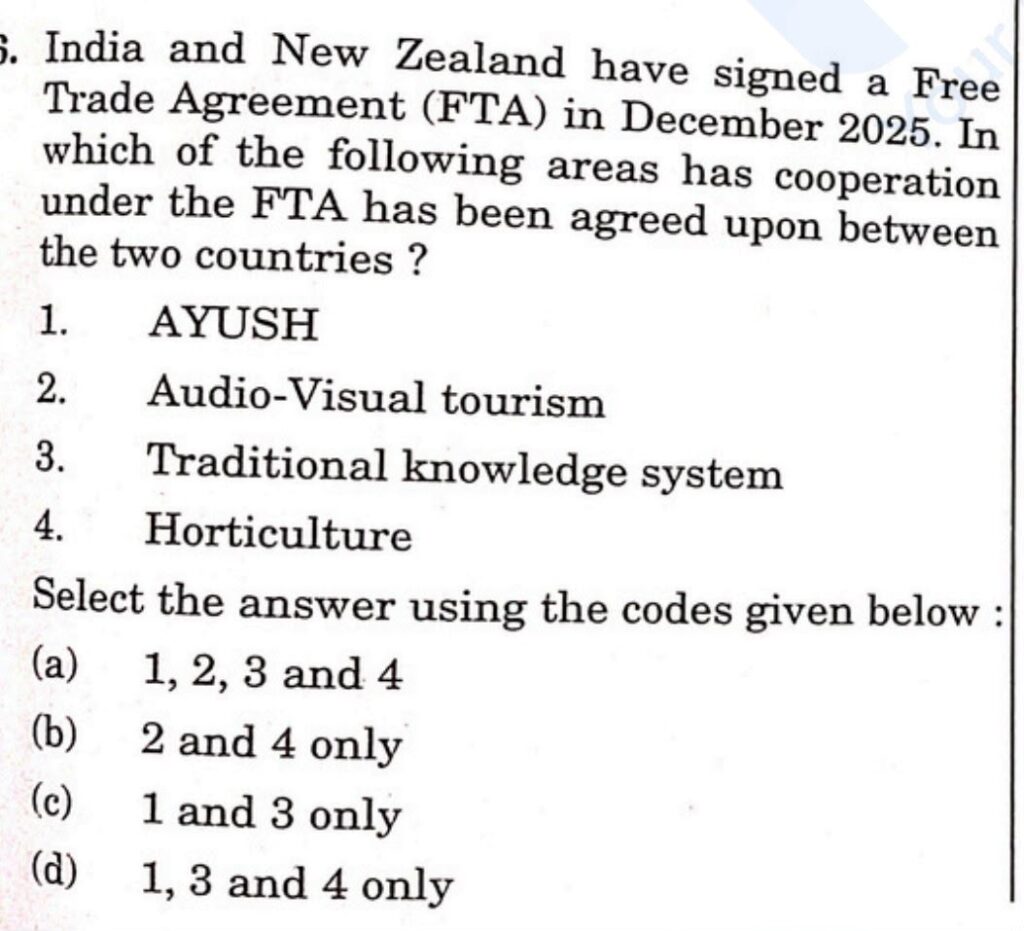
- Dedicated cooperation in:
- AYUSH
- Traditional Knowledge Systems
- Student Mobility
- Horticulture
Significance
- Strengthens India’s engagement with Oceania.
- Supports services exports.
- Improves professional and student mobility.
- Helps diversify trade partnerships.
- Builds modern trade architecture beyond tariffs.
- Improves export competitiveness through compliance and regulatory cooperation.