Context: SDG National Indicator Framework 2026
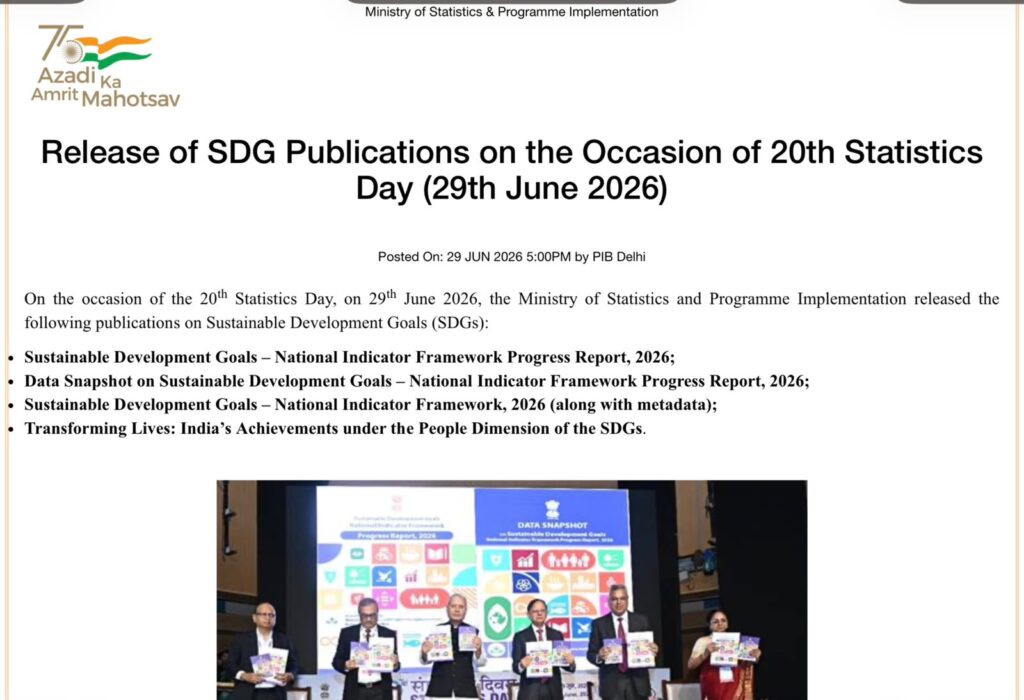
On the 20th Statistics Day, 29 June 2026, the Ministry of Statistics and Programme Implementation released the annual Sustainable Development Goals National Indicator Framework Progress Report, 2026, along with companion publications.
The report assesses India’s progress towards the 2030 Agenda for Sustainable Development.
National Indicator Framework
The National Indicator Framework is India’s official statistical framework for monitoring the 17 Sustainable Development Goals.
Developed By
- Ministry of Statistics and Programme Implementation
Developed In Consultation With
- NITI Aayog
- Line Ministries
- States / Union Territories
- United Nations agencies
Number of Indicators
- 277 National Indicators
Purpose
It serves as the national database for tracking SDG progress.
Key Findings
1. Social Development
Improvement seen in:
- Social protection coverage
- Maternal Mortality Ratio
- Sex Ratio at Birth
- Women’s participation in professional and technical jobs
2. Economic Development
Positive trends include:
- Decline in unemployment rate
- Growth in internet connectivity
- Improved digital inclusion
3. Environmental Sustainability
Progress seen in:
- Renewable energy capacity
- Waste recycling infrastructure
- Ramsar wetland coverage
Institutional Framework
MoSPI
Develops and publishes:
- National Indicator Framework
- SDG Progress Report
NITI Aayog
Publishes:
- SDG India Index using NIF indicators
States and Union Territories
Prepare:
- State Indicator Frameworks for SDG localisation
Significance
- Enables evidence-based policymaking.
- Supports outcome-based governance.
- Tracks India’s progress towards the 2030 SDGs.
- Identifies regional disparities.
- Helps better targeting of policies and resources.
- Strengthens cooperative federalism.
Challenges
- Data quality
- Timely availability of data
- Inter-State disparities
- Last-mile implementation gaps
- District-level monitoring limitations
Way Forward
- Strengthen real-time digital statistical systems.
- Improve district-level SDG monitoring.
- Deepen cooperative federalism.
- Improve data quality and timely reporting.
- Use evidence-based governance for targeted interventions.