
Operation Sindoor transparency debate for UPSC Ethics

Context: Operation Sindoor transparency debate
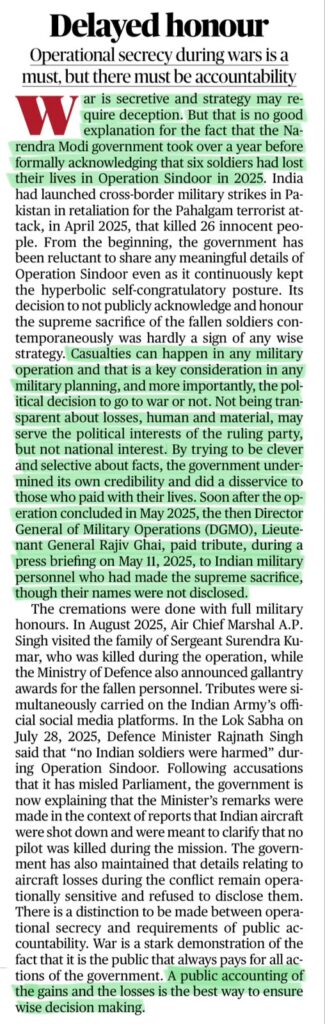
The editorial discusses the delayed disclosure of military casualties during Operation Sindoor and argues that operational secrecy during war may be necessary, but democratic accountability cannot be permanently denied.

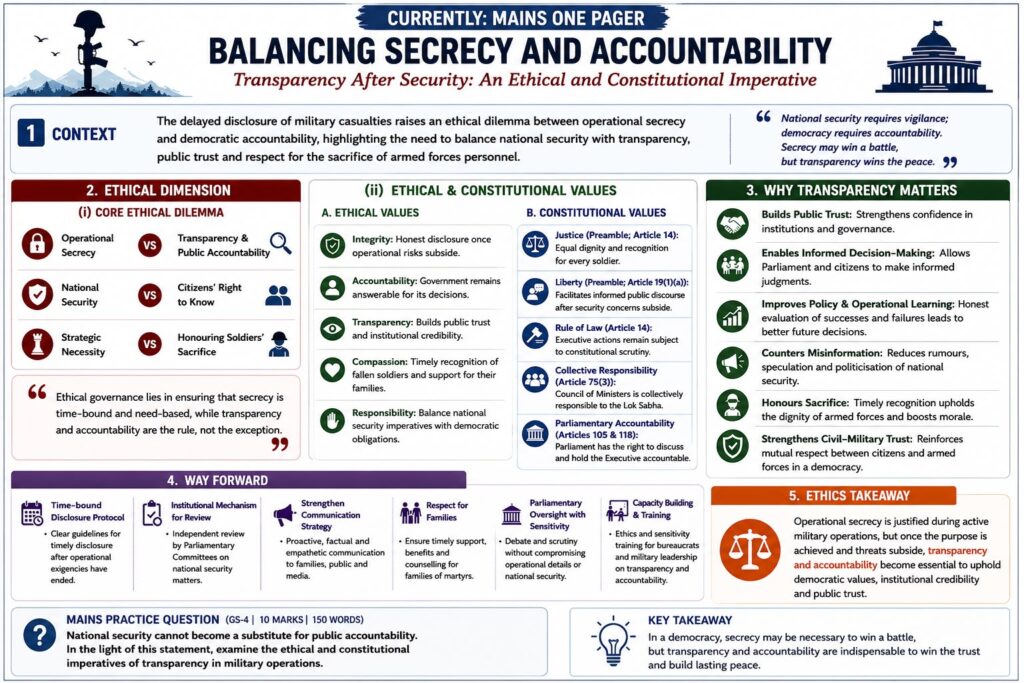
Core Ethical Issue

The issue reflects a tension between:

  • Operational secrecy
  • National security
  • Public accountability
  • Citizens’ right to know
  • Honour of sacrifice
  • Democratic transparency

Ethical Dimensions

1. Operational Secrecy vs Public Accountability

During military operations, secrecy may be needed to protect strategy, personnel and national security.

However, once operational risks reduce, the State has a duty to disclose relevant information.

2. National Security vs Citizens’ Right to Know

National security cannot become a permanent excuse for withholding information from citizens.

In a democracy, citizens must be able to trust official information.

3. Strategic Necessity vs Honouring Sacrifice

If soldiers make the supreme sacrifice, their service deserves timely recognition and institutional respect.

Delayed acknowledgement may weaken public trust.

Constitutional and Ethical Values

Article 19(1)(a)

Freedom of speech and expression includes the citizens’ right to receive information.

Article 14

Equality before law includes non-arbitrariness in State action.

Article 21

Right to life and dignity also supports the dignified recognition of sacrifice.

Parliamentary Accountability

In a parliamentary democracy, the executive is accountable to Parliament and, through Parliament, to the people.

Why Transparency Matters

Transparency:

  • Builds public trust
  • Honours soldiers’ sacrifice
  • Counters misinformation
  • Strengthens civil-military trust
  • Improves policy and operational learning
  • Allows informed democratic debate

Way Forward

1. Time-bound Disclosure Protocol

Clear guidelines should specify when and how casualties and sensitive operational information can be disclosed after risk assessment.

2. Institutional Mechanism

A structured system should exist for informing families, Parliament and the public.

3. Respect for Families

Families of fallen personnel must receive timely information, counselling and honour.

4. Parliamentary Oversight

Sensitive briefings may be given to relevant parliamentary committees.

5. Balance Between Security and Accountability

The State must protect national security while ensuring democratic transparency after immediate operational risks have passed.

GS4 Value Addition

This example can be used in answers on:

  • Accountability
  • Transparency
  • Probity in governance
  • Civil-military relations
  • Ethical governance
  • Duty-based ethics
  • Public trust
  • National security and democracy

Ethics Takeaway

Operational secrecy may be justified during active military operations, but once the purpose is achieved and threats reduce, transparency and accountability become essential to uphold democratic values and institutional credibility.
Subscribe
Notify of
guest
0 Comments
Oldest
Newest Most Voted

Operation Sindoor transparency debate for UPSC Ethics

Got a question? We're here to help!

Our dedicated Student Support team is ready to assist you and guide you every step of the way.
Reach out to us, and let’s tackle your queries together!


About the UPSC Civil Services Examination (UPSC CSE)

The UPSC Civil Services Examination (CSE) is one of the most competitive and esteemed examinations in India, conducted by the Union Public Service Commission to recruit officers for services such as the Indian Administrative Service (IAS), Indian Police Service (IPS), Indian Foreign Service (IFS), and others. The exam comprises three stages — Prelims, Mains, and the Personality Test (Interview) — designed to test a candidate’s knowledge, aptitude, decision-making, and leadership skills.


How to Prepare Effectively for UPSC CSE

Cracking the UPSC CSE requires a deep understanding of the syllabus, consistent revision, structured answer writing, and smart test-taking strategies. The Prelims test analytical and conceptual clarity, the Mains focuses on critical thinking, articulation, and subject mastery, while the Interview assesses presence of mind, ethical judgment, and personality traits relevant to public service.

At UnderStand UPSC, we empower aspirants with a personalized and focused approach to each stage of the exam.


Why Choose UnderStand UPSC?

UnderStand UPSC is a mentorship-driven platform offering a clear, clutter-free strategy to tackle the Civil Services Examination. Our programs like Transform (for beginners and intermediate learners) and Conquer (for advanced mains preparation) provide structured study plans, syllabus-wise video content, interactive live sessions, and answer writing support.

We emphasize:

  • Concept clarity through topic-wise lectures

  • Test series designed around real UPSC standards

  • Personalized mentorship in small groups

  • Regular performance tracking and peer benchmarking

  • Doubt-clearing sessions, current affairs analysis, and monthly magazines


Join the UnderStand UPSC Learning Community

Our mission is to make UPSC preparation less overwhelming and more strategic. We combine mentorship, discipline, and academic rigor to help you clear CSE with confidence. Whether you’re preparing from Delhi, Mumbai, Bangalore, or a remote village — our online-first model ensures quality guidance reaches every corner of India.

Join the thousands of aspirants who trust UnderStand UPSC to guide their journey toward becoming civil servants.

Stay connected with us through our Telegram, YouTube, and Instagram channels for daily tips, strategies, and updates.

Copyright © 2026 USARAMBHA EDUCATION (UnderStand UPSC). All Rights Reserved.

Fill out the form for

Downloading the free Agriculture Short Notes


Fill out the form

If you have any queries related to
GS Foundation 2027/28

0
Would love your thoughts, please comment.x
()
x







