Context: Three Language Formula NEP 2020
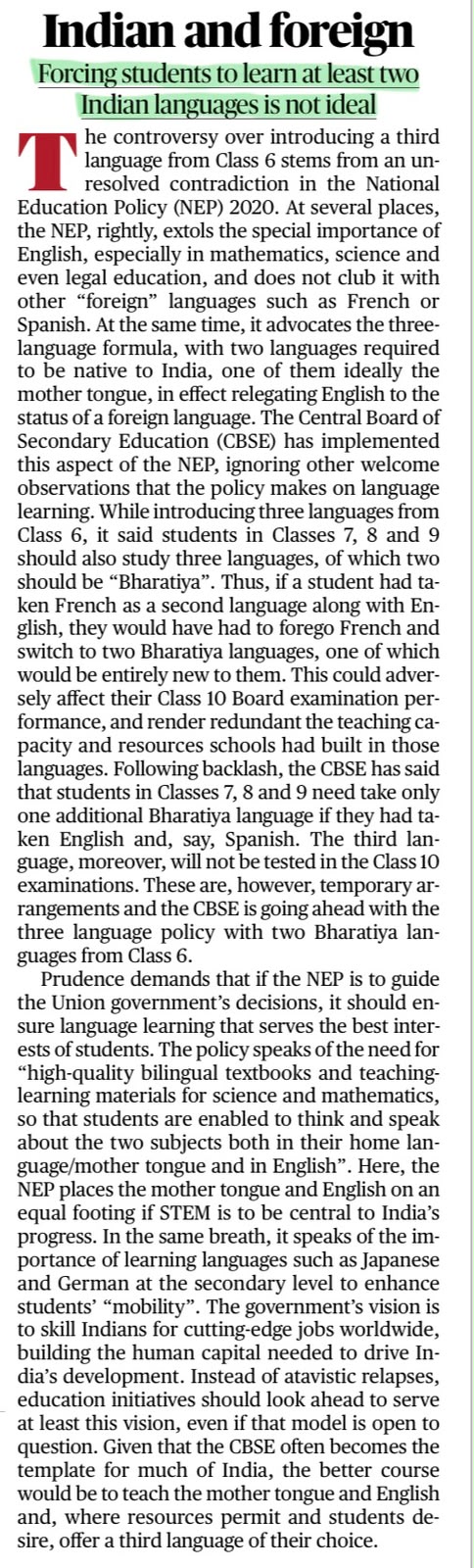
The article discusses the implementation of the Three-Language Formula under National Education Policy 2020, especially the debate around Indian and foreign languages in school education.
The Central Board of Secondary Education has informed schools that from 2026, Class 9 and Class 10 students will study three languages, including at least two Indian languages.
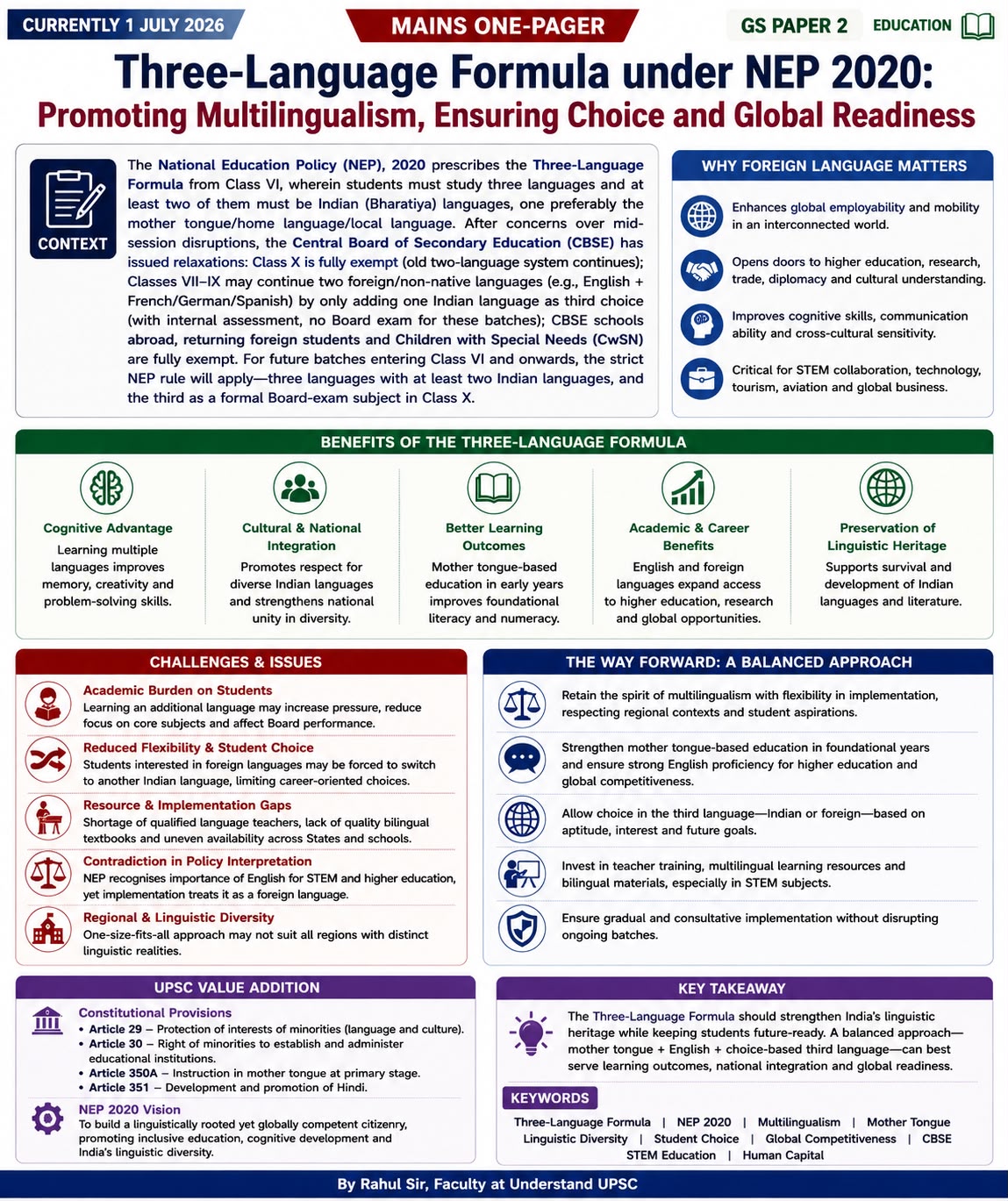
Three-Language Formula under NEP 2020
The National Education Policy 2020 recommends multilingual education.
Core Rule
Students should learn three languages, out of which:
- At least two must be Indian languages.
- The choice of languages should be flexible.
- No language should be imposed on any State or student.
CBSE Implementation
From 2026:
- Classes 9 and 10 will study three languages.
- At least two languages must be Indian languages.
- Foreign languages such as French or German may be offered as an additional or third language depending on school capacity.
Benefits of the Three-Language Formula
1. Cognitive Advantage
Learning multiple languages improves:
- Memory
- Creativity
- Analytical ability
- Problem-solving skills
2. Cultural and National Integration
Indian languages help students understand:
- Local culture
- Literature
- Heritage
- Regional identity
- National diversity
3. Better Learning Outcomes
Mother tongue or familiar language-based education improves conceptual understanding, especially in early education.
4. Academic and Career Benefits
Multilingual ability supports:
- Higher education
- Research
- Diplomacy
- Translation
- Tourism
- International business
- Global careers
5. Preservation of Linguistic Heritage
The policy can help protect Indian languages, many of which face declining use.
Challenges
1. Academic Burden on Students
Adding another compulsory language may increase pressure on students.
2. Reduced Flexibility
Some students interested in foreign languages may be forced to prioritise another Indian language.
3. Resource Constraints
Many schools lack trained teachers, textbooks and learning materials for multiple languages.
4. Regional and Political Sensitivity
Language policy in India is politically sensitive, especially in States with strong linguistic identities.
5. Impact on Foreign Language Learning
If foreign languages are pushed out of the main curriculum, students may lose exposure to globally useful languages.
Way Forward
- Keep the formula flexible and non-impositional.
- Strengthen mother-tongue and Indian-language teaching.
- Provide trained teachers and quality learning material.
- Allow foreign languages as additional choices.
- Use technology and digital platforms for language learning.
- Implement gradually without disrupting students.
- Respect linguistic diversity and federal sensitivities.
Constitutional Link
Article 29
- Protects interests of minorities, including language and culture.
Article 30
- Gives minorities the right to establish and administer educational institutions.
- Provides instruction in mother tongue at the primary stage.
- Directs promotion of Hindi while drawing upon other Indian languages.
Key Takeaway
The Three-Language Formula can promote multilingualism, national integration and global readiness, but only if implemented with flexibility, adequate resources and respect for linguistic diversity.